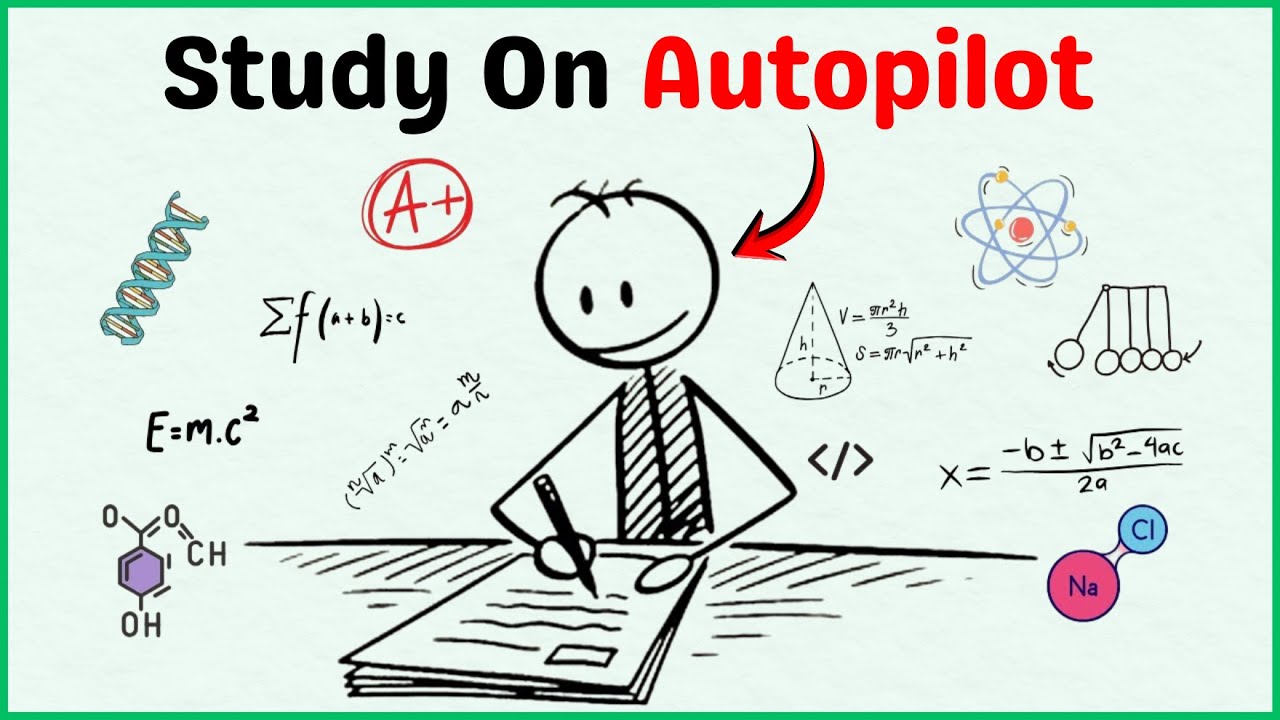
How to Force Your Brain to Study (Even When You Don’t Want To)
Blunt Guy
Overview
This video explains how to overcome the common struggle of studying by leveraging psychological principles rather than relying on willpower. It argues that our brains are wired for dopamine and pleasure, not forced focus, and that social media exploits this. The video introduces several techniques to "hack" the brain's reward system, reduce distractions, and enhance memory. These methods include pairing enjoyable activities with studying, making distractions harder to access, imbuing information with emotion, strategically interrupting study sessions, establishing consistent study times, reversing reward loops, using subconscious scripting, embracing desirable difficulty, employing sensory cues, and implementing micro-reflection. The goal is to make studying feel less like a chore and more like an automatic, ingrained habit.
Save this permanently with flashcards, quizzes, and AI chat
Chapters
- Our brains are not wired for sustained focus but are instead driven by the pursuit of dopamine and pleasure.
- Activities like social media are highly effective at delivering dopamine, making them more appealing than studying.
- Trying to force discipline against our brain's natural wiring leads to frustration and guilt.
- The solution is to trick the brain into associating studying with pleasure, similar to how social media creates addiction.
- Fuse studying with activities you already enjoy, such as listening to music, eating, or movement.
- When two actions are consistently paired, the brain begins to associate the reward from the enjoyable activity with the less enjoyable one.
- This process reprograms the dopamine response, making the brain crave the study-reward combination.
- The goal is to make studying feel like a natural, expected next step in a positive habit loop.
- The brain naturally follows the path of least resistance, making distractions more appealing than effortful tasks.
- Instead of making studying easier, focus on making distractions harder to access.
- Introduce small barriers to bad habits (e.g., moving your phone, logging out of apps) and reduce barriers to good habits (e.g., leaving books open).
- By increasing the effort required for distractions, studying becomes the easier, default option.
- The brain prioritizes and remembers information that is associated with strong emotions.
- Connect abstract study material to personal stories, vivid imagery, sounds, or intense feelings.
- Transforming dry facts into a more engaging, lived experience helps the amygdala (the brain's emotional center) mark the information as important.
- Information imbued with emotion is more likely to be retained long-term than information learned through rote memorization.
- The Zeigarnik effect suggests that unfinished tasks remain active in our minds, promoting continued engagement.
- Intentionally pausing a study session while still engaged and curious (an 'open loop') keeps the brain working on it subconsciously.
- Temporal anchoring involves studying at the exact same time each day to train your brain to anticipate focus periods.
- Consistent timing can trigger the release of focus-related chemicals, making concentration more automatic.
- The anticipation of a reward, not the reward itself, triggers dopamine.
- Giving yourself a small reward *before* starting a task creates a positive association and makes starting easier (reverse reward loop).
- Subconscious scripting involves playing recordings of yourself explaining study material while your conscious mind is disengaged (e.g., during commutes or before sleep).
- The subconscious mind absorbs this information without critical analysis, strengthening neural pathways.
- Forgetting is not a failure but an opportunity for memory strengthening (desirable difficulty).
- Recalling information when it's slightly faded (memory decay training) forces neurons to work harder, making the memory more robust.
- Sensory imprinting involves associating a specific, unique sensory cue (like a scent or sound) exclusively with study time.
- This cue trains your brain to automatically enter a focused state when encountered.
- Ending study sessions with a brief reflection significantly improves learning retention.
- Ask yourself: What clicked? What confused me? What will I fix next time?
- This process activates metacognition, helping you understand your own learning process.
- It 'saves progress' on your learning, ensuring that effort isn't lost and future sessions are more effective.
Key takeaways
- Your brain is wired for dopamine and pleasure, not forced discipline; leverage this by pairing study with enjoyable activities.
- Make distractions harder to access and studying easier to initiate by manipulating your environment (friction coding).
- Imbue information with emotion to make it more memorable and meaningful.
- Strategic interruptions and consistent timing can train your brain to enter focus states more easily.
- Prime your brain for study by creating anticipation of rewards and using subconscious learning methods.
- Embrace the struggle of recall (desirable difficulty) and use sensory cues to trigger focus automatically.
- Regular, brief reflection after study sessions is crucial for consolidating learning and improving future performance.
Key terms
Test your understanding
- How can you use 'task pair fusion' to make studying less aversive?
- What is 'friction coding,' and how does it differ from simply trying to focus more?
- Why is attaching emotion to information critical for long-term memory according to the video?
- Explain how 'temporal anchoring' can help you study more consistently.
- What is the principle behind a 'reverse reward loop,' and how can it be applied to studying?