29:18
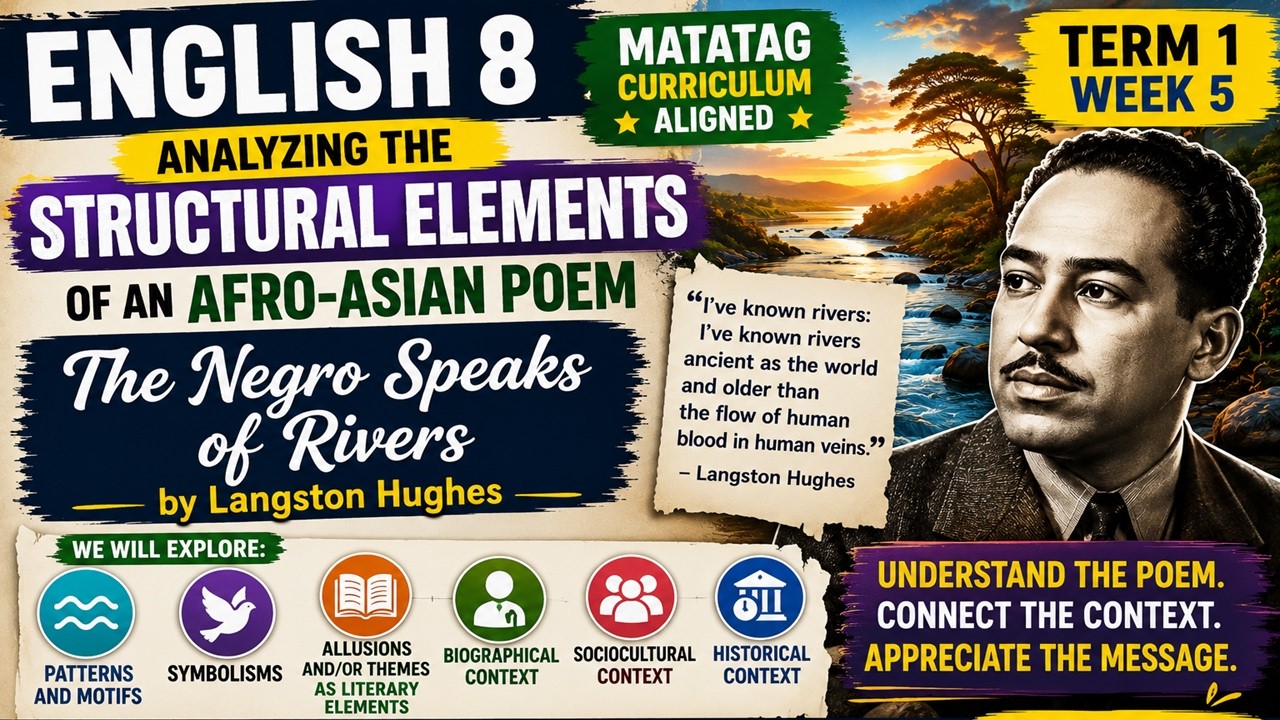
English 8 Term 1 Week 5 | Structural Elements & Contexts of Afro-Asian Poem | Complete PPT + ILAW LP
MATATAG Learning Hub
Overview
This video explores Langston Hughes' poem "The Negro Speaks of Rivers," focusing on how literary elements like patterns, motifs, symbolism, and allusions contribute to its themes of identity, heritage, and resilience. It delves into the biographical, sociocultural, and historical contexts surrounding the poem, explaining how Hughes' life experiences, the African-American experience, and significant historical periods like the Harlem Renaissance shaped its message. The lesson aims to equip learners with the ability to analyze poetry by connecting its literary devices and contextual elements to a deeper understanding of its meaning and impact.
How was this?
Save this permanently with flashcards, quizzes, and AI chat
Chapters
- The poem "The Negro Speaks of Rivers" by Langston Hughes will be analyzed for its literary elements and contextual influences.
- Learners will identify literary elements (patterns, motifs, symbolism, allusions) and explain their meanings.
- The analysis will connect these elements to biographical, sociocultural, and historical contexts to understand the poem's message about identity and heritage.
- Understanding rivers as a source of life and history serves as an initial point of reflection.
This chapter sets the stage for understanding how literary devices and real-world influences combine to create a powerful message in poetry, specifically focusing on themes of identity and heritage.
The initial reflection question asks learners to consider the importance of rivers in the Philippines, like the Kagayan River, to prime them for the poem's central river imagery.
- Patterns, such as repetition, are used by writers to highlight important ideas and make poems memorable.
- A motif is a recurring image or idea that develops a deeper meaning, like the river in this poem, symbolizing life, ancestry, wisdom, and resilience.
- Symbolism uses simple objects or images to represent deeper ideas; here, rivers symbolize life, history, African ancestry, strength, and the flow of time.
- Specific rivers mentioned (Euphrates, Congo, Nile, Mississippi) symbolize distinct aspects of African and African-American history and experience.
Understanding these literary devices allows for a deeper interpretation of the poem, revealing how abstract concepts like identity and history are conveyed through concrete imagery.
The repetition of 'I've known rivers' and the word 'rivers' serves as a pattern, emphasizing the speaker's profound connection to these bodies of water and the history they represent.
- An allusion is an indirect reference to a well-known person, place, event, or work that adds layers of meaning.
- Writers use allusions to connect their work to broader cultural or historical contexts without lengthy explanations.
- In the poem, allusions to the Euphrates (early civilization), Congo (African heritage), Nile (ancient Egypt), and Mississippi (slavery and freedom) enrich the narrative.
- The allusion to Abraham Lincoln and the Mississippi River connects the struggle for freedom with the African-American journey.
Mentioning the Nile River alludes to the achievements of ancient Egypt, connecting African heritage to one of the world's most influential ancient civilizations.
- A theme is the central message or insight an author conveys, discovered by analyzing literary elements.
- The poem's theme centers on the idea that identity is shaped by history, ancestry, and cultural heritage.
- The enduring flow of rivers symbolizes the strength and resilience of people through hardships.
- The poem celebrates African heritage and its connection to world history, advocating for respect and recognition of all cultures.
Identifying the theme helps learners grasp the core message of the poem and its universal relevance to understanding personal and collective identity.
The comparison of the speaker's soul to ancient rivers highlights how personal identity is deeply intertwined with the long and continuous history of one's ancestors and culture.
- Biographical context examines how an author's life influences their work.
- Langston Hughes, a key figure of the Harlem Renaissance, focused on equality, hope, and African-American identity.
- His childhood experiences, family stories about perseverance, and diverse cultural exposure shaped his views on identity and heritage.
- Hughes wrote "The Negro Speaks of Rivers" at age 18, inspired by a journey on the Mississippi River, expressing pride in African ancestry.
Understanding Langston Hughes's life provides insight into the personal motivations and experiences that fueled the poem's powerful message of pride and resilience.
Hughes' grandmother sharing stories of African-American history and courage influenced his understanding that history is carried through family memories, directly informing the poem's depiction of flowing, generational history.
- Sociocultural context explores how society and culture influence a literary work, including traditions, beliefs, and relationships.
- Despite facing discrimination, African-Americans preserved their history, traditions, and values, fostering a strong sense of pride.
- Writers like Hughes used art to celebrate heritage, share experiences, and call for respect and recognition.
- The 'I' in the poem represents a collective voice, symbolizing the shared history and identity of African ancestors and communities.
This context reveals how the poem is a product of a specific community's struggles and triumphs, offering a voice to shared experiences of resilience and cultural preservation.
The speaker's use of 'I' in 'I've known rivers' symbolizes the collective voice of a people whose history and strength have endured for thousands of years, representing the broader African-American community.
- Historical context examines significant events, people, and time periods that shape a literary work.
- Allusions to ancient civilizations like Mesopotamia (Euphrates) and Egypt (Nile) connect African identity to the earliest human history.
- The Congo River reference highlights Africa's rich history before colonization.
- The Mississippi River alludes to the history of slavery and the fight for freedom, with Abraham Lincoln symbolizing hope.
- The Harlem Renaissance (1920s-30s) was a cultural movement celebrating African-American creativity and identity, which Hughes actively participated in.
Understanding the historical backdrop, from ancient civilizations to the Harlem Renaissance, illuminates the specific references and the broader historical narrative the poem engages with.
The mention of the Mississippi River in conjunction with Abraham Lincoln symbolizes the journey from the suffering of slavery to the hope for freedom and equality for African-Americans.
Key takeaways
- Poetry uses literary devices like patterns, motifs, and symbolism to convey complex themes of identity and heritage.
- A poem's meaning is often enriched by understanding the author's life experiences (biographical context).
- The social and cultural environment in which a poem is created significantly influences its themes and messages.
- Historical events and eras provide crucial context for interpreting literary allusions and the broader significance of a work.
- Rivers in "The Negro Speaks of Rivers" serve as powerful symbols of life, history, ancestry, and enduring resilience.
- Langston Hughes' poem celebrates the depth and richness of African and African-American history and culture.
- Understanding our roots and cultural heritage is essential for developing a strong sense of self and respecting diversity.
Key terms
Literary ElementsPatternMotifSymbolismAllusionThemeBiographical ContextSociocultural ContextHistorical ContextHarlem RenaissanceIdentityHeritageResilience
Test your understanding
- How does the repetition of 'I've known rivers' function as a pattern in the poem, and what deeper meaning does it convey?
- Explain how the river serves as a central symbol in "The Negro Speaks of Rivers," representing multiple layers of meaning.
- What is an allusion, and how do Langston Hughes' references to the Euphrates, Congo, Nile, and Mississippi rivers enrich the poem's message?
- How did Langston Hughes' personal life experiences and the sociocultural context of the African-American community influence the themes of "The Negro Speaks of Rivers"?
- What is the primary theme of "The Negro Speaks of Rivers," and how do the poem's literary elements and historical context support this theme?