Intellectual Revolutions That Define Society
Ysalou Respicio
Overview
This video explores four major intellectual revolutions that have profoundly shaped society: the Copernican, Freudian, Darwinian, and Industrial Revolutions. It begins by highlighting the shift from unquestioned ancient and religious doctrines to a new era of scientific inquiry driven by curiosity and observation. The Copernican Revolution challenged the Earth-centered universe with a sun-centered model, paving the way for the scientific method. The Freudian Revolution delved into the unconscious mind, revealing hidden drives and shaping our understanding of human behavior. The Darwinian Revolution introduced the concept of evolution by natural selection, explaining the diversity of life. Finally, the Industrial Revolution, fueled by new energy sources and inventions like the steam engine, transformed production and daily life.
Save this permanently with flashcards, quizzes, and AI chat
Chapters
- The period from the 1300s to 1600s saw scholars begin to question long-held beliefs from ancient thinkers and the Catholic Church.
- Before this, truth was determined by referencing ancient texts or the Bible.
- The Reformation encouraged challenging established religious doctrines, fostering a spirit of critical thinking.
- The Scientific Revolution emerged as a new way to understand the natural world, emphasizing observation and questioning.
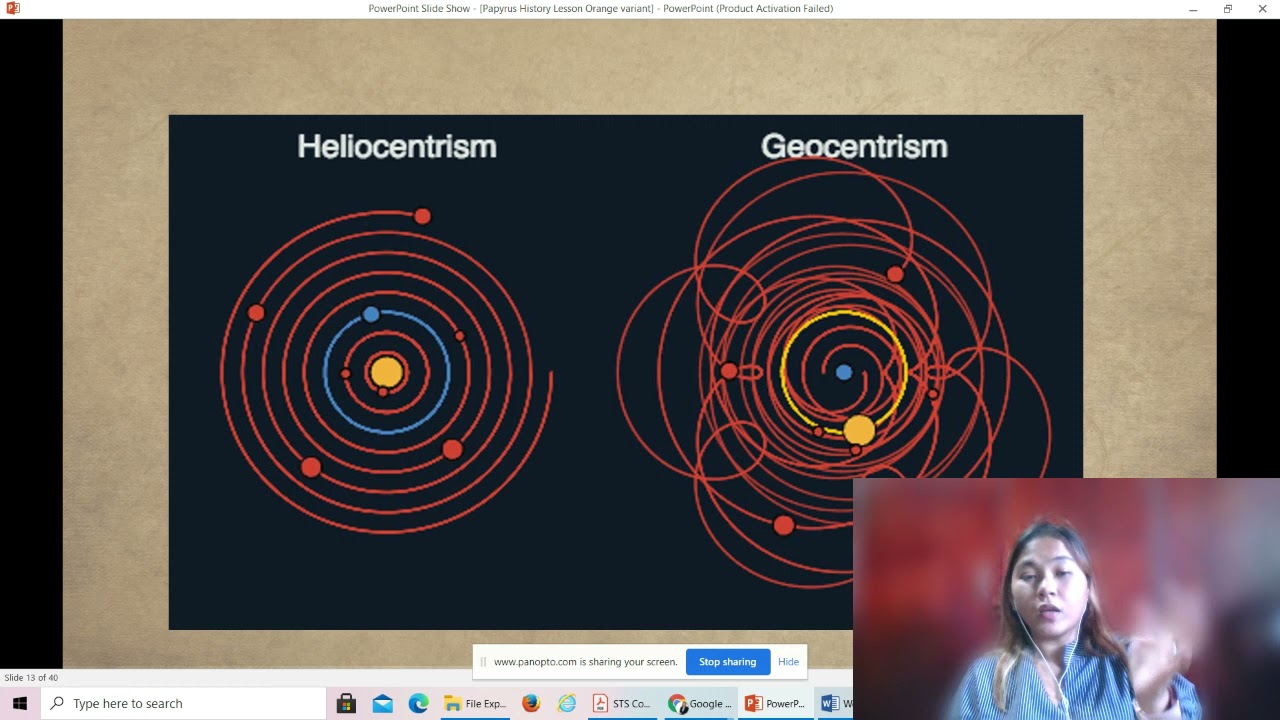
- The geocentric theory, proposed by Aristotle and expanded by Ptolemy, placed Earth at the center of the universe with celestial bodies orbiting in perfect circles.
- Nicolaus Copernicus proposed the heliocentric system, positing that the Sun, not Earth, is the center of the universe, with planets revolving around it.
- Tycho Brahe meticulously recorded planetary positions, providing crucial data.
- Johannes Kepler, using Brahe's data, discovered that planets move in elliptical orbits around the Sun, refining the heliocentric model.
- Galileo Galilei's telescopic observations, such as discovering Jupiter's moons and the Moon's uneven surface, provided empirical evidence supporting heliocentrism and contradicting Aristotelian physics, leading to conflict with the Church.
- The work of Copernicus, Kepler, and Galileo evolved into a formalized scientific method.
- Francis Bacon championed empiricism and the experimental method, arguing that conclusions must be based on experimental results.
- René Descartes contributed mathematics and logic as tools for scientific reasoning, notably with the Cartesian coordinate system.
- The Enlightenment, or Age of Reason, emphasized the use of reason and science over blind faith and superstition.
- Key Enlightenment ideals included rationalism (knowledge through reason), empiricism (knowledge through experience), progressivism (belief in human advancement), and cosmopolitanism (seeing oneself as a global citizen).
- Sigmund Freud, the founder of psychoanalysis, explored the unconscious and subconscious levels of the mind.
- He proposed the mind is like an iceberg, with the conscious, pre-conscious (subconscious), and unconscious levels.
- Freud identified three metaphorical parts of the mind: the Id (instinctual drives), the Ego (reality principle), and the Superego (morality and conscience).
- These parts interact, often leading to internal conflict.
- Charles Darwin's theory of evolution, detailed in 'On the Origin of Species', explains the diversity of life through natural selection.
- Evolution occurs through natural selection, driven by overproduction of offspring, variation within species, competition, and environmental change.
- Organisms with traits better suited to their environment are more likely to survive and reproduce, passing those advantageous traits to their offspring.
- Environmental changes necessitate adaptation; organisms must change to survive, as the environment does not adapt to them.
- The Industrial Revolution was driven by the discovery and utilization of fossil fuels like coal and oil.
- These new energy sources powered inventions that made work easier and increased production.
- The early steam engine, developed initially to pump water out of coal mines, was a key invention.
- This revolution began in Great Britain due to resource availability and necessity, transforming manufacturing and daily life.
Key takeaways
- Human curiosity is the primary driver of intellectual and scientific progress.
- Challenging established beliefs, even those held for centuries, is essential for advancing knowledge.
- The shift from a geocentric to a heliocentric model demonstrates the power of observation and mathematical reasoning to overturn deeply ingrained ideas.
- The scientific method, emphasizing experimentation and logical deduction, provides a robust framework for understanding the natural world.
- Understanding the unconscious mind, as proposed by Freud, offers insights into human behavior and motivations.
- Evolution by natural selection explains the vast diversity of life and the adaptability of organisms to changing environments.
- Technological innovations, particularly those harnessing new energy sources, have the power to fundamentally transform societies and economies.
Key terms
Test your understanding
- How did the Copernican Revolution challenge the prevailing worldview of its time?
- What are the core components of the scientific method as developed during the Enlightenment?
- Explain Freud's concept of the unconscious mind and its metaphorical parts (Id, Ego, Superego).
- How does natural selection, as described by Darwin, lead to the evolution of species?
- What was the primary impact of the Industrial Revolution on society and production?