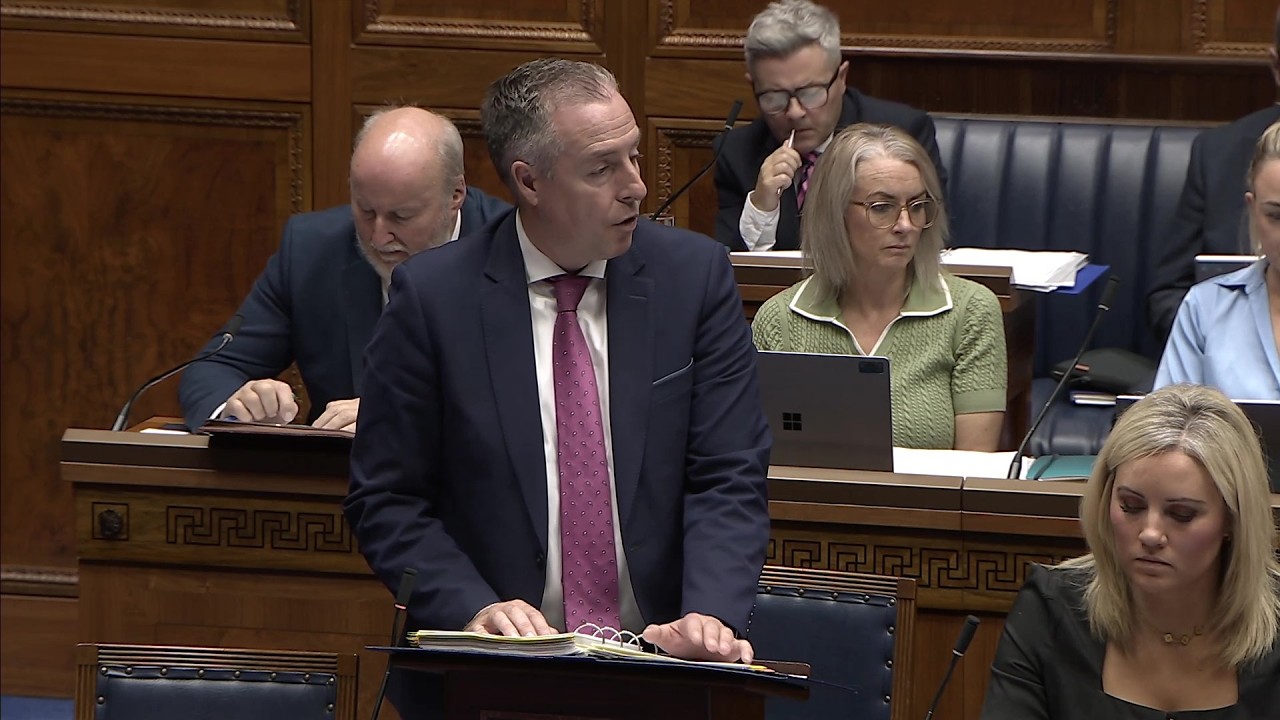
Question Time. Questions to the Minister of Education - Tuesday 6 October 2026
Northern Ireland Assembly
Overview
This video features a question-and-answer session with the Minister of Education, addressing various critical issues within the education system. Key topics include the efficiency of special educational needs (SEN) assessment and placement processes, the challenges faced by families navigating these systems, and proposed improvements like digitization and reduced timelines. The discussion also covers the provision of specialist education in mainstream classrooms, home-to-school transport for students with disabilities, and the critical issue of managing severe allergies in schools, with plans for a public consultation on new guidance. Furthermore, the minister addresses concerns raised by PISA results regarding declining literacy and numeracy, the need for targeted support for disadvantaged learners, and reforms through the "Transform Ed" program. Other points include school admissions policies, early years education for younger children, the rationale behind changes to the socially disadvantaged circumstances criterion, the discontinuation of German at A-level by CCEA, and the importance of democratic accountability and departmental engagement with committees. Finally, the session touches upon school maintenance, the impact of social determinants on academic achievement, and the youth sector's engagement with policy.
Save this permanently with flashcards, quizzes, and AI chat
Chapters
- The Education Authority (EA) works to plan specialist educational provision based on assessed needs and demographic trends.
- While the statutory assessment process can be lengthy, improvements and digitization are increasing efficiency, with the EA meeting statutory timelines in about 80% of cases.
- Placements for children with SEN are determined individually, considering needs, professional advice, parental preference, and available provision.
- Over 4,400 children with SEN secured placements before the start of the 26/27 school year, with ongoing strategic planning to identify gaps in provision.
- The minister acknowledges families' concerns about the lengthy SEN process and assures efforts to further improve it.
- A new regulatory framework aims to reduce the assessment timeframe from 26 to 22 weeks, though its implementation has been delayed.
- The department is developing an 'enhanced school model' to provide additional resources and flexibility within schools to meet a wider range of needs before a formal statement of SEN is required.
- The goal is to reduce reliance on legal documents for support and create a system where schools can proactively meet student needs.
- Oversight arrangements are in place for establishing specialist provision in mainstream classrooms, involving consultation and review by the EA's senior leadership team.
- Initial inspections of specialist provision in mainstream settings have reported positively on quality and its enriching effect on the school environment.
- The EA manages home-to-school transport for children with disabilities and SEN on an individual basis, using various methods including its own fleet and private operators.
- Outstanding taxi contracts for SEN transport are being addressed, with most now provisionally awarded, and financial support is available for parents if formal transport isn't secured.
- The department is reviewing guidance on managing severe allergies in schools, drawing on developments in the UK.
- Engagement with stakeholders and other UK counterparts has highlighted the need for stronger, more consistent allergy management in Northern Ireland schools.
- A public consultation is planned before the end of the year to gather views on developing standalone allergy guidance for schools.
- The objective is to ensure clear guidelines for best practice in allergy management to protect the well-being of all pupils.
- PISA results show a decline in reading and mathematics attainment, with persistent gaps linked to disadvantage and gender, and Northern Ireland now underperforming compared to England and the Republic of Ireland in all domains.
- A significant proportion of pupils are not reaching baseline literacy and numeracy standards by the end of primary school and key stage three.
- The 'Transform Ed' program focuses on improving teaching and learning, recognizing high-quality teaching as the most important in-school factor for raising standards.
- There is a need for ambitious reform and targeted support, especially for disadvantaged learners, to close attainment gaps and equip all young people with essential skills.
- A public consultation is underway to reform temporary variation policy, aiming for a more flexible admissions approach that prioritizes parental preference where school capacity allows.
- Current legislation requires statutory preschool settings to admit penultimate-age children if places remain, but research suggests this is not age-appropriate; legislative changes are proposed.
- The socially disadvantaged circumstances (SDC) criterion for preschool places, established in 1998, is being reviewed due to universal funding now being available, aiming for fairer access.
- The department is working to expand targeted early learning programs for younger children and aims to bring a final Early Learning and Childcare Strategy to the executive.
- The discontinuation of German at A-level by CCEA is a decision by the awarding body, but schools can access German qualifications from alternative awarding bodies.
- The minister explains that the small cohort for German with CCEA impacted grading consistency, potentially disadvantaging pupils.
- The minister asserts his commitment to democratic accountability, stating he will attend education committee meetings as scheduled.
- Concerns about bullying and harassment of officials by committee members are raised, emphasizing the need for appropriate protocols during committee sessions.
- Urgent attention is being given to issues at schools like Central Integrated Primary and Green Gable's Preschool, where temporary accommodation is in place, with efforts to expedite permanent solutions.
- The minister acknowledges that a lack of investment in routine maintenance contributes to such situations, which are not isolated incidents.
- Education is identified as the primary driver for tackling social determinants of academic achievement, economic inactivity, and health inequality.
- Engagement with the youth sector is ongoing to improve the youth framework, with a focus on enabling community and voluntary organizations to play a greater role in delivering youth services.
Key takeaways
- The education system is undergoing reforms to improve the efficiency and effectiveness of special educational needs (SEN) provision, including digitization and a focus on early intervention.
- Addressing declining literacy and numeracy rates, particularly among disadvantaged students, is a top priority, driving initiatives like the 'Transform Ed' program.
- Parental preference is being given greater consideration in school admissions, balanced with the need to maintain provision for students with special educational needs.
- Ensuring the safety and well-being of all students, particularly concerning severe allergies, requires clear guidance and robust management strategies in schools.
- Education is recognized as a fundamental tool for social mobility and for tackling broader issues like economic inactivity and health inequality.
- There is a commitment to enhancing early years education to ensure age-appropriate provision for all young children.
- The minister emphasizes the importance of democratic accountability and professional conduct in interactions between the department, its officials, and legislative committees.
Key terms
Test your understanding
- How is the Education Authority working to improve the efficiency and transparency of the SEN assessment and placement process?
- What is the 'enhanced school model,' and how is it intended to support students with special educational needs?
- What steps are being taken to address the concerns raised by the PISA results regarding declining literacy and numeracy attainment?
- What are the key considerations and planned actions regarding the management of severe allergies in schools?
- How does the department plan to balance parental preference with the needs of children with special educational needs in school admissions?