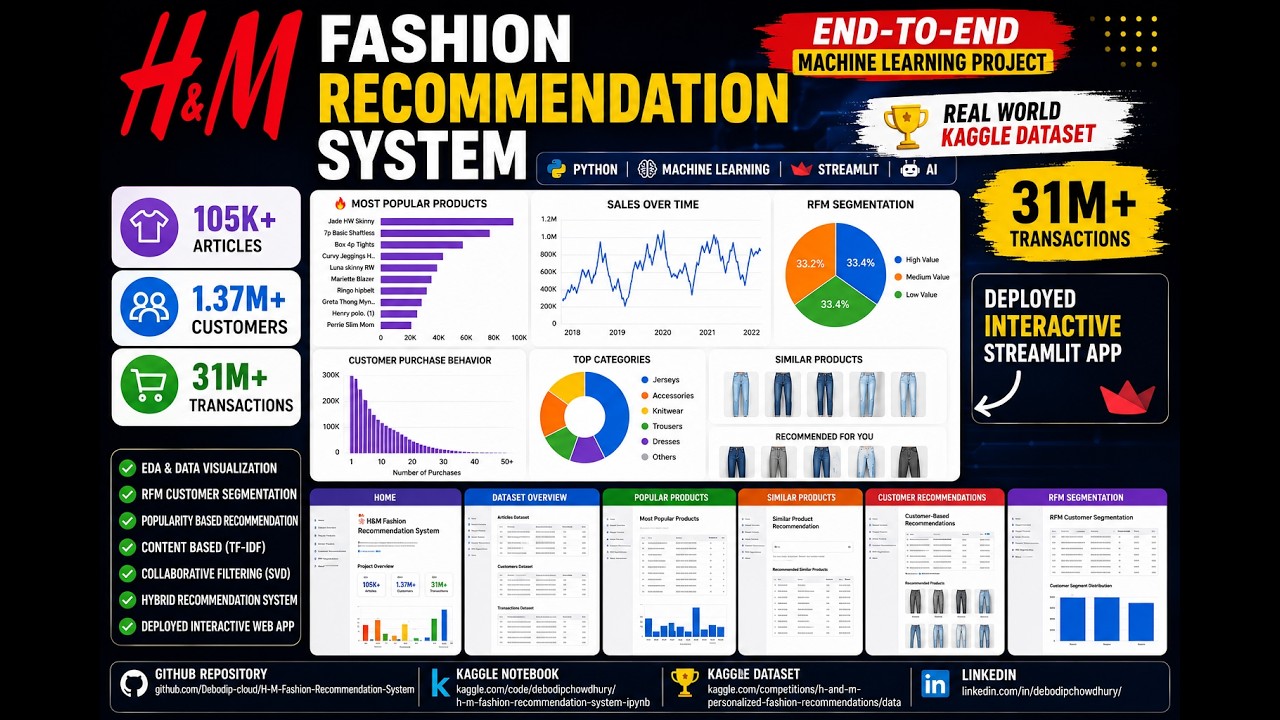
H&M Fashion Recommendation System | End-to-End Machine Learning Project with Python, Streamlit & AI
Infometrics Labs
Overview
This video details an end-to-end machine learning project to build a fashion recommendation system for H&M. It covers the entire data science lifecycle, from data collection and preprocessing of a large dataset (over 31 million transactions) to developing and deploying various recommendation models. The project emphasizes data quality, memory optimization, exploratory data analysis (EDA) to understand product and customer trends, and RFM segmentation for customer insights. It explores different recommendation approaches including popularity-based, content-based, collaborative filtering, and hybrid models, culminating in a deployed Streamlit application showcasing these features and their business impact.
Save this permanently with flashcards, quizzes, and AI chat
Chapters
- The project aims to build an H&M fashion recommendation system using a large, real-world dataset.
- Online retailers face challenges in helping customers discover relevant products among millions of items.
- Recommendation systems improve customer experience, increase sales, and enhance customer retention.
- The project follows a complete data science workflow from data collection to deployment.
- The dataset includes articles, customers, and transactions, totaling over 31 million purchase records.
- Data quality checks involved handling missing values (mostly in optional customer info) and investigating duplicates.
- Significant memory optimization was crucial due to the dataset's size, using appropriate data types for efficiency.
- Exploratory Data Analysis (EDA) revealed insights like dominant product types (dresses, accessories), colors (black), and customer age groups (21-30).
- RFM (Recency, Frequency, Monetary) segmentation was used to categorize customers based on their purchasing behavior.
- Analysis of customer age distribution, loyalty status, and fashion news subscriptions provided insights for targeted strategies.
- Monthly sales trends showed clear seasonal fluctuations, important for time-aware recommendations.
- Channel analysis indicated a strong preference for online shopping (channel 2).
- Four types of recommendation engines were built: popularity-based, content-based, collaborative filtering, and hybrid.
- Popularity-based models recommend globally popular items, useful for new users but not personalized.
- Content-based models use product metadata (color, type, description) to find similar items.
- Collaborative filtering learns from historical user-item interactions to predict preferences.
- Hybrid models combine multiple approaches to leverage diverse signals and generally outperform individual models.
- Model evaluation confirmed that hybrid models and production-grade frameworks are crucial for effective deployment.
- The project was deployed using Streamlit, creating an interactive web application.
- The application includes sections for data overview, popular product recommendations, similar product recommendations, and customer segmentation.
- The deployed system provides personalized customer experiences and improves product discovery.
- The recommendation system enhances decision-making by delivering personalized experiences and improving product relevance.
- It supports targeted retention campaigns, inventory planning, and promotional strategies.
- Future improvements include integrating image analysis (CNNs), using advanced collaborative filtering (LightFM), and adding explainable AI features.
- Further enhancements involve deploying pre-computed artifacts, adding A/B testing, and linking dashboard metrics for business experimentation.
Key takeaways
- End-to-end machine learning projects require a systematic approach, from data handling to deployment.
- Large-scale e-commerce datasets necessitate significant memory optimization and efficient processing techniques.
- Exploratory Data Analysis is vital for uncovering patterns in product assortment, customer demographics, and sales trends.
- RFM segmentation provides actionable insights into customer value and behavior for targeted marketing.
- Hybrid recommendation systems, combining multiple algorithms, generally offer superior performance by leveraging diverse data signals.
- Deploying recommendations via interactive applications like Streamlit makes them accessible and demonstrates their business value.
- Future advancements in recommendation systems involve integrating visual data, improving algorithms for sparse data, and enhancing explainability.
Key terms
Test your understanding
- What are the main challenges faced by online retailers that recommendation systems aim to solve?
- How does memory optimization contribute to the efficiency of processing large datasets in machine learning projects?
- Why is RFM segmentation a valuable technique for understanding customer behavior in e-commerce?
- What are the fundamental differences between content-based and collaborative filtering recommendation approaches?
- How can a hybrid recommendation system overcome the limitations of individual recommendation models?