21:52
Trigonometry For Beginners!
The Organic Chemistry Tutor
Overview
This video introduces the fundamentals of right triangle trigonometry, focusing on the relationships between angles and side lengths. It explains the six trigonometric functions (sine, cosine, tangent, cosecant, secant, cotangent) using the mnemonic SOH CAH TOA. The video demonstrates how to find missing side lengths using the Pythagorean theorem and special right triangle ratios, and then how to calculate the six trigonometric functions for a given angle. It also covers how to use trigonometric functions and their inverses to find missing angles and sides in right triangles when given some information.
How was this?
Save this permanently with flashcards, quizzes, and AI chat
Chapters
- Right triangle trigonometry relates the angles of a right triangle to the ratios of its side lengths.
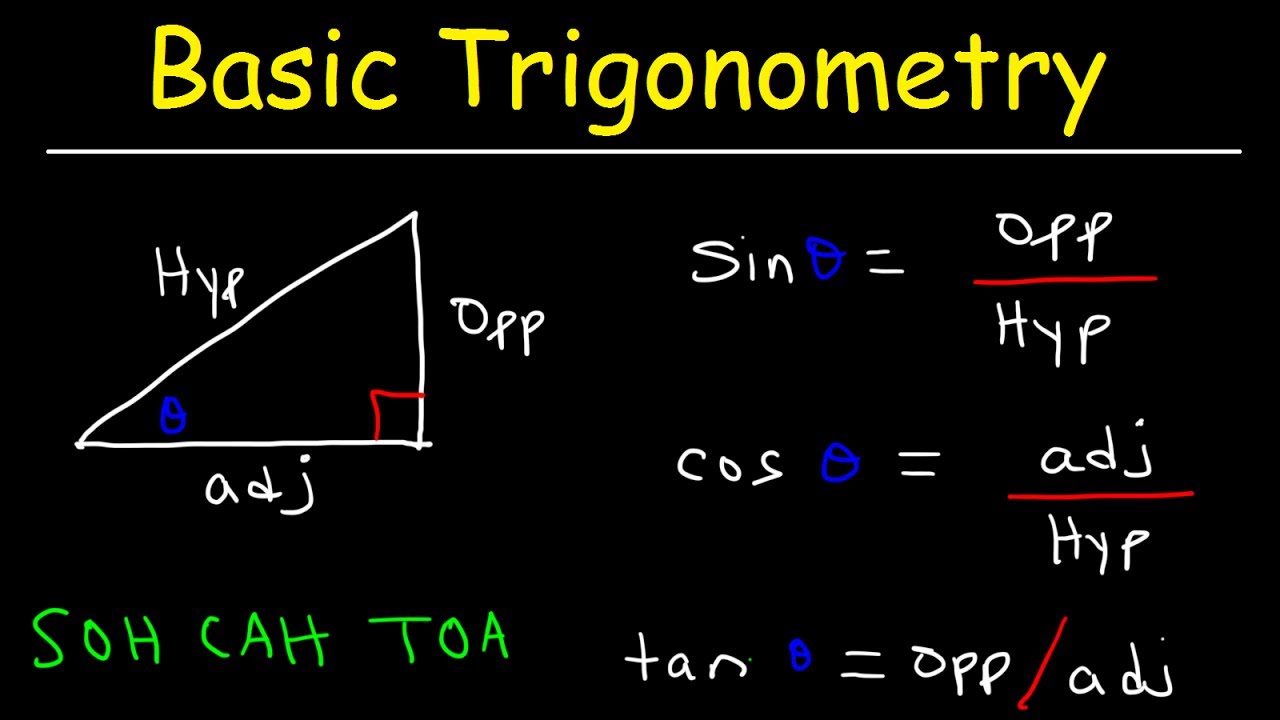
- The three sides of a right triangle relative to an angle (theta) are the opposite, adjacent, and hypotenuse.
- The hypotenuse is always the longest side, opposite the right angle.
- The Pythagorean theorem (a² + b² = c²) applies to right triangles for finding missing side lengths.
Understanding these basic definitions is crucial for applying trigonometric functions to solve problems involving right triangles.
In a right triangle with angle theta, if one leg is opposite theta and the other is adjacent, the longest side across from the right angle is the hypotenuse.
- The six trigonometric functions are sine (sin), cosine (cos), tangent (tan), cosecant (csc), secant (sec), and cotangent (cot).
- SOH CAH TOA is a mnemonic to remember the basic ratios: Sine = Opposite/Hypotenuse, Cosine = Adjacent/Hypotenuse, Tangent = Opposite/Adjacent.
- Cosecant, secant, and cotangent are the reciprocals of sine, cosine, and tangent, respectively (csc = H/O, sec = H/A, cot = A/O).
- These functions define the relationship between an angle and the ratios of the sides of a right triangle.
These functions are the building blocks of trigonometry and are used to model periodic phenomena and solve a wide range of geometric and real-world problems.
For an angle theta, sin(theta) = opposite side / hypotenuse, cos(theta) = adjacent side / hypotenuse, and tan(theta) = opposite side / adjacent side.
- Given two sides of a right triangle, you can find the third side using the Pythagorean theorem.
- Once all three sides are known, you can calculate the values of all six trigonometric functions for any acute angle.
- Special right triangles (like 3-4-5, 5-12-13) and their multiples provide common ratios that simplify calculations.
- Recognizing these special triangles can help quickly find missing sides and trigonometric values.
This skill allows you to determine the trigonometric relationships for any right triangle, forming the basis for more complex trigonometric applications.
In a 3-4-5 right triangle, if theta is opposite the side of length 4, then sin(theta) = 4/5, cos(theta) = 3/5, and tan(theta) = 4/3.
- When one angle and one side of a right triangle are known, you can find the other sides using trigonometric functions.
- Identify which sides are known (opposite, adjacent, hypotenuse) relative to the given angle.
- Choose the trigonometric function (sin, cos, or tan) that relates the known side, the unknown side, and the angle.
- Set up an equation and solve for the unknown side, using a calculator for trigonometric values if necessary.
This enables you to solve practical problems where direct measurement of all sides is not possible, such as determining heights or distances.
To find the height (x) of a tree when you are 42 units away and the angle of elevation to the top is 38°, use tan(38°) = x / 42, so x = 42 * tan(38°).
- When two sides of a right triangle are known, you can find the measure of an acute angle using inverse trigonometric functions (arcsin, arccos, arctan).
- Determine the relationship between the known sides (opposite, adjacent, hypotenuse) to choose the correct inverse function.
- Set up an equation where the inverse trigonometric function of the side ratio equals the angle.
- Use a calculator set to degree mode to find the angle measure.
This allows you to determine unknown angles in right triangles, which is essential for navigation, surveying, and engineering applications.
If the opposite side is 5 and the adjacent side is 4, then tan(theta) = 5/4, so theta = arctan(5/4), which is approximately 51.34 degrees.
Key takeaways
- Right triangle trigonometry provides a powerful way to relate angles and side lengths.
- The SOH CAH TOA mnemonic is a fundamental tool for remembering the definitions of sine, cosine, and tangent.
- Understanding reciprocal trigonometric functions (cosecant, secant, cotangent) expands the set of tools available.
- The Pythagorean theorem is essential for finding unknown side lengths when two sides are known.
- Trigonometric functions can be used to solve for unknown sides when an angle and one side are known.
- Inverse trigonometric functions are used to solve for unknown angles when two sides are known.
- Special right triangles and their ratios offer shortcuts for common problems.
Key terms
Right TriangleAngle (Theta)Opposite SideAdjacent SideHypotenusePythagorean TheoremSine (sin)Cosine (cos)Tangent (tan)Cosecant (csc)Secant (sec)Cotangent (cot)SOH CAH TOAReciprocal FunctionsInverse Trigonometric Functions (arcsin, arccos, arctan)
Test your understanding
- What are the three sides of a right triangle relative to a given acute angle, and how are they defined?
- How does the SOH CAH TOA mnemonic help in defining the primary trigonometric functions?
- Explain the relationship between sine and cosecant, cosine and secant, and tangent and cotangent.
- How can you find a missing side of a right triangle if you know two sides, and how can you find all six trigonometric functions once all sides are known?
- Describe the process of using a trigonometric function (like sine, cosine, or tangent) to find a missing side length when an angle and another side are given.
- When would you use an inverse trigonometric function (like arctan) instead of a regular trigonometric function to solve a problem involving a right triangle?