13:24
Chapter 9 Lecture
McGraw Hill Higher Education
Overview
This lecture focuses on the crucial skill of citing sources during oral presentations. It outlines when and how to verbally acknowledge the origin of information, emphasizing the importance of providing listeners with context about the source's credibility. The chapter also touches upon the necessity of maintaining research notes and using style manuals for creating bibliographies, which are essential for formal speech assignments. The core message is that proper citation not only fulfills academic integrity but also enhances the persuasiveness and trustworthiness of a speaker's message by demonstrating the foundation of their claims.
How was this?
Save this permanently with flashcards, quizzes, and AI chat
Chapters
- Cite information that you found in another source, such as statistics, examples, or quotations.
- Always cite when quoting or paraphrasing someone else's words to give credit and identify the original speaker.
- Cite definitions, especially for terms your audience may not know, to provide both the definition and its origin.
- Citing sources anchors claims to evidence, helping listeners understand the basis of your arguments.
Understanding when to cite prevents plagiarism and builds trust with your audience by showing your claims are supported by credible evidence.
If you use a statistic about climate change found in a scientific journal, you must mention the journal or the scientist who published it during your speech.
- When researching, record essential details about each source, not just the information you plan to use.
- The specific information needed depends on the type of source (e.g., journal article, book, website).
- Key details often include author, title, publication date, and where it was published.
- These notes are crucial for creating citations and bibliographies later.
Thorough note-taking during research ensures you have all the necessary information to properly cite your sources, saving time and preventing errors later.
For a book, you might record the author's name, the book's title, the publisher, the year of publication, and the page number where you found a specific quote.
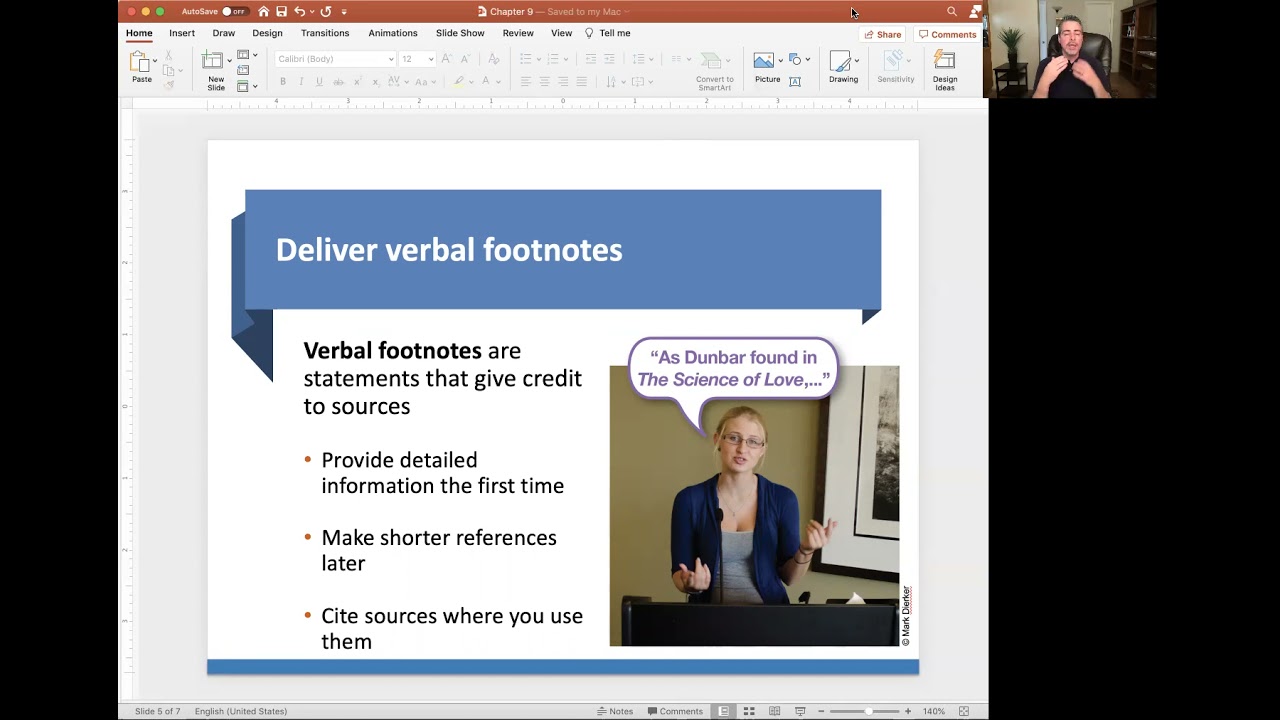
- A verbal footnote is a spoken acknowledgment of a source within your presentation.
- The first time you cite a source, provide more detail (author, title, publication year, author credentials).
- Subsequent references to the same source can be abbreviated.
- Citing sources as you present their information, rather than listing them all at once, helps listeners connect the evidence to your claims.
Verbal footnotes integrate source attribution seamlessly into your speech, reinforcing your credibility and helping your audience follow the flow of your evidence.
Instead of just stating a fact, say, 'According to Dr. Jane Smith, a leading researcher in neuroscience, in her 2022 book 'The Mind's Secrets,' the brain processes information in distinct stages.'
- Style manuals (like APA or MLA) provide guidelines for formatting citations and bibliographies.
- A bibliography is a list of all sources used in a speech, typically included at the end of a detailed outline or written assignment.
- While verbal footnotes are spoken, bibliographies are written and follow specific formatting rules.
- Learning to follow a style manual ensures consistency and professionalism in your written work.
Adhering to style manuals for bibliographies demonstrates attention to detail and academic rigor, making your research easily verifiable for others.
A style manual dictates whether you should write 'Smith, J.' or 'John Smith' and the order of information like title, publisher, and year for a book citation.
- Explain to your audience why a source is trustworthy and relevant to your topic.
- Credibility can be established through the source's education, experience, affiliations, or reputation.
- Mentioning credentials like degrees, years of work in a field, or affiliation with reputable organizations (e.g., CDC) lends weight to their statements.
- Highlighting a source's reputation (e.g., Nobel Prize winner) also builds trust.
Establishing credibility helps your audience understand why they should believe your source, making your arguments more persuasive and your presentation more impactful.
When citing a medical study, you might say, 'Dr. Anya Sharma, a cardiologist with 20 years of experience at Mayo Clinic, found that...'
Key takeaways
- Proper citation in speeches involves both verbal acknowledgments during the presentation and a formal bibliography.
- Always cite information that is not common knowledge or that you did not originate yourself.
- Verbal footnotes should provide enough information for the audience to identify the source and understand its relevance.
- The first mention of a source in a speech requires more detail than subsequent mentions.
- Style manuals provide standardized formats for written citations and bibliographies.
- Explaining the credibility of your sources (education, experience, affiliation, reputation) is essential for persuasion.
- Integrating source credibility into verbal footnotes enhances the audience's trust in your information.
Key terms
Verbal footnoteCitationBibliographyStyle manualCredibilityParaphrasingQuotationSupporting material
Test your understanding
- What are the primary reasons for citing sources in a speech?
- How does a verbal footnote differ from a footnote in a written paper?
- What types of information should be included in a verbal footnote, and how does this vary?
- Why is it important to establish the credibility of your sources when citing them?
- How can a speaker establish the credibility of a source for their audience?