26:29
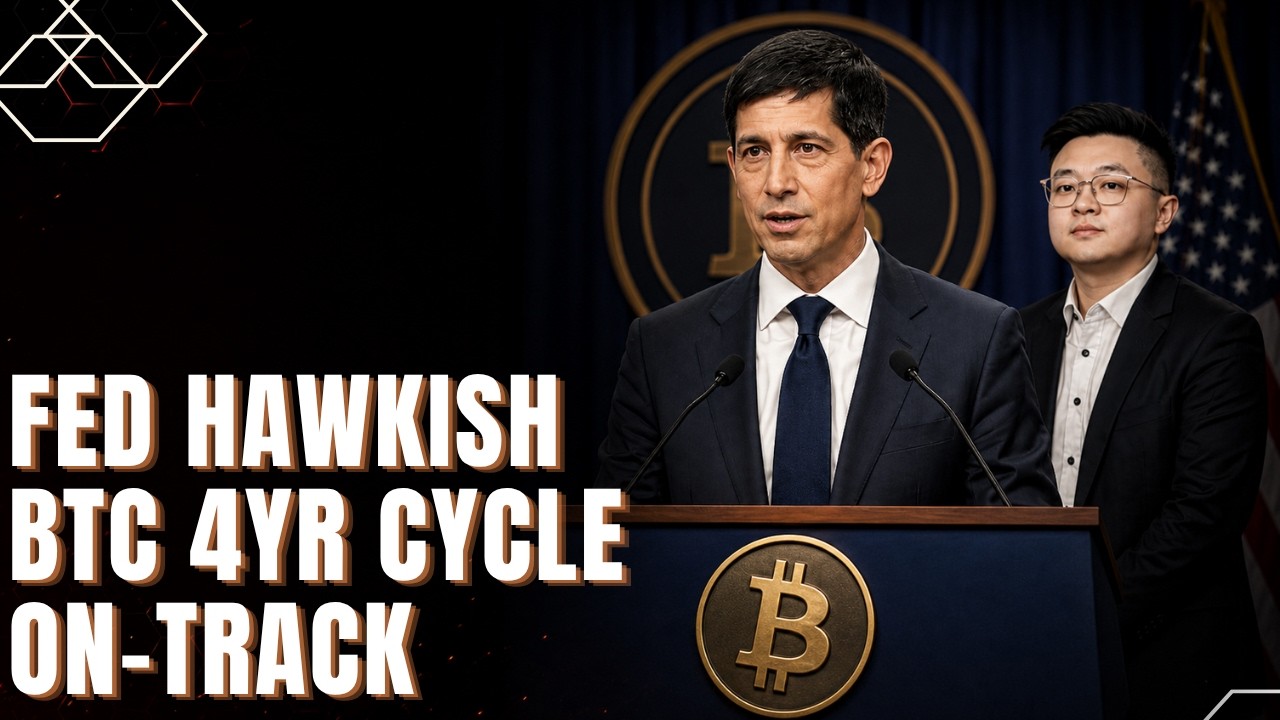
Bitcoin - Kevin Warsh's First Press Conference | The Fed Hawkish | 4 Yr-Cycle On-Track | #Dyor
Kevin Sailly
Overview
This video discusses the implications of the Federal Reserve's recent FOMC meeting and economic projections, particularly focusing on the shift towards a more hawkish stance. It analyzes how these changes, influenced by geopolitical events like the US-Iran situation and their impact on oil prices and inflation, affect the four-year Bitcoin cycle. The speaker explains the discontinuation of forward guidance and the significance of Kevin Warsh's unique approach to economic projections, suggesting a potentially bearish short-term outlook for Bitcoin while acknowledging opportunities for short-term trading and altcoin performance.
How was this?
Save this permanently with flashcards, quizzes, and AI chat
Chapters
- The Federal Reserve has adjusted its economic projections, reflecting current inflation data.
- Kevin Warsh's first public statement as Fed chair was perceived as clear and data-driven, offering more definitive clues.
- Market participants immediately priced in the new economic projections, especially the upward revision of interest rate expectations.
- The Fed's Summary of Economic Projections (SEP) indicated a potential shift from expected rate cuts to a possibility of rate hikes, raising the median projection for the effective federal funds rate.
- This hawkish shift, moving from a dovish outlook to a more restrictive one, signals potential headwinds for Bitcoin's rally.
Understanding the Fed's policy shifts is crucial because monetary policy directly influences market liquidity and investor risk appetite, significantly impacting asset prices like Bitcoin.
The median projection for the effective federal funds rate shifted upwards, implying fewer or no rate cuts and potentially even a rate hike, contrary to earlier market expectations.
- Geopolitical events, such as the US-Iran situation, have a notable impact on oil prices.
- A de-escalation in geopolitical tensions (e.g., US-Iran peace) has historically led to lower oil prices, which can influence inflation.
- Despite potential drops in oil prices, inflation has remained stubbornly high, as indicated by recent PCE data.
- The Fed's current projections anticipate inflation remaining elevated, with specific figures for year-end inflation and core PCE.
- New geopolitical threats, like potential sanctions on Russian oil, could disrupt the expected decline in oil prices and complicate inflation control.
The interplay between geopolitical events, energy prices, and inflation directly affects the Federal Reserve's policy decisions, which in turn shape the broader economic environment for investments.
The video notes that US oil prices dropped significantly below $100 following the US-Iran peace, which should theoretically help lower inflation, but inflation has persisted due to other factors.
- The current market conditions are described as being 'on track' with the traditional four-year Bitcoin cycle.
- Historically, Bitcoin price reversals have often coincided with changes in Federal Reserve policy.
- The speaker believes the four-year cycle is still relevant, despite institutional involvement, and that past bear market patterns are instructive.
- Previous bear markets have seen Bitcoin prices fall below key metrics like the realized price and the 200-day moving average.
- The current hawkish Fed stance suggests that a significant Bitcoin rally might be delayed, with a potential for a bearish trend in the short term (next three months).
Understanding the historical four-year cycle and how it aligns with macroeconomic factors helps investors anticipate potential market movements and adjust their strategies accordingly.
The video references past Bitcoin bear markets (2011, 2014, 2018, 2022) where prices consistently fell below the realized price, suggesting this metric is a strong indicator of market bottoms.
- The Federal Reserve has officially discontinued its policy of forward guidance.
- Forward guidance, previously used to signal future policy intentions, is now seen as less reliable.
- Kevin Warsh notably did not provide his individual projection (dot plot) for future interest rates, stating that such projections are 'drawn in pencil and can be erased'.
- This approach suggests a greater emphasis on data-dependent decision-making rather than pre-committing to a specific path.
- Warsh's strategy aims to manage market expectations by avoiding premature 'good news' and waiting for concrete data confirmation, especially regarding inflation.
The abandonment of forward guidance and Warsh's unique stance create uncertainty but also signal a more adaptive and data-driven monetary policy, requiring investors to be more vigilant.
Kevin Warsh's statement that the Fed's dot plot is 'drawn in pencil and can be erased' signifies that future interest rate projections are highly flexible and subject to change based on incoming economic data.
- Bitcoin's recent technical indicators (RSI, Stochastic) may suggest a potential short-term pullback after a recent rise.
- The market might be entering a corrective wave pattern (A, B, C, D, E) rather than an immediate extended rally.
- A break below a key trendline could signal the end of a relief rally and a move lower, potentially below $60,000.
- The realized price is identified as a critical support level, historically holding during bear markets.
- Despite Bitcoin's potential downturn, some altcoins may still see gains as money flows out of Bitcoin into other cryptocurrencies.
Technical analysis provides insights into potential price action, helping traders and investors identify entry and exit points, and manage risk in volatile markets.
The speaker suggests that if Bitcoin breaks below a certain trendline without showing signs of reversal, it could indicate the end of its current bounce and a subsequent drop towards the realized price level.
Key takeaways
- The Federal Reserve's recent shift to a more hawkish stance, indicated by revised economic projections, suggests a potentially challenging environment for Bitcoin in the short term.
- Geopolitical stability, particularly concerning oil prices, plays a significant role in influencing inflation and, consequently, the Fed's monetary policy decisions.
- The traditional four-year Bitcoin cycle remains a relevant framework for analysis, with historical bear market patterns suggesting potential downside risks even with institutional involvement.
- Kevin Warsh's decision to discontinue forward guidance and his metaphorical approach to projections signal a data-dependent and potentially more cautious Fed policy.
- Investors should be prepared for a possible bearish trend for Bitcoin in the next three months, but opportunities may arise in specific altcoins benefiting from money flow.
- Historical data, such as Bitcoin's performance relative to its realized price during bear markets, provides valuable context for assessing current market conditions.
- While institutional investment is a factor, it does not guarantee immunity from market downturns, as past events have shown institutions can also incur losses.
Key terms
FOMC (Federal Open Market Committee)Hawkish StanceDovish StanceSummary of Economic Projections (SEP)Effective Federal Funds RateCore PCE (Personal Consumption Expenditures)Forward GuidanceDot PlotFour-Year Cycle (Bitcoin)Realized Price (Bitcoin)Bear MarketAltcoinsDominance (Crypto)
Test your understanding
- How does the Federal Reserve's hawkish shift potentially impact Bitcoin's price trajectory in the short term?
- What is the relationship between geopolitical events, oil prices, and inflation, and how does this influence the Fed's policy?
- Why did Kevin Warsh choose to discontinue forward guidance, and what does his 'drawn in pencil' analogy signify for future Fed policy?
- Based on historical data and the current four-year cycle, what are the potential price movements for Bitcoin in the coming months?
- How might the current market conditions, influenced by the Fed's actions, affect the performance of altcoins relative to Bitcoin?