4:57
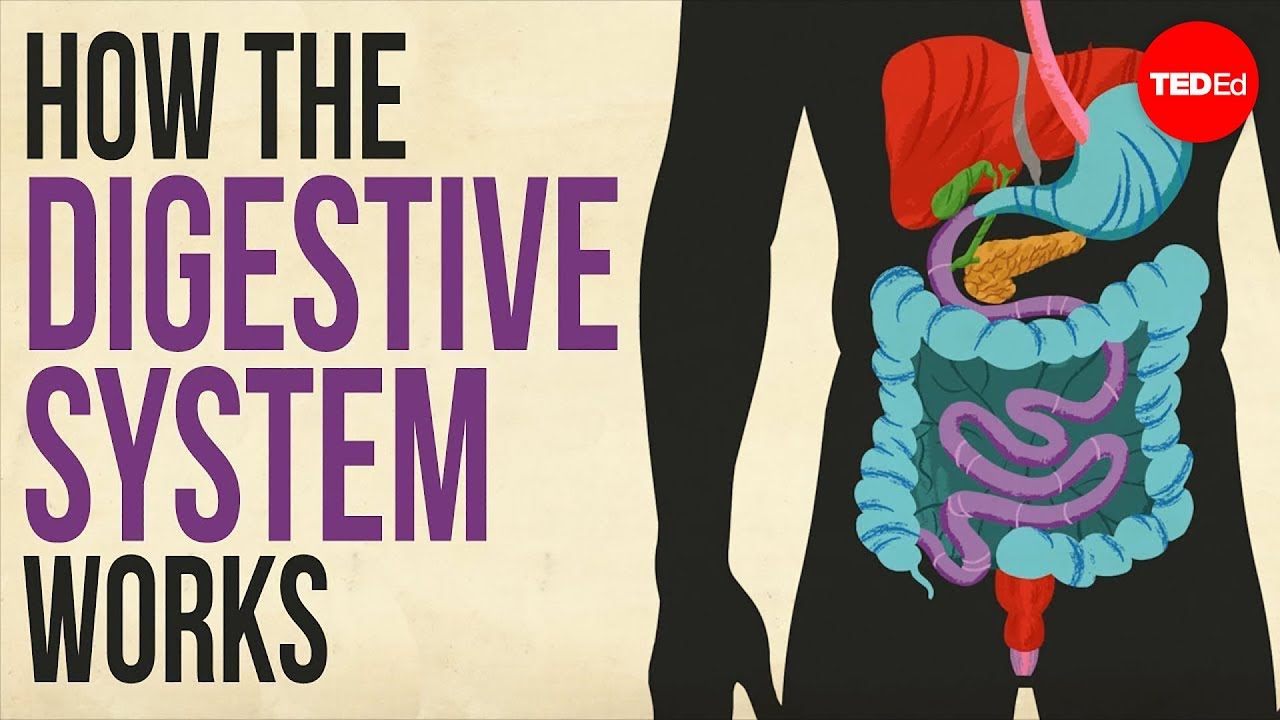
How your digestive system works - Emma Bryce
TED-Ed
Overview
This video explains the complex journey food takes through the human digestive system, a process that transforms food into energy and nutrients. It details the roles of various organs, including the gastrointestinal tract, liver, pancreas, and gallbladder, and describes the mechanical and chemical breakdown of food. The summary covers the stages from initial ingestion and saliva production to the absorption of nutrients in the small intestine and the final elimination of waste, highlighting the system's efficiency and importance for survival.
How was this?
Save this permanently with flashcards, quizzes, and AI chat
Chapters
- The human body consumes vast amounts of food annually, all processed by the digestive system.
- The digestive system is a complex network of ten organs spanning nine meters, with over 20 specialized cell types.
- Its primary function is to convert food into essential nutrients and energy for the body.
- The system comprises four main components: the gastrointestinal tract, accessory organs (pancreas, liver, gallbladder), supporting substances (enzymes, hormones, nerves, blood), and the mesentery.
Understanding the digestive system's scale and complexity highlights its critical role in sustaining life by processing the food we consume.
The internal surface area of the gastrointestinal tract is between 30 and 40 square meters, comparable to half a badminton court.
- Digestion starts in the mouth with saliva production, which moistens food and begins starch breakdown via enzymes.
- Chewing transforms food into a moist lump called a bolus.
- Peristalsis, a series of muscular contractions in the esophagus, propels the bolus to the stomach.
- The stomach's muscular walls mechanically break down the bolus, while acids and enzymes begin dissolving food and breaking down proteins.
This initial phase is crucial for preparing food for further breakdown and absorption, demonstrating how mechanical and chemical processes work together from the very first bite.
Saliva, produced at a rate of about 1.5 liters per day, mixes with food to form the bolus.
- After about three hours in the stomach, the food transforms into a liquid called chyme.
- The liver produces bile, stored in the gallbladder, which is released into the small intestine to digest fats.
- Enzymes from the pancreas and intestinal juices further break down fats into fatty acids and glycerol, and proteins into amino acids, and carbohydrates into glucose.
- The small intestine's inner lining, covered in villi, vastly increases surface area for efficient absorption of nutrients into the bloodstream.
This stage is where the majority of nutrient extraction occurs, showing how specialized organs and structures maximize the body's ability to utilize food components.
The small intestine's villi create a massive surface area, estimated to be large enough to cover half a badminton court, for nutrient absorption.
- Undigested material, primarily fiber and water, moves into the large intestine (colon).
- The colon absorbs most of the remaining water, solidifying the waste into stool.
- The rectum stores stool until the body signals for elimination.
- Waste exits the body through the anus, completing the digestive process which typically takes 30-40 hours.
This final phase ensures that the body conserves water and efficiently removes waste products, completing the cycle of nutrient acquisition and waste management.
The entire process, from ingestion to elimination, typically spans between 30 and 40 hours.
Key takeaways
- The digestive system is a highly organized and complex system responsible for extracting nutrients and energy from food.
- Digestion involves both mechanical processes (chewing, churning) and chemical processes (enzymes, acids, bile).
- Specialized organs like the liver, pancreas, and gallbladder play crucial roles in producing digestive juices.
- The small intestine's structure, with its villi, is optimized for maximum nutrient absorption.
- The large intestine's primary role is water absorption and waste formation.
- Efficient digestion is vital for overall health, providing the building blocks and energy our bodies need to function.
Key terms
Digestive SystemGastrointestinal TractEsophagusPeristalsisBolusChymeBileVilliColonEnzymes
Test your understanding
- What are the four main components of the digestive system?
- How does the mouth begin the digestive process?
- What is the role of the liver and gallbladder in digestion?
- Why is the structure of the small intestine important for nutrient absorption?
- What happens in the large intestine?