6:41
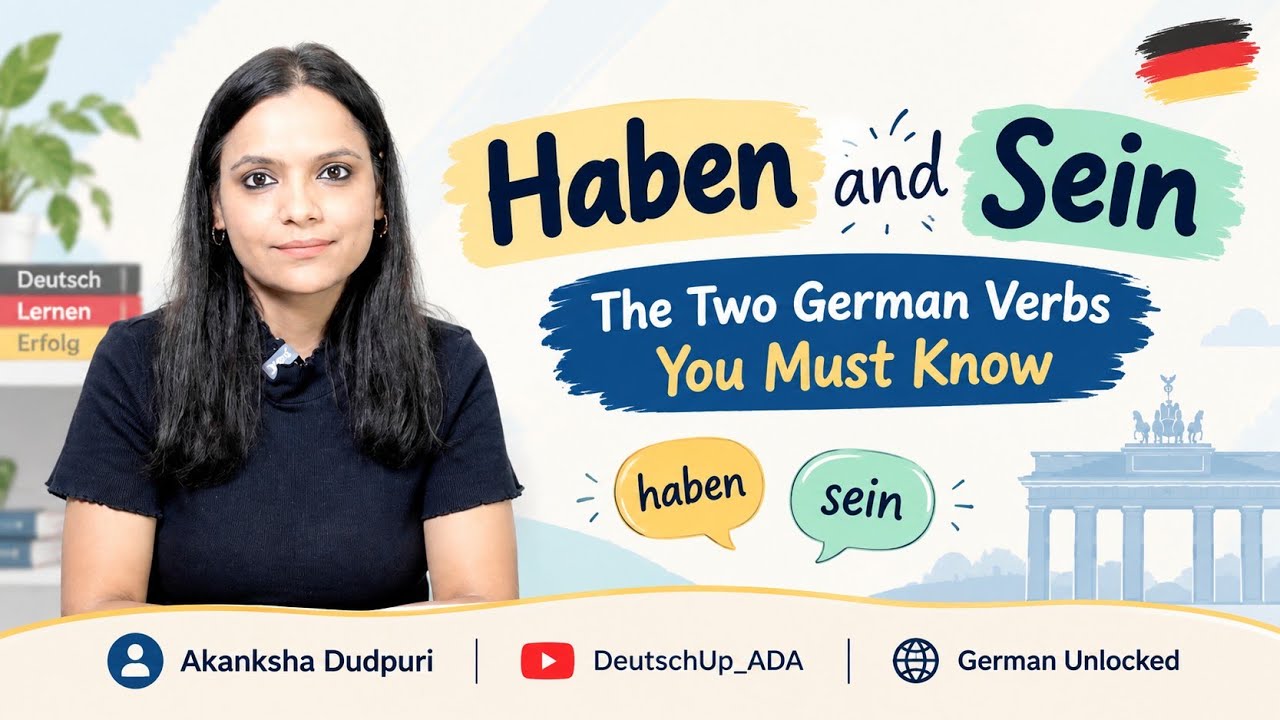
Haben and Sein - Two Very Important German Verbs - Master These Verbs @DeutschUp_ADA
DeutschUp_ADA
Overview
This video tutorial focuses on two fundamental German verbs: 'haben' (to have) and 'sein' (to be). It explains their irregular conjugations for different pronouns, highlighting specific patterns and exceptions. The video provides example sentences to illustrate usage and offers practical phrases incorporating these verbs. Finally, it includes a practice section with translation exercises to reinforce learning and encourage active application of 'haben' and 'sein' in German sentences.
How was this?
Save this permanently with flashcards, quizzes, and AI chat
Chapters
- 'Haben' means 'to have' and 'sein' means 'to be'.
- Both 'haben' and 'sein' are highly irregular verbs in German.
- Mastering these verbs is crucial for forming basic German sentences.
Understanding 'haben' and 'sein' is the foundation for constructing a vast number of German sentences, making them essential for any beginner.
The video introduces 'haben' and 'sein' by stating their English equivalents: 'to have' and 'to be'.
- The conjugation of 'haben' follows a regular pattern for 'ich', 'wir', 'ihr', and 'sie/Sie'.
- The forms for 'du' and 'er/sie/es' are irregular, requiring a change in the verb stem (dropping the 'b').
- Example: 'ich habe', 'du hast', 'er/sie/es hat', 'wir haben', 'ihr habt', 'sie/Sie haben'.
Recognizing the irregular forms for 'du' and 'er/sie/es' is key to correctly using 'haben' in everyday conversations.
The sentence 'Ich habe ein rotes Auto' (I have a red car) demonstrates the correct conjugation for 'ich'.
- 'Haben' is used in common expressions like 'Hunger haben' (to be hungry).
- Other useful phrases include 'Durst haben' (to be thirsty), 'Zeit haben' (to have time), and 'Geld haben' (to have money).
Learning these set phrases allows for more natural and idiomatic expression in German, going beyond simple possession.
The phrase 'Hunger haben' is presented as an example of using 'haben' to express a state of being, not just possession.
- The conjugation of 'sein' is completely irregular for all pronouns.
- Each pronoun ('ich', 'du', 'er/sie/es', 'wir', 'ihr', 'sie/Sie') has a unique form.
- Example: 'ich bin', 'du bist', 'er/sie/es ist', 'wir sind', 'ihr seid', 'sie/Sie sind'.
Since 'sein' is irregular for every pronoun, memorizing these distinct forms is essential for accurate sentence construction.
The sentence 'Ich bin aus Deutschland' (I am from Germany) shows the correct conjugation of 'sein' for the first-person singular pronoun 'ich'.
- The video provides translation exercises to practice using both 'haben' and 'sein'.
- Practice includes translating sentences from English to German and vice versa.
- Exercises cover filling in blanks and conjugating the verbs.
- The goal is to build confidence in using these verbs actively.
Active recall through practice solidifies the irregular conjugations and helps learners integrate 'haben' and 'sein' into their active vocabulary.
Translating 'I am tired' into German as 'Ich bin müde' is one of the practice exercises.
Key takeaways
- 'Haben' and 'sein' are essential, irregular German verbs that form the backbone of many sentences.
- While 'haben' has some regular conjugation patterns, 'du' and 'er/sie/es' forms require special attention.
- 'Sein' is entirely irregular, demanding memorization of each pronoun's unique verb form.
- Beyond possession, 'haben' is used in idiomatic expressions like 'to be hungry' or 'to be thirsty'.
- Consistent practice through translation and conjugation exercises is crucial for mastering these verbs.
- Understanding the correct conjugation of 'haben' and 'sein' is fundamental for speaking and writing accurate German.
Key terms
HabenSeinIrregular verbsConjugationVerb stemPronounFinite verb formIchDuEr/Sie/Es
Test your understanding
- What is the primary difference in conjugation patterns between 'haben' and 'sein'?
- How do the 'du' and 'er/sie/es' forms of 'haben' differ from the other pronoun forms?
- Why is it important to memorize the completely irregular forms of 'sein'?
- What are two common German phrases that use 'haben' to express a state of being, rather than possession?
- How can practicing sentence translations help solidify the use of 'haben' and 'sein'?