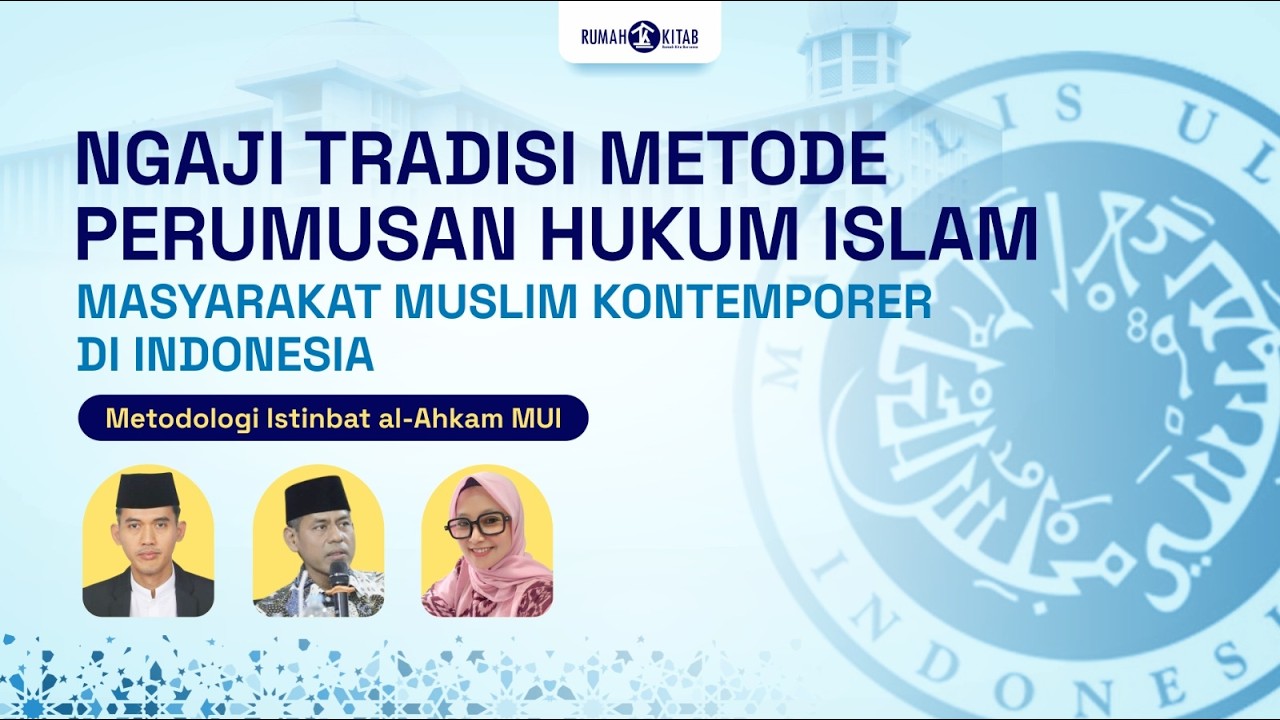
Ngaji Ramadan #1: Ngaji Metodologi Istinbat al-Ahkam MUI
Official Rumah KitaB
Overview
This video introduces the methodology of istinbat al-ahkam (deriving Islamic legal rulings) as practiced by the Indonesian Ulama Council (MUI). It highlights the challenges of applying timeless religious texts to ever-changing societal realities. The discussion emphasizes the importance of ijtihad (independent reasoning) and the framework of maqasid al-shariah (purposes of Islamic law) in formulating contemporary fatwas. The video also touches upon the historical development of these methods and their application in addressing modern issues like online transactions and public health concerns, showcasing MUI's role as a central reference for Islamic legal guidance in Indonesia.
Save this permanently with flashcards, quizzes, and AI chat
Chapters
- Istinbat al-ahkam is the process of deriving Islamic legal rulings from primary sources like the Quran and Hadith.
- The Indonesian Ulama Council (MUI) is a key institution responsible for issuing fatwas (legal opinions) in Indonesia.
- MUI's fatwas are crucial for addressing contemporary issues faced by the Muslim community.
- The video series aims to explore the methodologies used in Islamic legal reasoning within the Indonesian context.
- Religious texts (Quran and Hadith) are considered complete and unchanging after the Prophet's passing.
- However, societal phenomena and human experiences are constantly evolving and generating new issues.
- This creates a need for continuous interpretation and application of Islamic principles to new realities.
- The challenge lies in bridging the gap between static texts and dynamic life.
- Maqasid al-shariah (purposes of Islamic law) provides a framework for understanding the wisdom and objectives behind Islamic rulings.
- Key objectives include preserving faith, life, intellect, lineage, and property (daruriyyat al-khams).
- Contemporary scholars have expanded these objectives to include environmental protection, justice, and family well-being.
- This framework helps ensure that legal interpretations serve the broader welfare of humanity.
- MUI's Fatwa Commission comprises scholars from diverse Islamic organizations, fostering a rich intellectual exchange.
- The process begins with understanding the question or phenomenon (tasawwur) before delving into legal rulings.
- Methods include analogical reasoning (qiyas) based on the underlying cause (illah) and the broader framework of maqasid al-shariah.
- Fatwas are designed to be comprehensive, citing Quranic verses, Hadith, scholarly opinions, and considerations of maslahah (public interest) and mafsadah (harm).
- The permissibility of online transactions has evolved; initially viewed with suspicion due to potential fraud, it is now widely accepted.
- This shift reflects the Islamic legal principle that rulings can change with time, place, and circumstances (ahkam al-mutaghayyirat bi-taghayyur al-azmina wal-amkina wal-ahwal).
- MUI addresses issues like online fraud by emphasizing the principles of consent (ridha) and the absence of deception (gharar).
- The council also considers practical needs, such as water recycling in areas facing water scarcity, ensuring fatwas are beneficial and feasible.
- While central MUI fatwas focus on national-level issues, regional MUI bodies may address more specific concerns, including those related to women.
- The development of expanded maqasid, such as 'hifz al-biah' (environmental protection) and 'hifz al-adalah' (justice), reflects a growing awareness of broader societal well-being.
- There is an ongoing need to ensure that Islamic legal interpretations adequately address the specific experiences and rights of women.
- The methodology of istinbat al-ahkam continues to evolve to meet the challenges of the future.
Key takeaways
- Islamic legal rulings are derived through a process called istinbat al-ahkam, which interprets foundational texts in light of contemporary realities.
- The Indonesian Ulama Council (MUI) plays a vital role in issuing fatwas that guide Muslims in Indonesia.
- Maqasid al-shariah, the objectives of Islamic law, provides a crucial framework for ensuring that legal interpretations promote human welfare.
- The dynamic nature of life necessitates that Islamic legal reasoning, while grounded in tradition, must be adaptable and responsive to new challenges.
- MUI's fatwa process is inclusive, drawing from diverse scholarly opinions and considering practical implications like public interest and potential harm.
- Islamic jurisprudence recognizes that rulings can evolve over time and in different contexts, as seen in the case of online transactions.
- Ensuring that Islamic legal frameworks adequately address the concerns and rights of women is an ongoing area of development.
Key terms
Test your understanding
- What is the fundamental challenge in applying Islamic legal texts to contemporary issues, and how does MUI address it?
- How does the concept of 'maqasid al-shariah' help in deriving relevant Islamic legal rulings for modern society?
- Describe the process by which MUI formulates its fatwas, highlighting the role of diverse scholarly opinions.
- Explain how Islamic legal rulings can adapt to changing times and circumstances, using the example of online transactions.
- Why is it important for Islamic legal reasoning to consider principles like 'maslahah' (public interest) and 'mafsadah' (harm)?