1:50:41
Prompt Frameworks for Syllabus Design & Content Architecture
PLP Academy
Overview
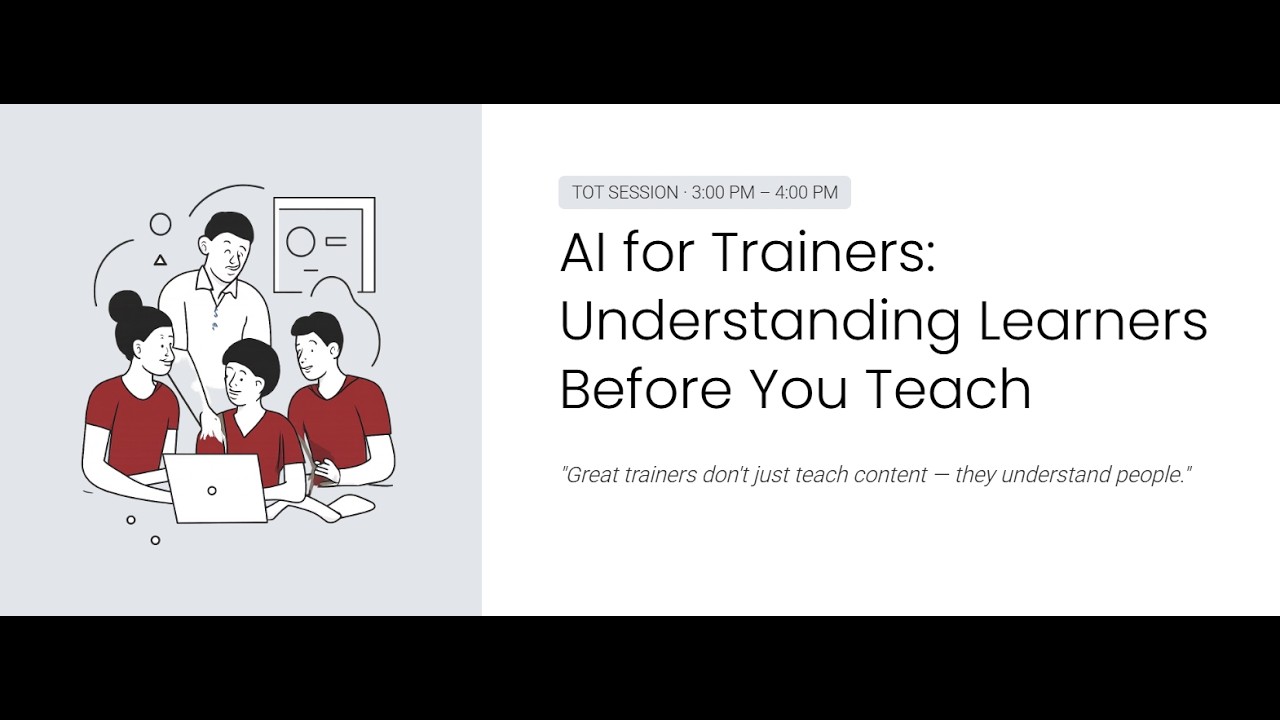
This video focuses on learner management, emphasizing the importance of understanding learners to improve teaching and content delivery. It introduces the concept of learner personas as a tool to visualize and empathize with students, detailing how to create them using AI prompts. The session also covers strategies for supporting diverse learners and mapping learning curves to ensure effective content structuring and engagement.
How was this?
Save this permanently with flashcards, quizzes, and AI chat
Chapters
- Learner management is about effectively interacting with, understanding, and supporting students.
- An excellent trainer must understand learners' prior knowledge, personal circumstances, motivations, challenges, and learning preferences.
- Understanding learners enables better decision-making regarding activities, assessments, instructional examples, and feedback.
- Building a comfortable and peer-like environment encourages learners to share their challenges and feelings about a course.
Effective learner management is crucial for creating a supportive learning environment that addresses individual needs and maximizes engagement and understanding.
If a learner expresses fear of highways, the instructor can adapt driving lessons to address this specific anxiety, rather than ignoring it.
- A learner persona is a semi-fictional representation of an ideal learner, created to understand their characteristics and needs.
- Personas help instructors anticipate learner backgrounds, motivations, potential barriers (like electricity or slow learning), and preferred learning styles.
- Creating personas helps answer critical questions about what examples will resonate, what terminology to use, and how to structure assessments.
- Learner personas are vital for making informed decisions about content delivery and assessment methods that align with learner needs.
Learner personas bridge the gap between the instructor's assumptions and the learners' reality, leading to more targeted and effective educational strategies.
An instructor might create a persona for a marketing manager with 10 years of experience who wants to integrate AI into campaigns, which differs significantly from a recent graduate studying AI for the first time.
- Effective AI prompting involves defining the 'who' (actor/persona), the 'what' (the task), and the 'how' (the desired output format and style).
- Starting with a vague prompt yields general results, while a structured prompt with a defined actor, clear task, and specific instructions produces more tailored and useful outputs.
- Using a 'context window' in AI interactions can lead to confusion if not managed properly; starting new chats for distinct prompts is often beneficial.
- Experimenting with different prompt structures (e.g., actor-focused vs. task-focused) reveals how AI responses vary in detail and relevance.
Mastering AI prompting allows for the efficient generation of detailed learner personas, saving time and improving the quality of insights derived from AI tools.
A prompt like 'Act as a higher education technology designer. Create a comprehensive learner persona for a mid-career professional, including demographics, motivations, challenges, and preferred learning style' is more effective than a simple request for a persona.
- Learners have diverse needs, including fast learners, slow learners, introverts, visual learners, working parents, and those with limited internet access.
- Effective support strategies must be tailored to each learner type; for example, introverts might benefit from small group work, while visual learners need more graphics.
- Learning curve mapping involves identifying concepts, anticipating blockers, designing interventions, and continuously monitoring and adjusting the learning path.
- Introducing practical application and hands-on activities can re-engage learners who may be losing interest in purely theoretical content.
Adapting teaching methods and content structure to accommodate learner diversity and learning progression ensures that all students have the opportunity to succeed.
For a learner in a remote area with poor internet, providing downloadable resources and offline activities is more effective than relying solely on live online sessions.
Key takeaways
- Understanding your learners' individual characteristics, motivations, and challenges is fundamental to effective teaching.
- Learner personas are powerful tools for empathizing with and designing educational experiences for specific student profiles.
- The 'who, what, and how' structure is essential for crafting precise and effective prompts when using AI to generate learner personas.
- Diverse learners require varied support strategies; a one-size-fits-all approach is rarely effective.
- Continuously mapping and adjusting the learning curve based on learner engagement and feedback is key to successful course design.
- AI can be a valuable assistant in creating learner personas and suggesting instructional interventions, but human insight remains critical.
- The goal of learner management is to create an inclusive and supportive environment where every student can thrive.
Key terms
Learner ManagementLearner PersonaPrior KnowledgeLearning BarriersAI PromptingActor (AI Prompt)Context Window (AI)Learning Curve MappingInstructional InterventionDiverse Learners
Test your understanding
- What are the key components of effective learner management?
- How can creating a learner persona help an instructor improve their teaching?
- What are the essential elements of a well-structured AI prompt for generating a learner persona?
- Why is it important to tailor support strategies for different types of learners?
- How does learning curve mapping contribute to better content delivery?