4:38
How does a Centrifugal pump work ?
Sabin Civil Engineering
Overview
This video explains the fundamental working principles of a centrifugal pump, a widely used device in hydraulics. It details how an impeller with curved vanes rotates to impart centrifugal force to a fluid, increasing its pressure and kinetic energy. The video also covers the importance of priming, the role of the pump casing in converting velocity to pressure, the phenomenon of cavitation and its prevention, different types of impellers, and essential mechanical design considerations like sealing and bearing placement.
How was this?
Save this permanently with flashcards, quizzes, and AI chat
Chapters
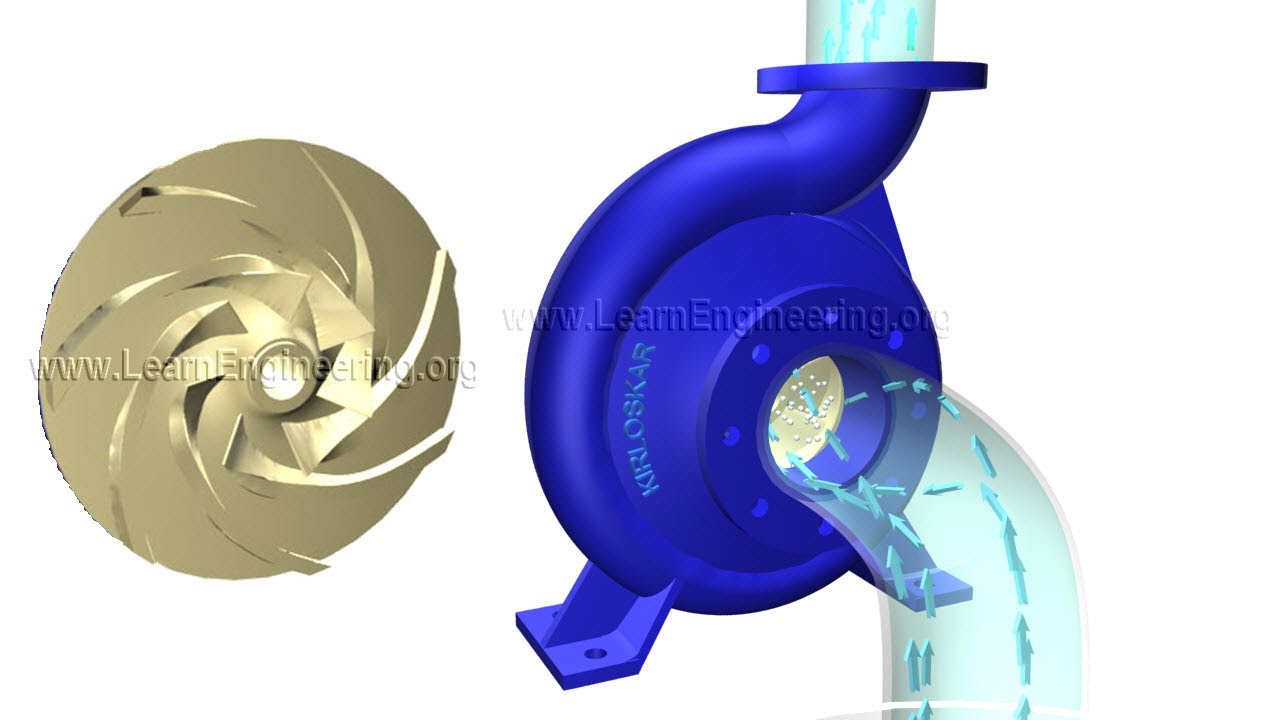
- The impeller, with its curved vanes, is the central component that rotates.
- Rotation of the impeller generates centrifugal force, pushing fluid radially outwards.
- This outward movement increases both the kinetic energy (velocity) and pressure of the fluid.
- A low-pressure area (negative pressure) is created at the impeller's eye, drawing more fluid into the pump.
Understanding the impeller's function is crucial because it's the primary mechanism by which mechanical energy is converted into fluid energy.
The video describes how the rotating impeller makes the surrounding fluid rotate, imparting centrifugal force and causing the water to move radially outwards.
- Priming is essential for centrifugal pumps to operate correctly.
- Priming involves filling the pump with fluid initially because air cannot create sufficient negative pressure to draw in water.
- The low pressure at the impeller's eye continuously draws fluid into the pump, sustaining the flow.
Proper priming ensures the pump can establish the necessary pressure differential to initiate and maintain fluid flow, preventing dry running.
If no water is present initially, the negative pressure developed by rotating air at the impeller's eye is too small to suck in a fresh stream of water, highlighting the need for priming.
- The pump casing collects the fluid discharged from the impeller.
- The casing features an increasing area in the direction of flow.
- This expanding area slows down the fluid's velocity.
- According to Bernoulli's principle, reducing velocity increases static pressure, which helps overcome system resistance.
The casing's design is vital for efficiently converting the fluid's kinetic energy into usable pressure energy needed to move it through the piping system.
The casing has an increasing area along the flow direction, which accommodates newly added water and reduces exit flow velocity, leading to an increase in static pressure.
- Cavitation occurs when the pressure at the impeller's suction side drops below the vapor pressure of the fluid.
- This pressure drop causes the fluid to boil, forming vapor bubbles.
- These bubbles collapse violently, damaging the impeller material over time.
- The maximum suction head is limited by the risk of cavitation.
Preventing cavitation is critical for the longevity and efficiency of the pump, as it can cause significant physical damage and reduce performance.
If the pressure at the suction side goes below the vapor pressure of water, water will start to boil, forming vapor bubbles that can spoil impeller materials.
- Centrifugal pumps can have enclosed, semi-open, or open impellers, chosen based on the fluid's properties.
- Open impellers are suitable for fluids with solids but are less efficient.
- A shaft connects the impeller to the motor, requiring robust sealing mechanisms (like mechanical seals or stuffing boxes) to prevent leakage.
- Bearings are typically placed at the non-suction end of the shaft to avoid blocking flow, making the impeller act like a cantilever.
The choice of impeller and the mechanical design, including sealing and bearing placement, directly impact the pump's suitability for specific applications and its operational reliability.
For fluids that are cloggy, an open impeller is preferred, although it comes with a slight efficiency penalty compared to enclosed types.
Key takeaways
- Centrifugal pumps operate by converting rotational mechanical energy into fluid energy (pressure and kinetic energy) using a rotating impeller.
- The pressure difference created by the impeller's rotation is essential for drawing fluid into the pump, making priming a necessary step.
- The pump casing's design plays a key role in converting fluid velocity into pressure, enabling the pump to overcome system resistance.
- Cavitation is a destructive process caused by low pressure leading to fluid vaporization and bubble collapse, which must be avoided through careful pump selection and operation.
- Different impeller designs exist to handle various fluid types, with trade-offs between efficiency and suitability for solids-laden fluids.
- Effective sealing and strategic bearing placement are critical mechanical considerations for ensuring the pump's durability and preventing leaks.
Key terms
Centrifugal PumpImpellerVanesCentrifugal ForceSuction PressurePrimingPump CasingKinetic EnergyStatic PressureCavitationVapor PressureMechanical SealStuffing BoxBearings
Test your understanding
- How does the rotation of the impeller generate pressure in a centrifugal pump?
- Why is priming a critical step before operating a centrifugal pump?
- Explain the function of the pump casing in converting fluid velocity to pressure.
- What is cavitation, and how does it negatively impact a centrifugal pump?
- What factors influence the choice between different types of impellers (enclosed, semi-open, open)?