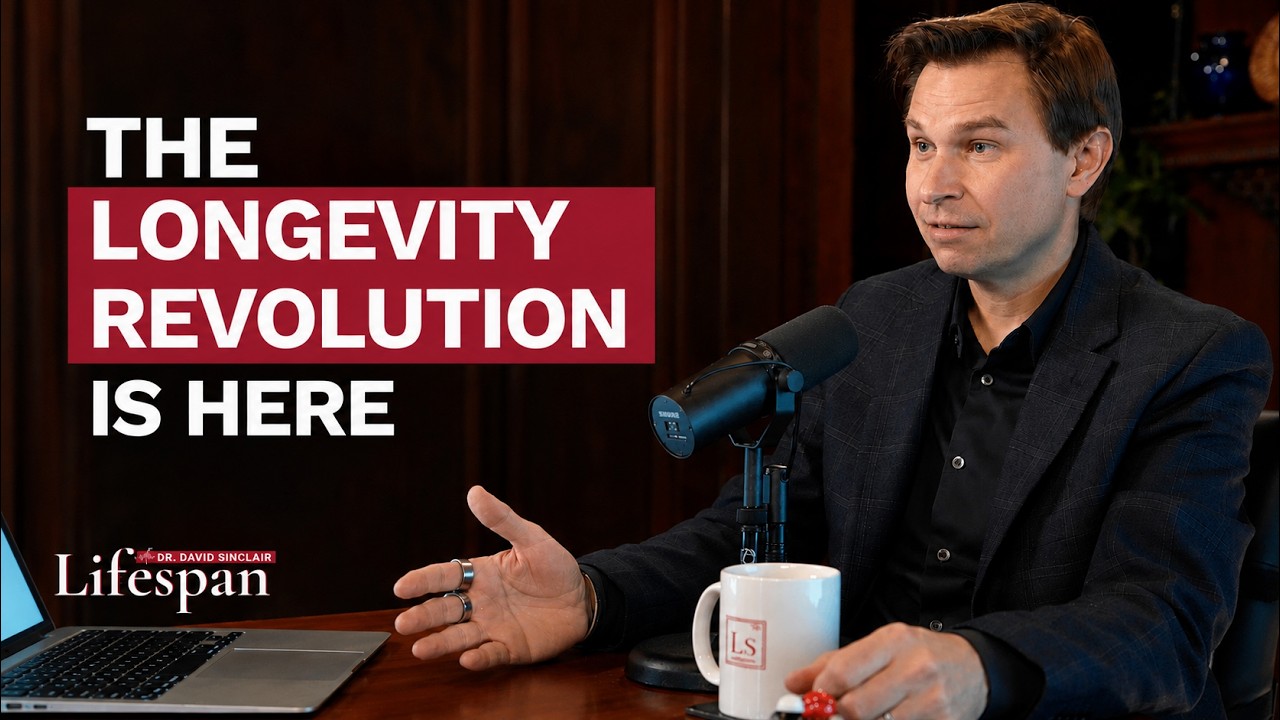
The Longevity Revolution Is Here | Lifespan with Dr. David Sinclair - Season 2, Episode 1
David Sinclair
Overview
This video introduces the concept of the "longevity revolution," suggesting that current scientific advancements may allow humans to live significantly longer and healthier lives, potentially exceeding current maximum lifespans. Dr. David Sinclair explains the shift in understanding aging from simple damage accumulation to a loss of biological information, specifically epigenetic information. The episode highlights groundbreaking research in epigenetic reprogramming, exemplified by the ER 100 therapy entering human clinical trials for vision restoration, and discusses the potential for AI and personalized medicine to accelerate these advancements. It also showcases extraordinary examples of human longevity and performance to illustrate current biological potential and the future possibilities.
Save this permanently with flashcards, quizzes, and AI chat
Chapters
- Humanity is entering an era where lifespans could be significantly extended beyond current limits.
- Breakthroughs in epigenetic reprogramming, like ER 100, are moving from lab to human clinical trials.
- The show "Lifespan" aims to explore aging science, share lab insights, and discuss future possibilities.
- The mission is to extend healthy lifespan for all by targeting aging itself, as most deaths are due to age-related diseases.
- AI is transforming longevity research by identifying aging biomarkers, drug targets, and repurposing compounds.
- Future adaptive AI systems could act as personalized longevity partners.
- The cost of genome sequencing has plummeted, enabling personalized longevity guidance and disease prediction.
- This shift moves away from one-size-fits-all advice towards individualized health strategies.
- The longest verified human lifespan is 122 years, held by Jeanne Calment, proving extreme longevity is biologically possible.
- Exceptional physical performance can be maintained at advanced ages, as shown by 80-year-old sprinters and endurance runners.
- Fertility can persist beyond typical age norms, as demonstrated by a woman conceiving naturally at 59.
- Cognitive function can remain high in very old age, with a 115-year-old woman scoring above average for younger adults.
- Aging is increasingly understood not as damage accumulation, but as a loss of biological information.
- There are two types of information: the stable digital genome (DNA) and the dynamic analog epigenetic information (the software).
- Aging occurs when cells lose their ability to correctly read and interpret epigenetic information, leading to loss of cellular identity.
- This information loss causes cells to drift from their specialized functions, leading to organ dysfunction and disease.
- Early research in yeast identified longevity genes (Sirtuins) that regulate the epigenome, suggesting aging is genetically controlled.
- The SUR 4 gene in yeast, involved in removing chemical tags from proteins, linked cellular metabolism to epigenetic regulation.
- Studies in mice (ICE model) demonstrated that disrupting epigenetic information accelerates aging, providing causal evidence for ITA.
- These findings suggest that aging is driven by changes in epigenetic information, not just DNA damage.
- Inspired by Claude Shannon's information theory, the idea emerged that a 'backup copy' of youthful epigenetic information might exist.
- Reprogramming involves resetting the epigenome to a more youthful state, potentially reversing aging.
- Early attempts using all four Yamanaka factors led to tumors; however, using only OSK factors safely rewound the epigenetic clock in human cells.
- This partial reprogramming, demonstrated in mice, restored vision and reversed age-related molecular signatures without causing cancer.
- ER 100 is a gene therapy based on the OSK reprogramming factors, designed for human clinical trials.
- The first human trials are testing ER 100's safety and efficacy in patients with glaucoma and other eye conditions.
- The goal is to rejuvenate damaged retinal nerve cells to restore lost vision, offering hope where current treatments only slow progression.
- This represents a paradigm shift, moving from managing aging to actively reversing it, with potential applications beyond vision loss.
Key takeaways
- Aging is increasingly understood as a loss of biological information, particularly epigenetic information, rather than just accumulated damage.
- Epigenetic reprogramming, using specific factors like OSK, can safely reset the biological clock of cells and tissues, offering a path to reversing age-related decline.
- Advancements in AI and personalized medicine, including affordable genome sequencing, are accelerating the pace of longevity research and enabling tailored health interventions.
- Extraordinary examples of human longevity and performance demonstrate that current biological limits are far beyond what is commonly experienced.
- The development of therapies like ER 100, now in human clinical trials, signifies a major shift from slowing aging to actively reversing it.
- Understanding and tracking personal health metrics is crucial for evaluating the effectiveness of lifestyle changes and longevity interventions.
- The potential exists to extend not just lifespan, but more importantly, healthspan, allowing individuals to remain vigorous and disease-free for much longer.
Key terms
Test your understanding
- How has the understanding of aging evolved from damage accumulation to information loss, and what is the role of the epigenome in this new framework?
- What is epigenetic reprogramming, and how do the OSK factors differ from the full Yamanaka factors in terms of safety and efficacy for age reversal?
- What are the key contributions of AI and personalized medicine to the field of longevity research?
- How do the extraordinary examples of human longevity and performance discussed in the video challenge our current perceptions of biological limits?
- What is the significance of ER 100 entering human clinical trials, and what is its potential impact on treating age-related diseases like vision loss?