41:35
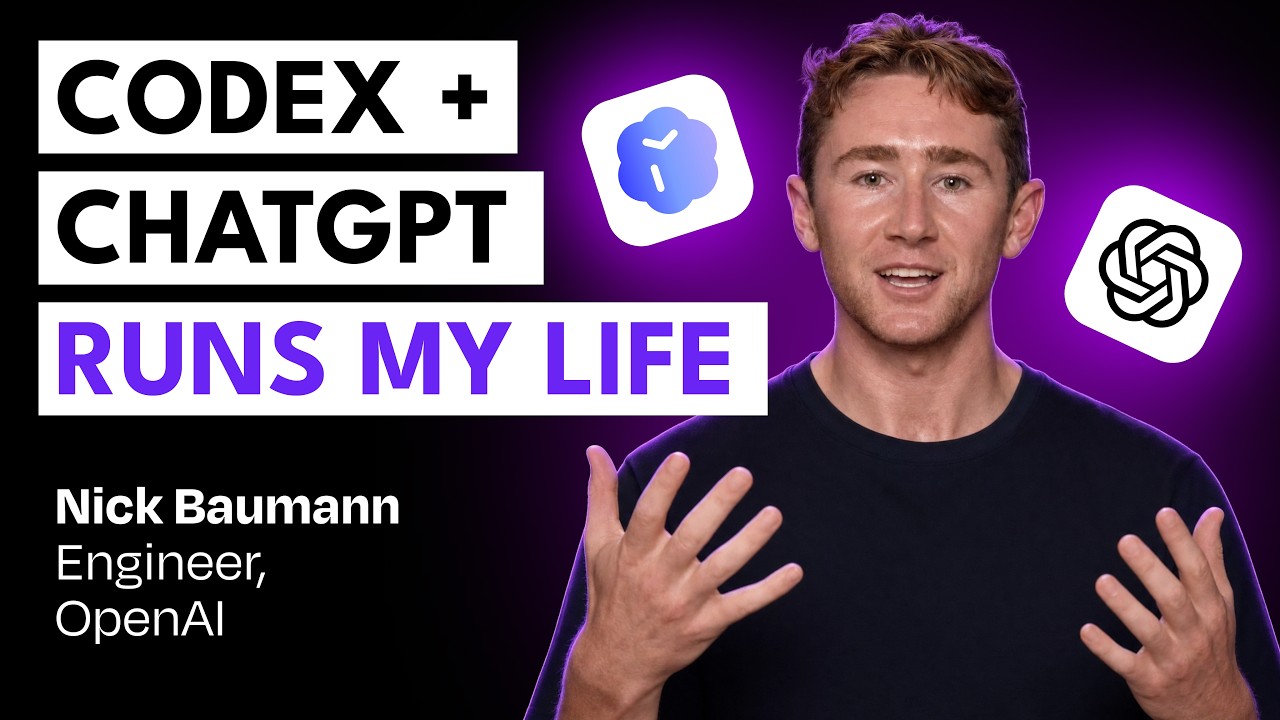
How this OpenAI engineer uses Codex + ChatGPT Work to automate everything
How I AI
Overview
This video explores advanced use cases of OpenAI's Codex and ChatGPT Work, focusing on how they can automate tasks and enhance productivity. The discussion highlights the evolution from basic chatbots to sophisticated agents capable of managing multiple threads, interacting via voice, building websites, and even editing video content. The presenter and guest demonstrate practical applications, emphasizing the potential for these tools to act as powerful personal assistants and streamline complex workflows for both technical and non-technical users.
How was this?
Save this permanently with flashcards, quizzes, and AI chat
Chapters
- Early AI chatbots were primarily conversational, responding to user input.
- Newer AI agents, like those in Codex, can actively read files, create files, and execute commands, demonstrating a significant leap in capability.
- The voice interface for ChatGPT represents a major advancement, allowing for natural language interaction and screen awareness.
- These tools can now manage multiple 'threads' or sub-agents to handle complex, multi-step tasks autonomously.
Understanding this evolution helps learners appreciate the increasing power and autonomy of AI tools, moving beyond simple Q&A to proactive task management.
The example of asking the AI to handle an expense report by finding an Amazon receipt and staging a report, which it does by spinning up a new thread.
- Users often underutilize the 'meta-capabilities' of AI, such as the ability to create and manage sub-agents or new threads.
- These AI models can access and process their own memory and past data, allowing them to manage context effectively.
- The ChatGPT Work app, especially on mobile, integrates plugins (like Gmail, GCal) for seamless automation.
- Proactive notifications from AI agents monitoring email and finances provide a 'magical' experience of being kept informed without constant manual checking.
Awareness of these underlying capabilities is crucial for unlocking the full potential of AI tools beyond basic commands, enabling more sophisticated automation.
Receiving a notification from the AI about a purchased item or an incoming package, demonstrating proactive monitoring of personal information.
- The voice feature allows users to interact with AI naturally, acting like a highly capable assistant.
- The AI can 'see' the user's screen, enabling it to understand context from open applications like Slack.
- Voice commands can initiate complex tasks like booking flights and hotels, checking calendars, and planning travel itineraries.
- This high-bandwidth, low-friction interaction method can overcome 'blank chat window syndrome' and encourage broader use case discovery.
Voice interaction lowers the barrier to entry for complex AI tasks, making powerful delegation accessible through natural conversation.
Asking the AI to book flights and a hotel for an offsite, check calendar availability, and then delegate the task of inviting a colleague and booking their travel.
- ChatGPT can be used to build and deploy websites directly, with capabilities like SQL database support and S3 storage.
- Websites can be configured for public access or restricted to specific email addresses, offering privacy controls.
- The AI can generate content for websites based on provided data, such as curating tips from YouTube videos.
- The process involves describing the desired website, its branding, and content structure, which the AI then builds and deploys.
This demonstrates how AI can democratize website creation, enabling users to build functional, shareable web presences with minimal technical expertise.
Building a website for the 'How I AI' podcast that aggregates tips from YouTube videos, categorized by tool and function, with specific branding.
- Codex can automate tedious video editing tasks, such as transcribing clips, identifying best takes, and assembling footage.
- Users can provide guidance through voice notes or text prompts, specifying desired formats (e.g., 9x16, 4x5) and content requirements.
- The AI can handle tasks like redaction and blurring of sensitive information in screen recordings, a complex manual process.
- This capability is particularly useful for content creators who want to offload the self-critique and editing process to an AI.
AI-driven video editing significantly reduces the time and effort required for content creation, making it more accessible and efficient.
Uploading raw video clips for a UGC-style video, instructing the AI to find the best takes, transcribe them, and assemble the final product, including blurring sensitive details.
- The primary differentiator in AI tools is increasingly becoming latency, as users abandon workflows that are too slow.
- Reducing latency allows for more seamless and real-time interactions, enabling new product possibilities.
- The challenge of using voice AI in shared spaces (like offices) requires solutions for privacy and minimizing disruption.
- The 'AGI moment' is evolving from understanding chatbots to experiencing AI agents that autonomously perform complex tasks.
Focusing on latency and practical integration highlights the ongoing development towards more intuitive and efficient human-AI collaboration.
The discussion around needing private spaces or future solutions for using voice AI in an office environment, contrasting with the ideal of direct mind-to-agent connection.
Key takeaways
- AI agents are evolving from passive responders to active task managers capable of complex, multi-threaded operations.
- Voice interaction provides a high-bandwidth, natural way to delegate tasks to AI, overcoming traditional interface limitations.
- ChatGPT's web and mobile applications offer powerful integrated workflows, including website building and proactive monitoring.
- AI can significantly automate creative processes like video editing, including challenging tasks like redaction and content selection.
- The speed of AI response (latency) is becoming a critical factor in user adoption and workflow efficiency.
- Understanding and utilizing AI's 'meta-capabilities,' such as thread management and context awareness, is key to maximizing productivity.
- AI tools are increasingly accessible to non-technical users, enabling them to build websites and automate complex tasks.
Key terms
CodexChatGPT WorkAI AgentsVoice OrchestrationThreads (AI)AppshotsPluginsUGC Video EditingLatencyAGI Moment
Test your understanding
- How has the capability of AI agents evolved from simple chatbots to the current state described in the video?
- What are the key benefits of using voice interaction for delegating tasks to AI assistants?
- Describe how ChatGPT can be used to build and deploy a website, including its technical capabilities and access controls.
- What specific video editing tasks can AI automate, and why is this beneficial for content creators?
- Why is reducing latency considered a critical factor for the future of AI user experience?