Ch 7 Captioned
Laz Lahera
Overview
This video emphasizes the critical importance of accurate, complete, and ethical report writing in the fire service, framing it as a crucial tool for reducing civil liability. It explains that reports are public legal documents that can be scrutinized in court. The content details what constitutes a 'threshold incident' that requires meticulous documentation and outlines the key elements of effective incident documentation, including reports, witnesses, evidence, photographs, and electronic records. The video also provides practical advice, such as using the active voice, the five Ws and two Hs, and the importance of proofreading, all while highlighting that report writing is a discretionary task that must be done correctly the first time.
Save this permanently with flashcards, quizzes, and AI chat
Chapters
- Fire service reports are considered public legal documents, subject to discovery in legal proceedings.
- Accurate and ethical report writing is essential to defend against civil liability, which involves legal obligations arising from private wrongs.
- Understanding that your report can be used by both the prosecution and the defense is crucial.
- Adhering to specific writing rules can significantly reduce your exposure to civil liability.
- As fire services engage in broader operations (EMS, hazmat), their exposure to liability claims increases.
- The first prong is to 'do your job right,' meaning perform duties correctly and competently.
- The second prong is to 'be able to prove it' through solid incident documentation.
- Effective documentation is necessary when required by law, agency policy, or when involved in a threshold incident.
- A threshold incident is one that causes significant injury, harm, or damage, potentially exposing you to civil liability.
- Situations signaling a threshold incident include any injury, deprivation of liberty, or damage to property (including when reported by others).
- Major injuries, deaths, hospitalizations, involvement of city property, or direct threats of litigation ('I'll sue') also indicate a threshold incident.
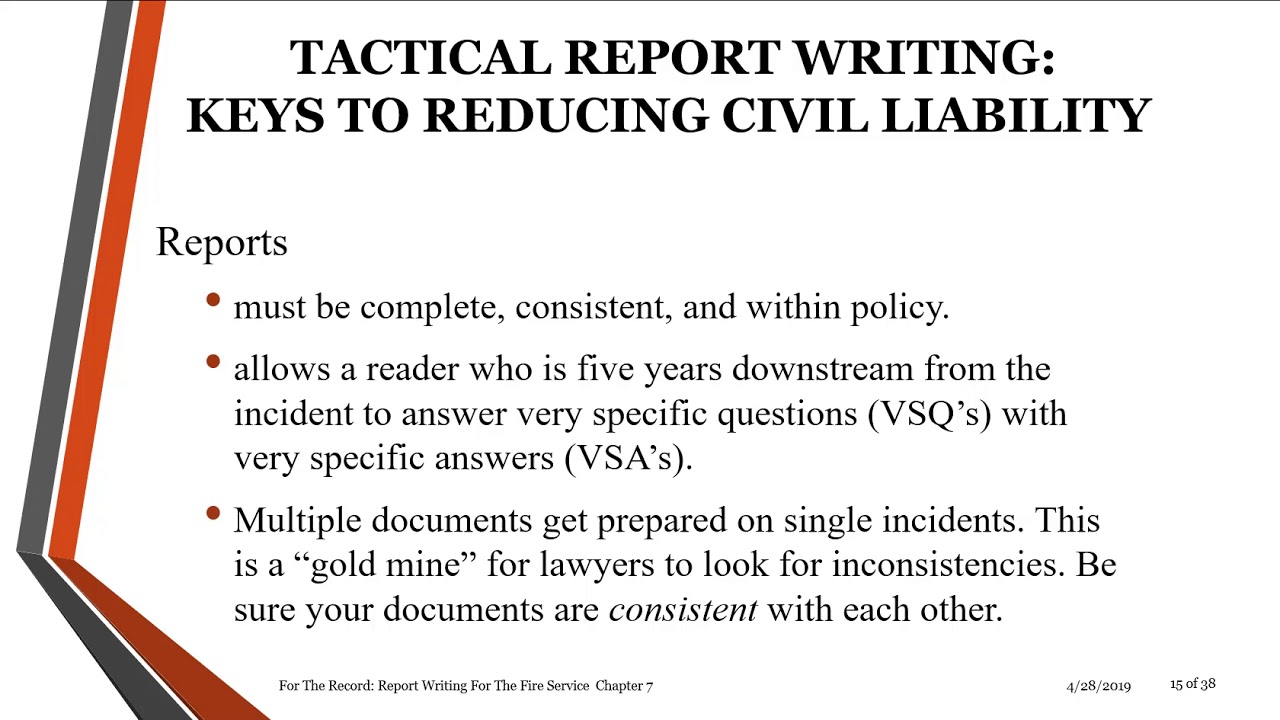
- Involvement in a threshold incident mandates complete, consistent documentation immediately, as delays make proof difficult and supplemental reports can appear as cover-ups.
- Effective documentation includes comprehensive reports, witness statements, evidence logs, photographs, and electronic records.
- Reports must be complete, consistent, and within policy, allowing clear understanding by anyone, even years later.
- Gather statements from all witnesses, especially civilians, and ensure all evidence, including exculpatory evidence (favorable to the defendant), is logged.
- Photographs should capture all aspects of threshold incidents, and all electronic communications (emails, radio logs) are subject to discovery and must be included.
- Report writing is an essential job component; if you can't write, you may be in the wrong profession.
- Take timely notes during incidents, focusing on specific details like times, locations, and statements.
- Understand the purpose of documentation (legal defense, policy updates, learning from mistakes) and write factually.
- Before writing, plan your approach; use headings for clarity in narrative reports and always use the active voice.
- Answer the 'Five Ws and Two Hs' (Who, What, Where, When, Why, How, How Many) with factual statements, labeling inferences clearly.
- Accuracy in times, dates, locations, and statements is paramount; minor errors can imply incompetence or dishonesty.
- Follow the CCP rule: Complete, Consistent, and within Policy.
- Proofread all documentation thoroughly, ideally having someone else review it.
- Substantive changes to reports should only be made to correct inaccuracies and must be properly explained and approved.
- Learn from experience and mistakes; your written words represent you ('you are what you write').
- The Risk Frequency Analysis Grid helps categorize activities based on how often they occur (frequency) and their potential consequences (risk).
- High-risk, low-frequency events often require the most careful documentation.
- Report writing itself is considered a high-risk activity due to its potential legal implications.
- Report writing is a discretionary time task, meaning you have control over how and when you do it, emphasizing the importance of doing it right the first time.
Key takeaways
- All fire service reports are potential legal documents that can be used in court, making accuracy and completeness essential.
- Reducing civil liability hinges on two actions: performing your job correctly and meticulously documenting your actions.
- Threshold incidents, characterized by injury, significant damage, or threats of litigation, demand immediate and thorough documentation.
- Effective incident documentation is a comprehensive process involving reports, witnesses, evidence, photos, and electronic records.
- Treat every report as if it will be scrutinized by an adversary to ensure maximum accuracy and detail.
- Supplemental reports are often viewed negatively; strive to get the initial documentation right the first time.
- Report writing is a discretionary task, meaning you have control over its quality, so invest the time to do it correctly.
- Learn from your experiences and mistakes in report writing to continuously improve your documentation skills.
Key terms
Test your understanding
- Why are fire service reports considered legal documents, and what are the implications for report writers?
- Explain Gordon Graham's two-pronged approach to reducing civil liability in the fire service.
- What are the key indicators that an incident might be a 'threshold incident,' and why is immediate documentation critical in such cases?
- Describe the essential elements that comprise effective incident documentation.
- How can understanding the 'Five Ws and Two Hs' and using the active voice improve the clarity and effectiveness of a report?