1:18:45
CIE Topic 25 Equilibria REVISION
Allery Chemistry
Overview
This video revises topic 25 on equilibria for the Cambridge International specification, building on year one concepts. It covers conjugate acid-base pairs, the pH scale and calculations for strong and weak acids and bases, the ionic product of water (Kw), and the concept of buffer solutions. The latter half delves into solubility products (Ksp), the common ion effect, and introduces the partition coefficient (Kp) for partitioning substances between two immiscible solvents.
How was this?
Save this permanently with flashcards, quizzes, and AI chat
Chapters
- Conjugate pairs are species differing by a single proton (H+).
- Acids are proton donors, bases are proton acceptors (Brønsted-Lowry theory).
- When an acid donates a proton, it forms its conjugate base; when a base accepts a proton, it forms its conjugate acid.
- Reactions involving proton transfer are often reversible and establish equilibria.
Understanding conjugate pairs is fundamental to acid-base chemistry and predicting the direction of proton transfer in reversible reactions.
In the reaction HA + B <=> BH+ + A-, HA and A- are a conjugate pair, and B and BH+ are another conjugate pair.
- pH is a logarithmic scale measuring H+ ion concentration: pH = -log[H+].
- For strong acids, [H+] is equal to the acid's concentration (adjusted for polyprotic acids).
- For strong bases, calculate [OH-] first, then use Kw = [H+][OH-] to find [H+] and subsequently pH.
- Polyprotic acids (e.g., H2SO4, H3PO4) can donate more than one proton, affecting the [H+] calculation.
The pH scale provides a convenient way to express acidity or alkalinity, and these calculations are essential for quantitative analysis in chemistry.
Calculating the pH of 0.03 mol/dm³ HCl gives a pH of 1.52.
- Weak acids only partially dissociate in solution, establishing an equilibrium.
- The acid dissociation constant (Ka) quantifies this dissociation: Ka = ([H+][A-]) / [HA].
- Assumptions for weak acids include [H+] ≈ [A-] and [HA] at equilibrium ≈ [HA] at start.
- Ka values are temperature-dependent; lower Ka indicates a weaker acid.
Ka allows for the calculation of pH for weak acids, which are common in biological and industrial systems, and indicates their relative strengths.
For ethanoic acid (CH3COOH) with Ka = 1.76 x 10⁻⁵ mol/dm³, a 0.03 mol/dm³ solution has a pH of 3.14.
- Water undergoes autoionization: 2H₂O <=> H₃O⁺ + OH⁻, simplified to H₂O <=> H⁺ + OH⁻.
- The ionic product of water, Kw = [H+][OH-], is constant at a given temperature (1.0 x 10⁻¹⁴ mol²/dm⁶ at 25°C).
- pKw = -log(Kw), analogous to pH = -log[H+].
- Kw links the [H+] and [OH-] concentrations in any aqueous solution.
Kw is crucial for relating acid and base concentrations in aqueous solutions and is fundamental to understanding pH calculations for both acids and bases.
In pure water at 25°C, [H+] = [OH-] = 1.0 x 10⁻⁷ mol/dm³.
- Buffers resist changes in pH when small amounts of acid or base are added.
- Acidic buffers are made from a weak acid and its conjugate base (salt).
- Basic buffers are made from a weak base and its conjugate acid (salt).
- Buffers work by reacting added H+ or OH- with components of the buffer system, shifting equilibria to minimize pH change.
Buffers are vital for maintaining stable pH in biological systems (like blood) and in chemical processes where pH fluctuations can be detrimental.
A buffer solution can be made from ethanoic acid and sodium ethanoate.
- Solubility product (Ksp) is the equilibrium constant for the dissolution of a sparingly soluble ionic solid.
- Ksp = [cation]ⁿ[anion]ᵐ for a solid MₙAₘ.
- The common ion effect occurs when an ion already present in a saturated solution is added, causing precipitation and shifting the equilibrium to the left.
- Ksp calculations help predict precipitation and determine the solubility of ionic compounds.
Understanding Ksp is essential for predicting whether a precipitate will form when solutions are mixed and for calculating the solubility of sparingly soluble salts.
For AgCl(s) <=> Ag+(aq) + Cl-(aq), Ksp = [Ag+][Cl-].
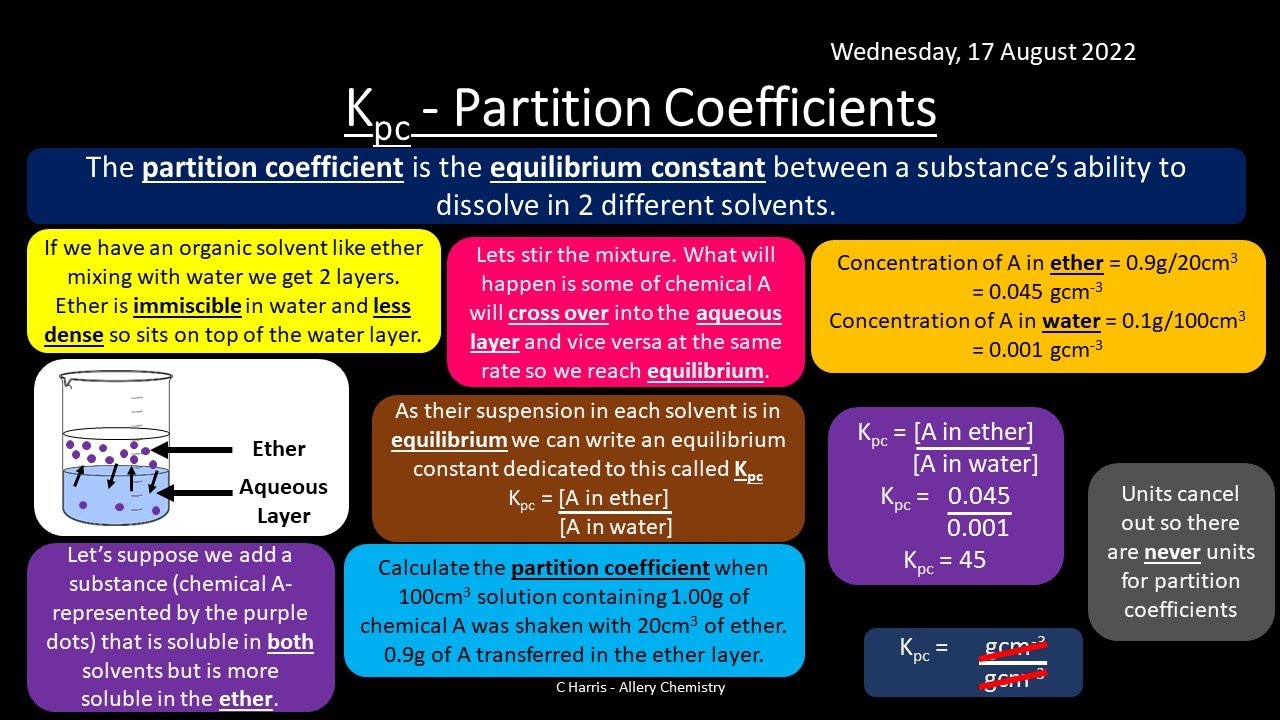
- The partition coefficient (Kp) describes the distribution of a solute between two immiscible solvents at equilibrium.
- Kp = Concentration of solute in solvent 1 / Concentration of solute in solvent 2.
- It is an equilibrium constant specific to the solute and the two solvents.
- Kp values are used in separation techniques like chromatography and extraction.
The partition coefficient is important for understanding and optimizing separation processes in chemistry and pharmacology.
If a substance is more soluble in organic solvent than water, its Kp (organic/water) will be greater than 1.
Key takeaways
- Equilibria involve reversible reactions where forward and reverse rates are equal, leading to constant macroscopic properties.
- Conjugate acid-base pairs are linked by the transfer of a single proton.
- pH is a logarithmic measure of [H+], crucial for quantifying acidity and alkalinity.
- Weak acids and bases are characterized by their dissociation constants (Ka and Kb, respectively), indicating partial ionization.
- Buffer solutions resist pH changes by neutralizing added acids or bases through equilibrium shifts.
- The solubility product (Ksp) governs the equilibrium between a sparingly soluble ionic solid and its ions in solution.
- The common ion effect shifts equilibria involving sparingly soluble salts, often leading to precipitation.
- The partition coefficient (Kp) quantifies how a solute distributes between two immiscible phases at equilibrium.
Key terms
EquilibriumReversible reactionConjugate pairBrønsted-Lowry acid/basepHStrong acid/baseWeak acid/baseAcid dissociation constant (Ka)Ionic product of water (Kw)Buffer solutionSolubility product (Ksp)Common ion effectPartition coefficient (Kp)
Test your understanding
- How does the addition of a strong acid affect a buffer solution containing a weak acid and its conjugate base?
- What is the relationship between pH, pOH, and pKw in an aqueous solution?
- Explain why the concentration of the solid reactant is not included in the Ksp expression.
- How can the common ion effect be used to reduce the solubility of an ionic compound?
- What are the two essential components required to form an acidic buffer solution?