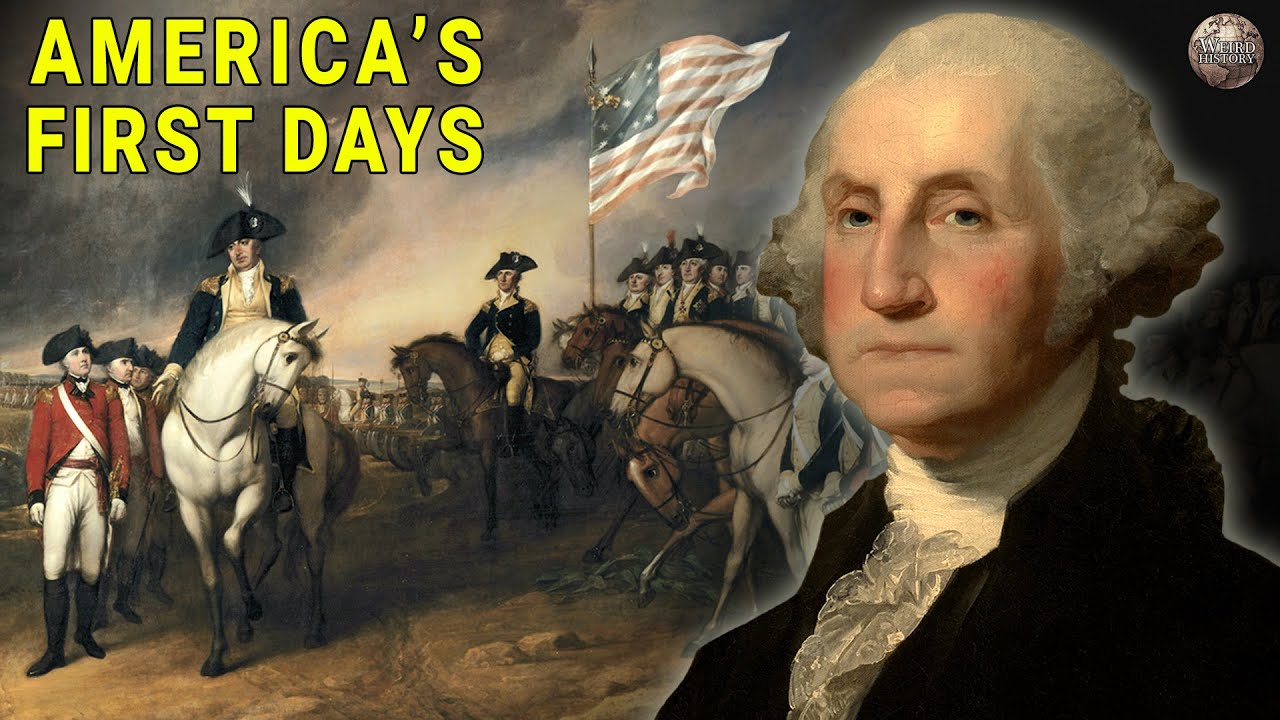
What Happened Immediately After the American Revolution Ended
Weird History
Overview
The period immediately following the American Revolution was not a smooth transition to nationhood, but a complex and challenging era. Despite the victory at Yorktown, the new United States faced significant hurdles including economic instability, disorganized state governments, and internal dissent. The departure of British forces and loyalists, the negotiation of the Treaty of Paris, the internal conflict exemplified by Shays' Rebellion, and the eventual drafting and ratification of the Constitution all shaped the nascent nation. This period laid the groundwork for the government and society that would eventually emerge, highlighting the difficulties in transforming idealistic aspirations into a functional republic.
Save this permanently with flashcards, quizzes, and AI chat
Chapters
- Not all colonists supported the revolution; 15-20% remained loyal to the British Crown.
- Following the British surrender, loyalists faced persecution and many chose to leave with the departing British forces.
- The British withdrawal was a gradual process, with the last soldiers leaving New York in November 1783, an event celebrated as Evacuation Day.
- The departure of British troops and loyalists marked a significant symbolic end to British rule.
- Official peace talks between the United States and Great Britain began in Paris in 1782, a year after the surrender at Yorktown.
- Key American negotiators included John Jay, John Adams, and Benjamin Franklin, who worked to secure favorable terms.
- The Treaty of Paris, ratified in 1784, formally recognized American independence and granted the U.S. territory up to the Mississippi River.
- The treaty also included provisions regarding the treatment of loyalists and the collection of debts, reflecting ongoing negotiations.
- General George Washington resigned his commission as commander of the U.S. Army shortly after the last British troops departed.
- This act was seen as a powerful display of civic virtue, prioritizing the nation over personal power.
- Washington's resignation reinforced his popularity and set a precedent for civilian control of the military.
- He returned to his home at Mount Vernon, Virginia, intending to live as a private citizen.
- Economic hardship in Massachusetts in the 1780s led to widespread farmer debt and resentment towards the state government.
- Farmers, many of whom were Revolutionary War veterans, protested against foreclosures and imprisonment for debt.
- Daniel Shays led an armed uprising, highlighting the inability of the weak federal government under the Articles of Confederation to maintain order.
- The rebellion was eventually suppressed by the Massachusetts militia, but it exposed critical flaws in the existing system of government.
- The ineffectiveness of the Articles of Confederation, particularly its lack of federal power, led to calls for a new constitution.
- Delegates convened in Philadelphia in 1787 to draft a new framework for government, debating various plans and compromises.
- The resulting U.S. Constitution established a stronger federal government but faced opposition from Anti-Federalists concerned about individual rights.
- The addition of the Bill of Rights (10 amendments) addressed these concerns, and the Constitution was eventually ratified by the required number of states.
- The Federalist Papers, written by Hamilton, Madison, and Jay, were instrumental in advocating for the Constitution's ratification.
- The first presidential election under the new Constitution was held in 1789, with significantly different rules than today.
- Voting rights were restricted to white male property owners.
- The candidate with the second-highest number of votes became Vice President, an electoral mechanism that was later changed.
- George Washington was overwhelmingly elected as the first President, unanimously chosen by both Federalists and Anti-Federalists.
- Washington's inauguration on April 30, 1789, marked the official beginning of the executive branch under the Constitution.
Key takeaways
- The end of the Revolutionary War did not immediately result in a stable, unified nation.
- The transition from colonies to a functional republic involved significant economic, political, and social challenges.
- The fate of loyalists and the process of British withdrawal reveal the deep divisions within American society.
- Shays' Rebellion exposed the critical weaknesses of the Articles of Confederation and the need for a stronger federal government.
- The U.S. Constitution was a product of intense debate and compromise, with the Bill of Rights added to secure individual liberties.
- George Washington's leadership and his voluntary relinquishment of power were crucial for the early success of the republic.
- The early American government operated under vastly different rules than today, particularly concerning voting rights and the electoral process.
Key terms
Test your understanding
- What challenges did the newly independent United States face immediately after the Revolutionary War?
- Why was the Treaty of Paris significant for the new nation?
- How did Shays' Rebellion demonstrate the weaknesses of the Articles of Confederation?
- What were the main arguments between Federalists and Anti-Federalists during the Constitution's ratification?
- What made the first presidential election under the Constitution unique compared to modern elections?