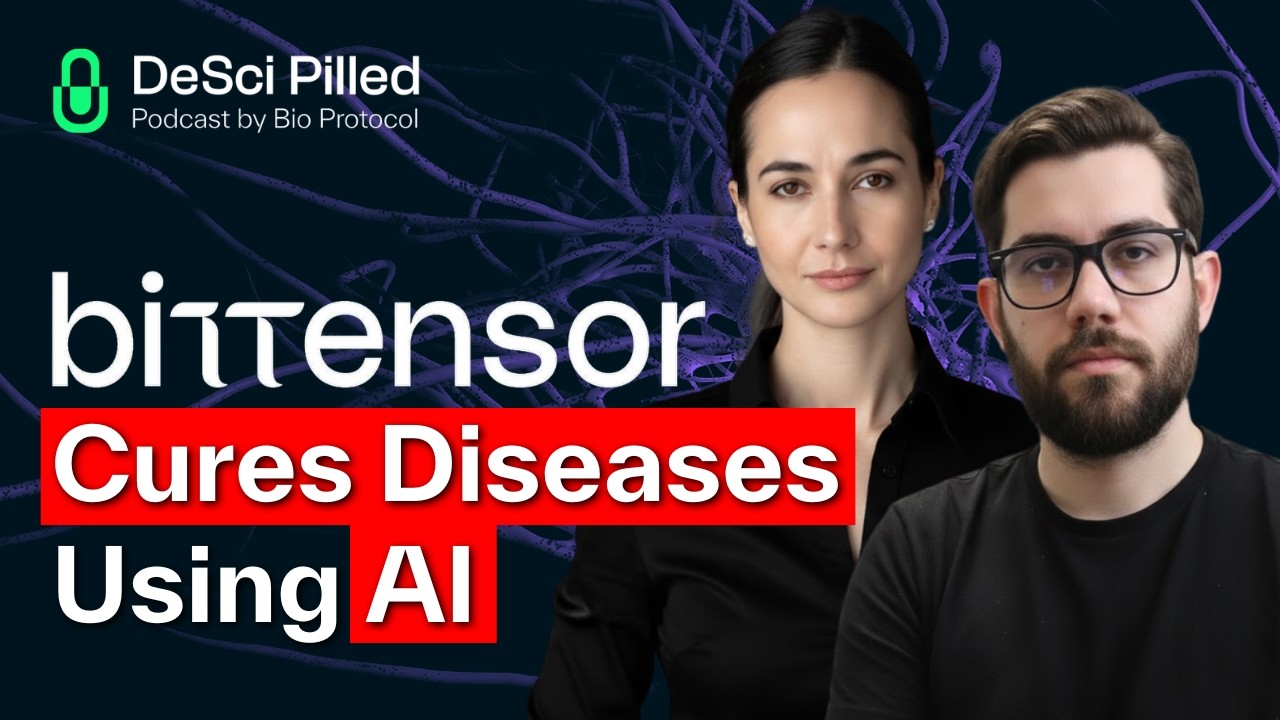
How Bittensor Is Reinventing Drug Discovery
DeSci Pilled
Overview
This video introduces Metanova, a crypto-native biotech company operating as the first subnet on Bittensor focused on drug discovery. It explains how Bittensor, inspired by Bitcoin, utilizes decentralized compute power for AI development, contrasting it with traditional proof-of-work. Metanova leverages this network for virtual drug screening, aiming to accelerate and reduce the cost of drug development. The discussion highlights the 'Darwinian' ecosystem of Bittensor, where competition among miners and validators drives innovation and identifies model weaknesses. Metanova's mission is to create 'metaprogramming' drugs that regulate foundational behaviors for improved health and longevity, expanding beyond small molecules to include nanobodies through a partnership. The conversation also touches upon the broader implications of decentralized science (DeSci) for global collaboration, innovation, and addressing systemic inefficiencies in traditional biotech and regulatory processes.
Save this permanently with flashcards, quizzes, and AI chat
Chapters
- Bittensor is a decentralized network that uses computational power, inspired by Bitcoin, to train AI models rather than for random mathematical problems.
- It hosts various 'subnets' dedicated to different AI applications, including Metanova's focus on drug discovery.
- Metanova aims to make drug discovery faster and cheaper by utilizing Bittensor's decentralized infrastructure for virtual screenings.
- The network's economic model, similar to Bitcoin's scarcity, incentivizes efficiency and innovation.
- Michaela, with a background in strategy and a passion for neuroplasticity, sought a technical co-founder to decentralize science.
- Pedro, with extensive experience in drug design and bioinformatics, was inspired to integrate decentralized approaches into drug discovery platforms.
- Both founders were drawn to crypto's potential beyond finance, seeing it as a tool for global collaboration and merit-based talent acquisition.
- Metanova was founded to create a crypto-native biotech company focused on reprogramming body and mind through novel therapeutics.
- Bittensor's network operates like a 'Darwinian' ecosystem, where competition and incentives drive AI models to become more efficient and resilient.
- Subnets, like Metanova's, also have a limited token supply (21 million), mirroring Bitcoin's scarcity and promoting long-term stability.
- The adversarial nature of the network, where miners are incentivized to exploit scoring functions, quickly reveals model weaknesses and blind spots.
- This 'stress testing' allows for rapid retraining and the development of more reliable and robust AI models.
- Metanova runs two main challenge formats: one for submitting molecules with specific binding affinities and another for submitting search algorithms.
- They provide miners with vast chemical universes (e.g., 65 billion molecules) to search, optimizing the crucial first step of virtual screening.
- The company is partnering with a Chinese biotech firm to expand beyond small molecules into biologics, specifically nanobodies.
- This partnership includes in-vitro testing for 50 candidate molecules identified by miners, bridging the gap between virtual screening and real-world validation.
- Nanobodies are small, highly potent, and selective antibody fragments derived from camelids (like llamas and camels).
- They are humanized, making them well-tolerated by the human body, and hold significant promise for various therapeutic indications.
- Metanova's miners will soon be able to submit nanobody sequences, further diversifying the types of therapeutic candidates generated on the platform.
- This expansion into biologics, alongside small molecules, positions Metanova to tackle a broader range of diseases and health challenges.
- The traditional drug development process is slow, expensive, and often geographically concentrated, leading to inefficiencies.
- Decentralized science (DeSci) offers a global, merit-based approach, leveraging networks like Bittensor to democratize access to compute and talent.
- The 'Fourth Turning' philosophy suggests that existing institutions, including those in science funding and regulation, may be outdated and require adaptation or replacement.
- Metanova advocates for a global, collaborative approach to drug discovery, unconstrained by geography, to make scientific progress more efficient and accessible.
- The rapid advancement of AI necessitates new frameworks for thinking and scientific paradigms, as suggested by Thomas Kuhn.
- AI is seen as a tool to help humanity adapt to a rapidly changing world and address modern challenges like loneliness and chronic stress.
- The vision includes a future where AI can rapidly identify and develop cures for diseases, potentially through 'vibe coding' cures.
- Bittensor's architecture, supporting both human and machine agents, is well-suited for complex, human-in-the-loop AI processes required for future drug discovery.
Key takeaways
- Bittensor is a decentralized network that repurposes computational power for AI development, creating an efficient and competitive ecosystem.
- Metanova leverages Bittensor to accelerate drug discovery through decentralized virtual screening and R&D, aiming to reduce costs and timelines.
- The 'Darwinian' nature of Bittensor's subnets, driven by adversarial competition, rapidly identifies and corrects flaws in AI models, leading to more robust technology.
- Metanova is expanding its capabilities beyond small molecules to include nanobodies, a promising class of biologics, through strategic partnerships.
- Decentralized Science (DeSci) offers a global, collaborative, and merit-based alternative to traditional, often inefficient, scientific research models.
- AI and decentralized networks have the potential to not only speed up scientific discovery but also to help humans adapt to modern societal challenges and improve overall well-being.
- The future of drug discovery may involve highly integrated AI systems and human expertise, enabling rapid identification and development of novel therapeutics.
Key terms
Test your understanding
- How does Bittensor's approach to computational power differ from traditional proof-of-work systems, and why is this significant for AI development?
- What is Metanova's core mission, and how does it plan to leverage the Bittensor network to achieve it?
- Explain the concept of Bittensor's 'Darwinian' ecosystem and how adversarial competition contributes to the development of more reliable AI models.
- What are nanobodies, and why is their inclusion in Metanova's platform a significant advancement for drug discovery?
- How does the philosophy of Decentralized Science (DeSci) challenge traditional models of scientific research and development, and what are its potential benefits?