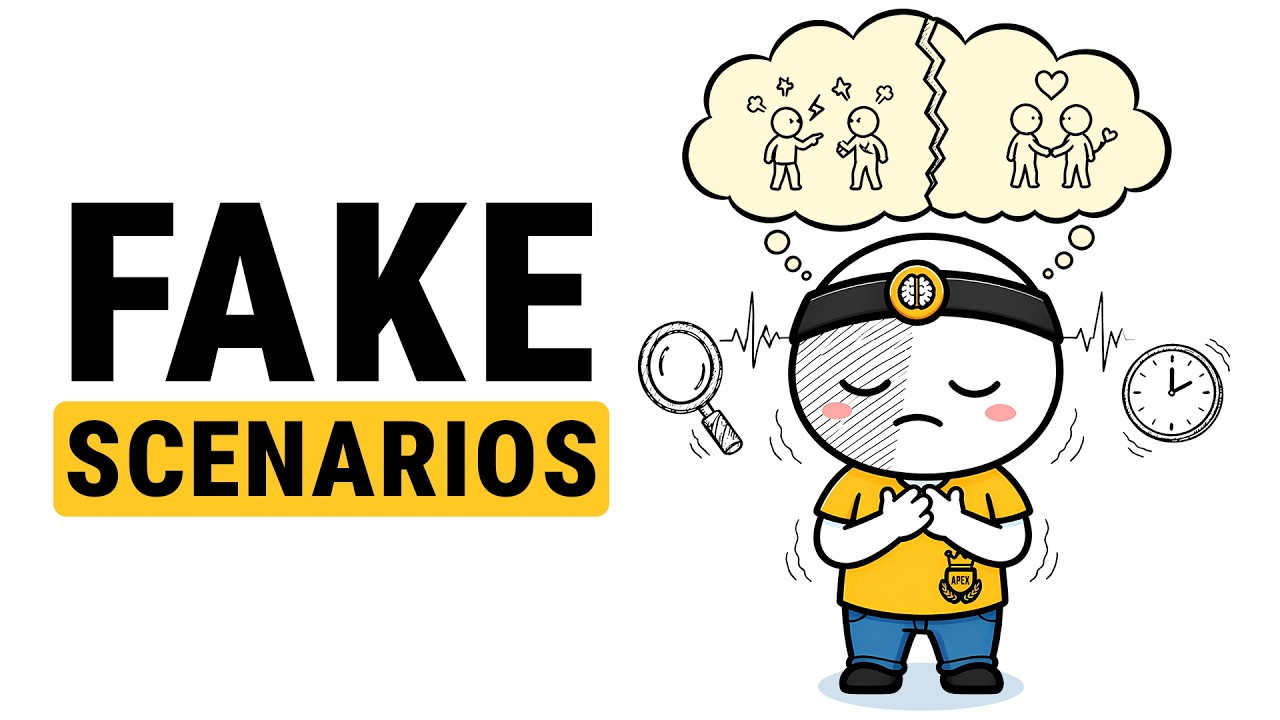
Psychology of People who Imagine FAKE Scenarios
Apex Psychology
Overview
This video explores the psychology behind imagining fake scenarios, often experienced as vivid mental replays of conversations or events. It clarifies that this isn't mere daydreaming but a complex brain mechanism, particularly involving the Default Mode Network (DMN). These imagined scenarios serve as a mental laboratory for problem-solving, emotional regulation, and self-exploration, offering a sense of control absent in chaotic reality. However, over-reliance can blur the lines between imagination and reality, leading to emotional confusion and a lack of motivation in real life. The video offers a four-step strategy to manage these scenarios: writing them down, distinguishing between preparation and protection, setting time limits, and grounding oneself in the present through sensory awareness.
Save this permanently with flashcards, quizzes, and AI chat
Chapters
- Imagining fake scenarios involves creating detailed, parallel realities where you control the narrative and outcomes.
- This is more complex than simple daydreaming; it's an active construction of a mental experience.
- These scenarios often arise when the brain attempts to solve problems or fulfill desires unmet in real life.
- They are a natural evolutionary mechanism, not a sign of being broken or wasting time.
- The Default Mode Network (DMN) is the brain's 'background app' that activates during rest.
- It combines past memories with present desires to create alternate realities, a process known as counterfactual thinking.
- For highly imaginative or perfectionistic individuals, the DMN may operate at a higher intensity.
- These simulations serve as a learning tool, a way to test future paths, or to heal emotional wounds.
- The brain uses imagined scenarios for rehearsal, building confidence and neural pathways for future real-life events.
- The line between preparation (rehearsing for action) and substitution (living out the outcome mentally) is thin.
- Over-rehearsing can lead to a lack of motivation in real life because the mental outcome already feels achieved.
- This can create a 'soft glass cage,' where the simulated future prevents engagement with the present.
- The core driver behind these imagined scenarios is the deep human desire for control in a chaotic world.
- In mental simulations, you are the absolute ruler, ensuring perfect outcomes and safety.
- This provides comfort, especially after experiences of powerlessness or rejection.
- However, excessive immersion blurs the lines between real and imagined emotions, leading to confusion and misplaced reactions.
- Do not try to force yourself to stop thinking; instead, work with the mechanism.
- Step 1: Expressive writing – write down the scenario to give it a concrete form and complete the mental loop.
- Step 2: Distinguish between preparation (action-oriented) and protection (avoidance-oriented).
- Step 3: Set time limits for imagined scenarios, treating them as temporary mental entertainment.
- Step 4: Ground yourself in the present using sensory awareness (feel your body, notice objects) when you drift too far.
- Imagined scenarios are drafts or rehearsal rooms, not destinations.
- Real life, though messy and uncertain, offers genuine experiences, connections, and hard-earned victories.
- The goal is not to eliminate imagination but to ensure it doesn't replace engagement with the real world.
- Embrace the imperfect richness of reality over the curated safety of illusion.
Key takeaways
- Imagining fake scenarios is a natural brain function, often serving as a mental laboratory for problem-solving and emotional processing.
- The Default Mode Network (DMN) plays a significant role in generating these alternate realities, especially during periods of rest.
- These mental simulations can be beneficial for preparation and self-exploration, but can become detrimental if they substitute for real-life action.
- The desire for control in an unpredictable world is a primary motivator for creating and revisiting these idealized scenarios.
- Over-reliance on imagined scenarios can blur the lines between reality and illusion, leading to emotional confusion and a diminished motivation for real-world engagement.
- Managing these scenarios involves conscious strategies like expressive writing, distinguishing preparation from avoidance, setting boundaries, and grounding oneself in sensory reality.
- True fulfillment and growth are found in embracing the imperfect, tangible nature of real life, rather than living solely within mental constructs.
Key terms
Test your understanding
- What is the primary psychological function of imagining fake scenarios, according to the video?
- How does the Default Mode Network (DMN) contribute to the creation of these imagined realities?
- What is the key difference between using imagined scenarios for 'preparation' versus 'protection'?
- Why is the desire for 'control' a significant factor in why people engage in these mental simulations?
- Describe one of the four recommended strategies for managing imagined scenarios and explain how it helps reclaim the present.