6:31
DNA vs RNA (Updated)
Amoeba Sisters
Overview
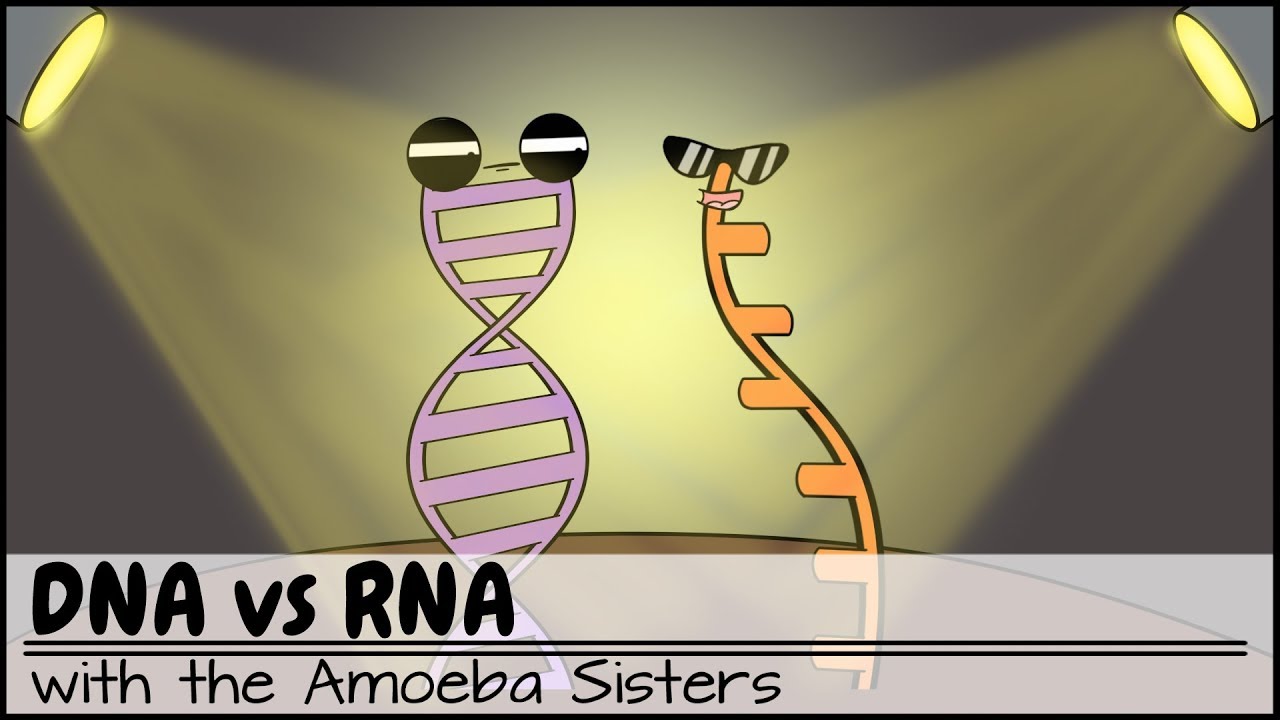
This video compares and contrasts DNA and RNA, two essential nucleic acids. While DNA stores genetic information in a double helix structure, RNA plays a crucial role in protein synthesis by carrying genetic messages from the DNA to the ribosomes. The video details their structural differences, including the type of sugar and bases they contain, and explains the functions of different types of RNA (mRNA, rRNA, tRNA) in translating genetic code into proteins. It also includes a short quiz to test understanding of base pairing and RNA transcription.
How was this?
Save this permanently with flashcards, quizzes, and AI chat
Chapters
- DNA stores genetic information and determines traits, often highlighted for its double helix structure.
- RNA is equally vital, enabling the expression of genetic information by carrying messages for protein production.
- The RNA World hypothesis suggests RNA may have preceded DNA.
- Both DNA and RNA are found in all living organisms and are classified as nucleic acids.
Understanding the distinct yet complementary roles of DNA and RNA is fundamental to grasping how genetic information is stored and utilized in all living cells.
DNA's double helix structure is described as a 'twisted ladder'.
- Both DNA and RNA are nucleic acids made of nucleotide monomers.
- Nucleotides consist of three parts: a phosphate, a sugar, and a base.
- DNA is typically double-stranded and antiparallel, while RNA is usually single-stranded.
- DNA contains the sugar deoxyribose, while RNA contains the sugar ribose.
- DNA uses bases Adenine, Thymine, Guanine, and Cytosine (A-T, C-G pairing), whereas RNA uses Adenine, Uracil, Guanine, and Cytosine (A-U, C-G pairing).
These structural differences, particularly the sugar and bases, dictate how DNA and RNA function and interact within the cell.
Mnemonic devices like 'apples in the tree' (A-T) and 'car in the garage' (C-G) help remember DNA base pairing rules.
- DNA's genetic code is inaccessible for protein synthesis directly; RNA acts as an intermediary.
- Messenger RNA (mRNA) carries the genetic message from the nucleus (in eukaryotes) to ribosomes.
- Ribosomal RNA (rRNA) is a key component of ribosomes, the sites of protein synthesis.
- Transfer RNA (tRNA) brings specific amino acids to the ribosome to match the mRNA codons.
- Amino acids are linked together to form polypeptide chains, which fold into proteins.
RNA's diverse forms enable the complex process of translating genetic blueprints into functional proteins, the workhorses of the cell.
mRNA leaves the nucleus to deliver its message to a ribosome.
- Each nucleotide has one base; 8 DNA nucleotides contain 8 bases.
- DNA base pairing involves A with T and C with G.
- Transcription creates a complementary RNA strand from a DNA template, substituting Uracil for Thymine.
Testing your understanding through practice problems reinforces the concepts of nucleotide composition, base pairing, and the relationship between DNA and RNA during transcription.
Given a DNA sequence A, T, T, G, A, C, the complementary RNA sequence is U, A, A, C, U, G.
Key takeaways
- DNA is the master blueprint for genetic information, while RNA is the active messenger and builder in protein synthesis.
- The structural difference in sugar (deoxyribose vs. ribose) and one base (thymine vs. uracil) is key to DNA and RNA's distinct roles.
- RNA's single-stranded nature allows it to be more mobile and versatile in carrying out its functions.
- The three main types of RNA (mRNA, rRNA, tRNA) work in concert to translate genetic code into proteins.
- Understanding base pairing rules is crucial for predicting complementary strands in DNA and for RNA transcription.
- While DNA resides primarily in the nucleus (in eukaryotes), RNA can move freely within and outside the nucleus to facilitate protein production.
Key terms
DNA (Deoxyribonucleic acid)RNA (Ribonucleic acid)Nucleic acidsNucleotidesPhosphateSugar (Deoxyribose, Ribose)Bases (Adenine, Thymine, Guanine, Cytosine, Uracil)Double helixSingle-strandedAntiparallelmRNA (Messenger RNA)rRNA (Ribosomal RNA)tRNA (Transfer RNA)RibosomeCodonTranscriptionProtein synthesis
Test your understanding
- What are the three main structural differences between DNA and RNA?
- How does RNA's structure enable its role in protein synthesis, compared to DNA?
- Why is RNA considered essential for expressing the genetic information stored in DNA?
- What is the function of each type of RNA (mRNA, rRNA, tRNA) in the process of creating proteins?
- How do the base pairing rules differ between DNA and the transcription of DNA into RNA?