AI-Generated Video Summary by NoteTube
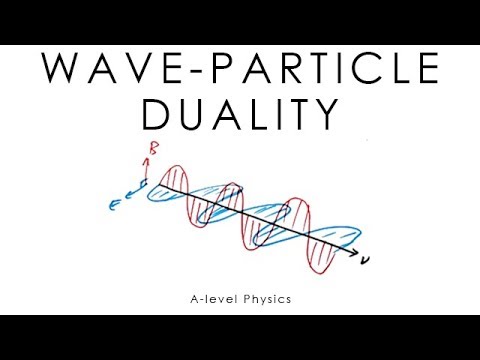
Wave Particle Duality & Electron Microscopes - A-level Physics (Turning Points)
Science Shorts
Overview
This video explores the concept of wave-particle duality, a fundamental principle in quantum physics, and its application in electron microscopes. It begins by contrasting the historical particle theory of light proposed by Newton with Huygens' wave theory, highlighting key experiments like the photoelectric effect and electron diffraction. The discussion then moves to James Clerk Maxwell's unification of electricity and magnetism, leading to the understanding of light as electromagnetic waves and the calculation of its speed. The video further details Heinrich Hertz's experimental verification of electromagnetic waves and their properties, including polarization and wavelength measurement. Finally, it delves into the workings of transmission electron microscopes (TEM) and scanning tunneling microscopes (STM), explaining how the wave nature of electrons enables high-resolution imaging of microscopic and atomic structures, overcoming the limitations of light microscopes.
Want AI Chat, Flashcards & Quizzes from this video?
Sign Up FreeChapters
- •Newton proposed light consists of particles (corpuscles) that could explain reflection.
- •Huygens suggested light behaves as waves, explaining phenomena like diffraction.
- •The photoelectric effect provided evidence for the particle nature of light (photons).
- •Electron diffraction demonstrated the wave nature of particles.
- •James Clerk Maxwell linked changing electric and magnetic fields.
- •He theorized light is an electromagnetic wave with perpendicular oscillating electric and magnetic fields.
- •Maxwell used permittivity and permeability of free space to calculate the speed of light.
- •This calculation matched the experimentally determined speed of light.
- •Heinrich Hertz experimentally generated and detected electromagnetic waves (radio waves).
- •He used sparks across gaps to demonstrate wave generation and detection.
- •Hertz measured the wavelength of radio waves using standing waves and nodes.
- •Experiments with a dipole antenna proved the transverse and polarized nature of these waves.
- •TEM uses an electron gun to fire electrons at a thin sample.
- •Magnetic lenses focus the electron beam, as glass lenses are unsuitable for electrons.
- •The wave nature of electrons allows for imaging at much smaller scales than light microscopes.
- •Electron diffraction occurs as electrons pass through the sample, requiring additional lenses to focus the image.
- •A higher accelerating voltage leads to a shorter de Broglie wavelength, improving resolution.
- •STM utilizes the quantum tunneling effect of electrons.
- •A sharp probe is brought very close (nanometer scale) to a conductive sample.
- •Electrons tunnel across the gap due to their wave nature, creating a measurable current.
- •The microscope maps the surface by maintaining either a constant height or constant current.
- •This allows for atomic-level resolution imaging of surfaces.
Key Takeaways
- 1Wave-particle duality states that entities like light and electrons exhibit both wave-like and particle-like properties.
- 2The photoelectric effect supports the particle nature of light (photons), while electron diffraction supports the wave nature of particles.
- 3Maxwell's theory unified electricity and magnetism, predicting electromagnetic waves traveling at the speed of light.
- 4Hertz's experiments confirmed the existence and properties of electromagnetic waves.
- 5Electron microscopes (TEM and STM) leverage the wave nature of electrons to achieve resolutions far beyond light microscopes.
- 6TEM uses magnetic lenses to focus electron beams and image thin samples.
- 7STM relies on quantum tunneling, where electrons cross a small gap due to their wave probability, enabling atomic-scale surface imaging.
- 8To achieve better resolution in electron microscopy, a shorter de Broglie wavelength (higher electron speed) is desirable.