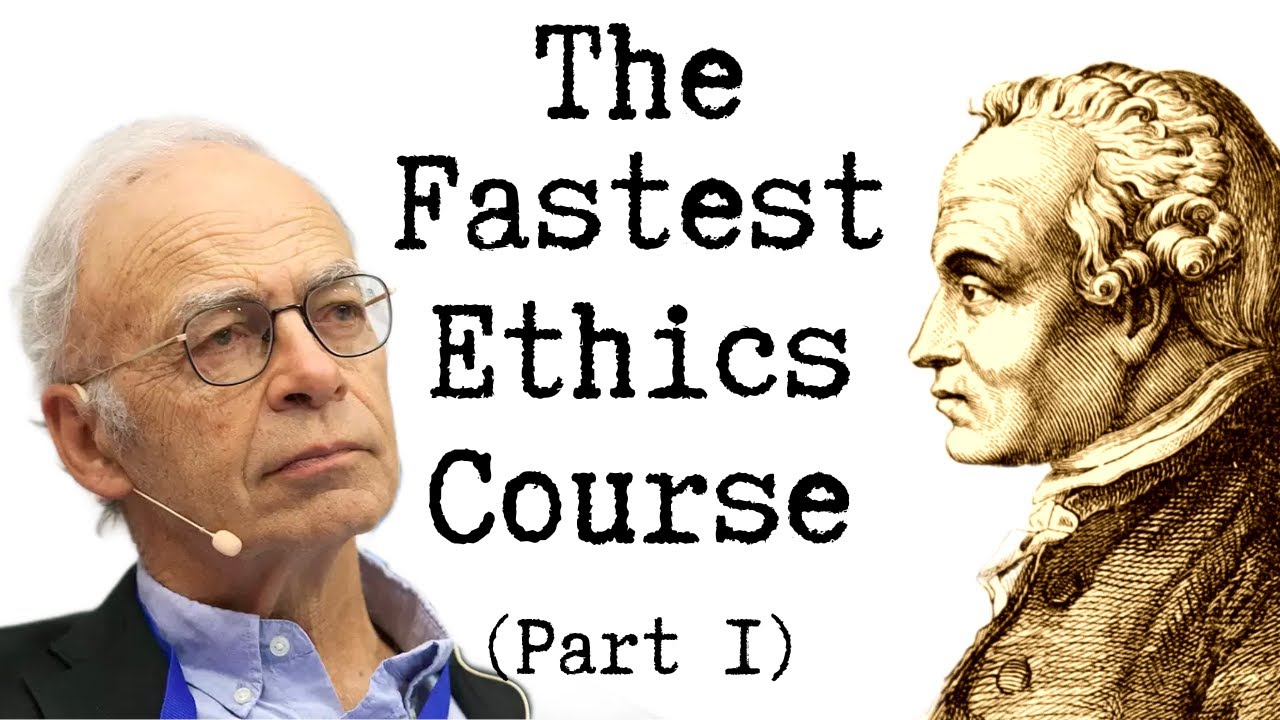
Semester Ethics Course condensed into 22mins (Part 1 of 2)
Jeffrey Kaplan
Overview
This video introduces fundamental concepts in ethics, beginning with Jeremy Bentham's utilitarianism, a consequentialist theory focused on maximizing pleasure and minimizing pain. It explores critiques of utilitarianism, such as Robert Nozick's experience machine, which questions whether pleasure is the sole intrinsic good. The video then contrasts utilitarianism with Immanuel Kant's deontological ethics, emphasizing the importance of maxims and universalizability. Finally, it touches upon Aristotle's virtue ethics, linking morality to human flourishing and rationality, and briefly introduces Peter Singer's argument for radical giving to alleviate global poverty. The presenter notes that this is the first of two parts, with future topics including Nietzsche, objective moral facts, Plato, Locke, and Hume.
Save this permanently with flashcards, quizzes, and AI chat
Chapters
- Utilitarianism, proposed by Jeremy Bentham, is a moral theory stating that the right action is the one that produces the greatest total pleasure minus pain.
- It is a form of consequentialism, meaning the morality of an action is judged solely by its outcomes.
- Bentham argued that all pleasures are equal in value; only the quantity of pleasure matters, not its source (e.g., pushpin vs. poetry).
- This 'arithmetic theory of morality' implies everyone's pleasure and pain count equally.
- Robert Nozick's 'experience machine' thought experiment challenges the idea that pleasure is the only intrinsic good.
- The machine offers a life of guaranteed pleasure, but most people would refuse to plug in, suggesting other values like control, friendship, and genuine experience matter.
- This implies that a life solely focused on maximizing pleasure might not be the best or most fulfilling life.
- Hedonism, the view that pleasure is the only intrinsic good, is questioned by these intuitions.
- Bentham's utilitarianism led to progressive conclusions, such as arguing against the death penalty for consensual homosexual acts, as they produce pleasure without causing harm.
- However, utilitarianism faces challenges with counter-examples, like H.J. McCloskey's sheriff scenario.
- In the sheriff example, framing an innocent person to prevent a deadly riot seems morally required by utilitarianism (maximizing good outcomes), but intuitively wrong.
- This highlights a potential conflict between utilitarian calculations and deeply held moral intuitions about justice and individual rights.
- Peter Singer argues in 'Famine, Affluence, and Morality' that affluent individuals are morally obligated to donate significantly to alleviate global poverty.
- He uses the 'shallow pond' analogy: just as one should save a drowning child at minimal cost, one should donate money to save lives from famine if the cost is relatively small.
- Singer dismisses common objections like proximity (we can help distant people via organizations) and the presence of others (their inaction doesn't absolve our responsibility).
- His radical conclusion is that failing to give away luxury spending money for famine relief is morally wrong.
- Immanuel Kant's moral theory, deontology, focuses on duties and rules, contrasting with utilitarianism's focus on consequences.
- The core concept is the 'maxim,' which is the underlying principle or intention behind an action.
- Kant's test for moral permissibility is whether a maxim can be willed as a universal law that everyone could follow without contradiction.
- This means actions are judged based on the intention, not the outcome; for example, lying is wrong because the maxim 'I may lie' cannot be universally applied without undermining the concept of truth-telling itself.
- Aristotle's ethics focuses on virtue and character, aiming for 'eudaimonia,' often translated as flourishing or living well.
- He argues against pleasure, honor, and wealth as the ultimate good, as they are either animalistic, dependent on others, or merely instrumental.
- Aristotle identifies the unique function of humans as rationality.
- Therefore, human flourishing involves exercising virtues (like courage, justice, temperance) in accordance with reason throughout one's life.
Key takeaways
- Moral theories offer frameworks for determining right and wrong actions, but they often rely on different foundational principles (consequences vs. duties vs. character).
- Utilitarianism's focus on maximizing pleasure and minimizing pain is intuitive but faces challenges when outcomes conflict with justice or other deeply held values.
- Thought experiments like the experience machine and the sheriff scenario are crucial tools for testing the limits and assumptions of ethical theories.
- Kantian deontology emphasizes universalizability and intention, providing a deontological alternative to consequentialism.
- Aristotle's virtue ethics links morality to human nature and flourishing, suggesting that the goal is to cultivate a virtuous character.
- Peter Singer's work compels us to consider our obligations to those suffering globally, challenging the distinction between charity and moral duty.
- Understanding different ethical perspectives is essential for navigating complex moral dilemmas.
Key terms
Test your understanding
- What is the core principle of utilitarianism, and why is it considered a form of consequentialism?
- How does Robert Nozick's experience machine challenge the hedonistic assumption that pleasure is the only intrinsic good?
- What is a 'maxim' in Kantian ethics, and how is it used to determine the morality of an action?
- According to Aristotle, why are pleasure, honor, and wealth not the ultimate good for humans?
- What is Peter Singer's main argument in 'Famine, Affluence, and Morality,' and what common objections does he address?