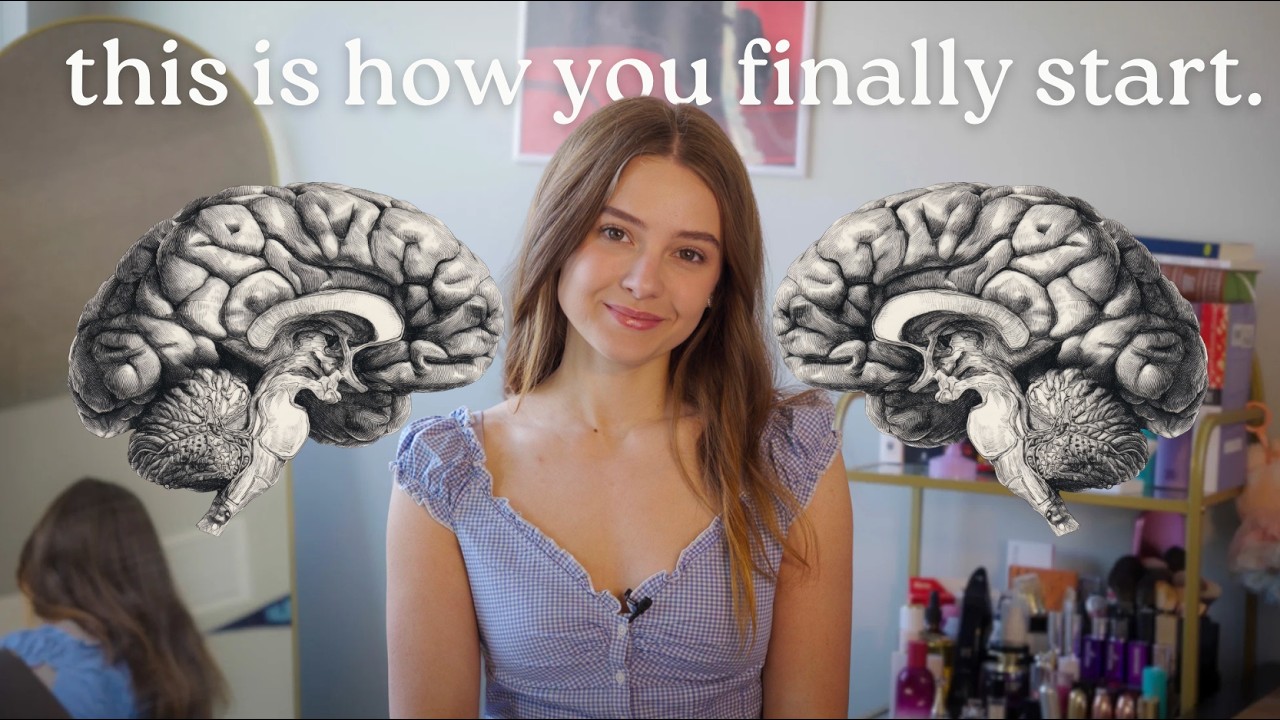
I DREAM BIG BUT DO NOTHING. the neuroscience behind why & how to fix
Olga Loiek
Overview
This video explores the neuroscience behind procrastination, reframing it not as laziness but as an emotion regulation problem. It explains how the brain's amygdala triggers negative emotions when faced with daunting tasks, leading to avoidance and temporary relief, which reinforces the behavior. The video details how this 'avoidance loop' strengthens neural pathways for procrastination. It then offers practical strategies to break this cycle, emphasizing the power of simply starting small, naming emotions, and understanding that the dread of a task is often worse than the task itself. The content also addresses how perfectionism and 'productive procrastination' can mask true avoidance.
Save this permanently with flashcards, quizzes, and AI chat
Chapters
- Procrastination is not a failure of time management but a way to avoid negative emotions like anxiety and self-doubt triggered by difficult tasks.
- When faced with an unpleasant task, the brain seeks immediate relief by engaging in distracting activities, which provides a temporary reward.
- This cycle of avoidance and relief creates an 'avoidance loop,' training the brain to default to procrastination for short-term emotional comfort.
- The amygdala, the brain's threat detector, can override the rational brain (dorsal anterior cingulate cortex) when a task is perceived as a threat, leading to an 'amygdala hijack'.
- Two brain systems compete: the amygdala (alarm system) flags tasks as threats, and the dorsal anterior cingulate cortex (action center) is supposed to overcome fear and initiate tasks.
- When procrastination occurs, the amygdala's 'threat' response wins, causing an 'amygdala hijack' where emotions override rational action.
- Repeatedly engaging in the avoidance loop physically strengthens the neural pathways for procrastination, making it a more automatic response.
- Conversely, the neural pathways for discipline weaken with disuse, like an underworked muscle.
- The most effective way to break the avoidance loop is to simply start the task, even for a very short period (5-10 minutes), without focusing on completion or perfection.
- This 'just start' strategy interrupts the cycle by preventing the build-up of dread and demonstrating that the task is often less daunting than anticipated.
- The key is to learn to interrupt the avoidance loop before it fully takes hold.
- Step 1: 'Catch and Name It' – Recognize when you are procrastinating and identify the underlying emotion (e.g., overwhelm, anxiety, fear of failure). Naming the emotion shifts you from the emotional brain to the rational brain.
- Step 2: 'Make It Stupidly Small' – Break down the task into the smallest possible action to ensure immediate progress and reduce the perceived difficulty.
- Research shows that the dread associated with starting a task is often far worse than the actual experience of doing it.
- Procrastination can be disguised as productivity to avoid guilt, a negative emotion the amygdala also seeks to escape.
- Perfectionism is a common disguise, where the fear of not meeting high standards prevents starting altogether, leading to less output even for perfectionists.
- 'Productive procrastination' involves engaging in less risky, seemingly productive tasks (like organizing or researching) instead of the high-stakes task, providing a false sense of accomplishment.
- These disguised forms of avoidance still stem from avoiding the anticipated negative feelings associated with the core task, not the task itself.
Key takeaways
- Procrastination is a coping mechanism for managing negative emotions, not a sign of laziness.
- The brain reinforces procrastination through an 'avoidance loop' that provides short-term relief, making it a learned behavior.
- Starting a task, even for a few minutes, is the most effective way to break the procrastination cycle.
- Identifying and naming the emotion driving procrastination helps regain control from the amygdala.
- Breaking tasks into extremely small, manageable steps reduces the perceived threat and makes starting easier.
- The dread of starting a task is usually worse than the actual experience of doing it.
- Be aware of 'productive procrastination' and perfectionism, as they often mask avoidance rather than genuine progress.
Key terms
Test your understanding
- How does the brain's response to negative emotions contribute to procrastination?
- What are the roles of the amygdala and the dorsal anterior cingulate cortex in the decision to procrastinate or act?
- Why is the strategy of 'just starting' for a short period effective in overcoming procrastination?
- How can identifying and naming your emotions help you break an avoidance loop?
- What is 'productive procrastination,' and how does it differ from genuine productivity?