16:35
Labtube-(Linear Algebra I)- Linear Dependence: an Equivalent Version
Asghar Ghorbanpour
Overview
This video explores the concept of linear dependence in vector sets, presenting an equivalent condition to the standard definition. It explains that a set of vectors is linearly dependent if and only if at least one vector in the set can be expressed as a linear combination of the others. The video clarifies that this doesn't mean *all* vectors can be written this way, and provides examples to illustrate these points, including the special case of sets containing the zero vector and the condition for two vectors to be linearly dependent (being parallel).
How was this?
Save this permanently with flashcards, quizzes, and AI chat
Chapters
- A set of vectors {v1, ..., vm} is linearly dependent if the zero vector can be written as a non-trivial linear combination of these vectors.
- A non-trivial linear combination means that at least one of the scalar coefficients (c1, ..., cm) is non-zero.
This is the foundational definition used to determine if a set of vectors is linearly dependent.
If there exist constants c1, ..., cm, not all zero, such that c1*v1 + c2*v2 + ... + cm*vm = 0, then the set {v1, ..., vm} is linearly dependent.
- If a set of vectors is linearly dependent, then at least one vector can be expressed as a linear combination of the other vectors.
- This is derived from the definition: if c1*v1 + ... + cm*vm = 0 and c1 is non-zero, we can rearrange to solve for v1.
- The converse is also true: if one vector is a linear combination of others, the set is linearly dependent.
This provides a more intuitive and often easier way to check for linear dependence than the original definition.
If v1 = (-c2/c1)*v2 + ... + (-cm/c1)*vm, then the set {v1, v2, ..., vm} is linearly dependent.
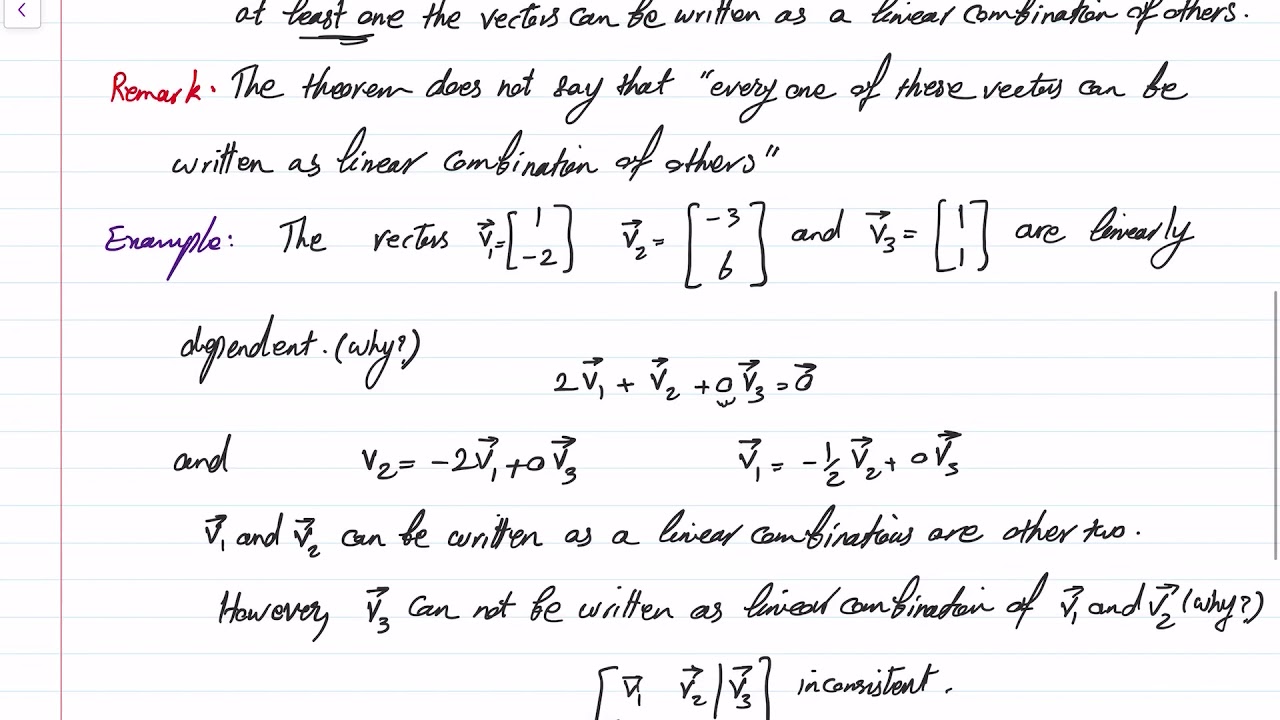
- The theorem states *at least one* vector can be written as a linear combination of others, not *all* vectors.
- A set containing the zero vector is always linearly dependent because the zero vector can be trivially expressed as a linear combination of others (e.g., 0*v1 + 0*v2 + ... + 1*0 = 0).
- For two vectors, linear dependence is equivalent to them being parallel (one is a scalar multiple of the other).
These clarifications prevent common misunderstandings and highlight special cases that simplify checking for linear dependence.
The set {v1, v2, v3} where v1 = [1, -2], v2 = [-3, 6], and v3 = [1, 1] is linearly dependent because v2 = 3*v1, but v3 cannot be written as a linear combination of v1 and v2.
- Consider a set of three vectors: v1, v2, and v3 = v1 + v2.
- Since v3 is explicitly defined as a linear combination of v1 and v2, the set {v1, v2, v3} is linearly dependent.
- This demonstrates how adding a vector that is already a combination of existing vectors immediately creates linear dependence.
This example reinforces the core concept that if any vector in a set can be formed by combining others, the entire set is linearly dependent.
The set {v1, v2, v1+v2} is linearly dependent because v1+v2 is a linear combination of v1 and v2.
Key takeaways
- Linear dependence means a set of vectors is not 'independent' in its span; one vector is redundant.
- The most useful test for linear dependence is checking if any single vector can be formed by combining the others.
- If a set of vectors includes the zero vector, it is automatically linearly dependent.
- Two vectors are linearly dependent if and only if they lie on the same line (are parallel).
- Understanding linear dependence is crucial for determining the dimension of vector spaces and the uniqueness of solutions to systems of linear equations.
Key terms
Linear DependenceLinear CombinationTrivial Linear CombinationNon-trivial Linear CombinationZero VectorScalar CoefficientParallel Vectors
Test your understanding
- What is the difference between a trivial and a non-trivial linear combination?
- How can you determine if a set of vectors is linearly dependent using the equivalent condition?
- Why is any set of vectors containing the zero vector considered linearly dependent?
- What specific condition must two vectors satisfy to be linearly dependent?
- If a set of vectors {v1, v2, v3} is linearly dependent, does it necessarily mean v3 can be written as a linear combination of v1 and v2?