13:09
Elements and atoms | Atoms, compounds, and ions | Chemistry | Khan Academy
Khan Academy
Overview
This video introduces the fundamental building blocks of matter: elements and atoms. It explains that elements are pure substances with unique properties, and the smallest unit of an element that retains those properties is an atom. Atoms themselves are composed of even smaller particles: protons, neutrons, and electrons. The number of protons defines the element, while the number of neutrons can vary (isotopes), and electrons determine how atoms interact and form chemical bonds. The video emphasizes the incredibly small size of atoms and the fundamental forces that hold them together.
How was this?
Save this permanently with flashcards, quizzes, and AI chat
Chapters
- Humans have long observed that different substances in the environment have distinct properties (e.g., color, state at a given temperature) and react differently with each other.
- Examples of substances include carbon (graphite), lead, and gold, which can exist as solids, liquids, or gases depending on conditions.
- Historically, the idea of breaking down substances led to the philosophical question of whether there's a smallest, indivisible unit that still retains the substance's properties.
Understanding that matter exists in different forms with unique properties is the first step towards comprehending the underlying structure of the universe.
Observing that gold can be solid at room temperature but melts into a liquid when heated.
- An element is defined as a pure substance with specific properties, and its most basic unit is the atom.
- An atom is the smallest particle of an element that still exhibits the properties of that element.
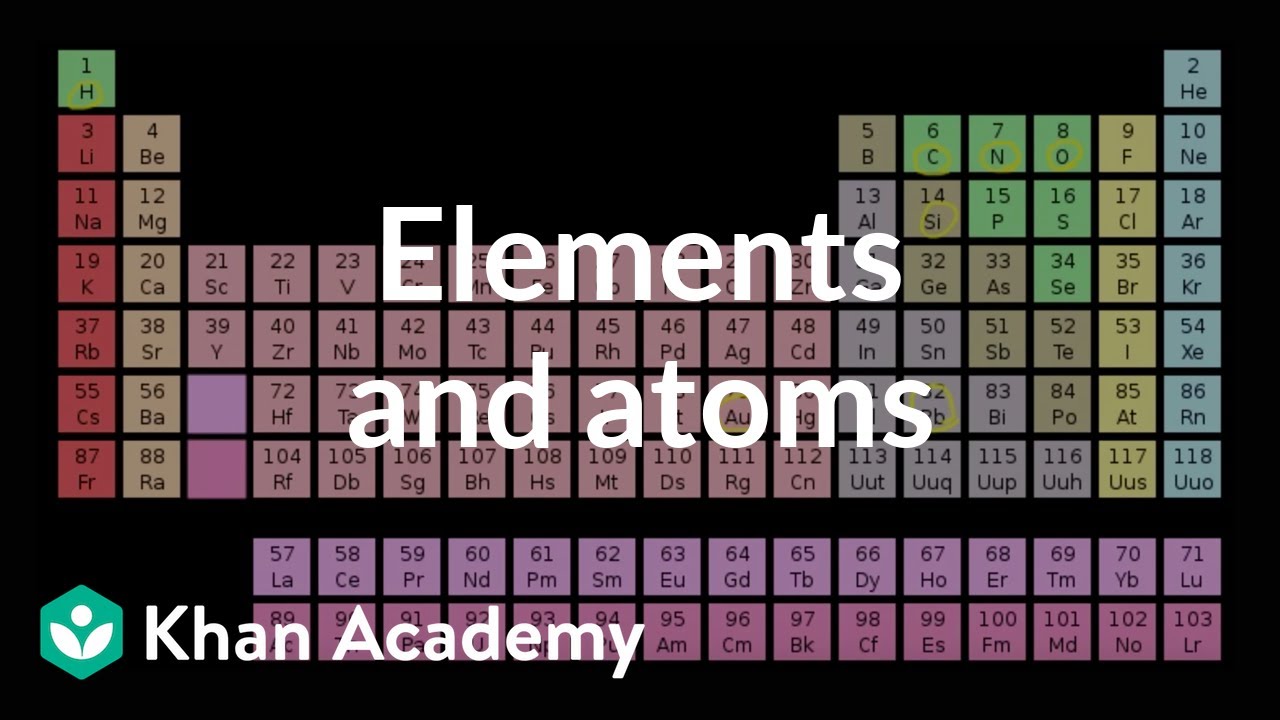
- The Periodic Table of Elements organizes all known elements, with symbols like C for carbon, Au for gold, and Pb for lead.
- Water, often thought of as an element historically, is actually a compound made of simpler elements: hydrogen and oxygen.
Defining elements and atoms provides the foundational vocabulary for understanding all of chemistry and the composition of everything around us.
A carbon atom is the smallest unit of carbon that still behaves like carbon; breaking it down further would lose its carbon properties.
- Atoms are incredibly, unimaginably small.
- Approximately one million carbon atoms could fit across the width of an average human hair.
- This scale highlights the vast number of atoms that make up even everyday objects.
Grasping the minuscule size of atoms helps appreciate the complexity and density of matter at its most fundamental level.
The width of a human hair is about one million carbon atoms wide.
- Atoms are composed of even more fundamental particles: protons, neutrons, and electrons.
- The number of protons in an atom's nucleus defines the element; this is its atomic number.
- For example, hydrogen has 1 proton, carbon has 6 protons, and oxygen has 8 protons. Changing the number of protons changes the element.
- Neutrons also reside in the nucleus and can vary in number for a given element, creating isotopes (e.g., carbon-12 vs. carbon-14).
- Electrons, which have a negative charge, are attracted to the positively charged protons in the nucleus and move around it.
Understanding the subatomic particles and their roles explains why elements are distinct and how atoms interact.
A carbon atom always has 6 protons; if it had 7 protons, it would be nitrogen.
- The nucleus, containing protons and neutrons, is at the center of the atom.
- Electrons 'buzz' or move around the nucleus, held by the attraction between their negative charge and the positive charge of the protons.
- While neutrons don't have a charge, they contribute to the atom's mass (protons + neutrons = mass number).
- The number of electrons in a neutral atom typically equals the number of protons.
- Changes in electron number (gaining or losing electrons) can give an atom a net charge, turning it into an ion, which is crucial for chemical reactions.
The arrangement and behavior of electrons dictate how atoms bond and react, forming the basis of all chemical processes.
If a carbon atom loses an electron, it goes from having 6 protons and 6 electrons (neutral) to 6 protons and 5 electrons, resulting in a net positive charge.
Key takeaways
- Elements are fundamental pure substances, and atoms are their smallest, characteristic units.
- The identity of an element is determined solely by the number of protons in its atoms.
- Atoms are composed of protons (positive), neutrons (neutral), and electrons (negative).
- The nucleus contains protons and neutrons; electrons orbit the nucleus.
- The attraction between positively charged protons and negatively charged electrons holds atoms together.
- Variations in neutron number create isotopes, while changes in electron number create charged ions.
- The behavior and arrangement of electrons are key to understanding chemical reactions and bonding.
Key terms
ElementAtomSubstancePropertiesPeriodic TableProtonNeutronElectronNucleusAtomic NumberIonIsotope
Test your understanding
- What defines an element at the atomic level?
- How does the number of protons relate to the atomic number and the identity of an element?
- What are the three main subatomic particles, and where are they located within an atom?
- Why are atoms able to hold together, and what role do electrons play in chemical interactions?
- What is the difference between an atom, an ion, and an isotope?