1:49
Patella Tendinopathy Eccentric Exercise
Sport Rehab Guide
Overview
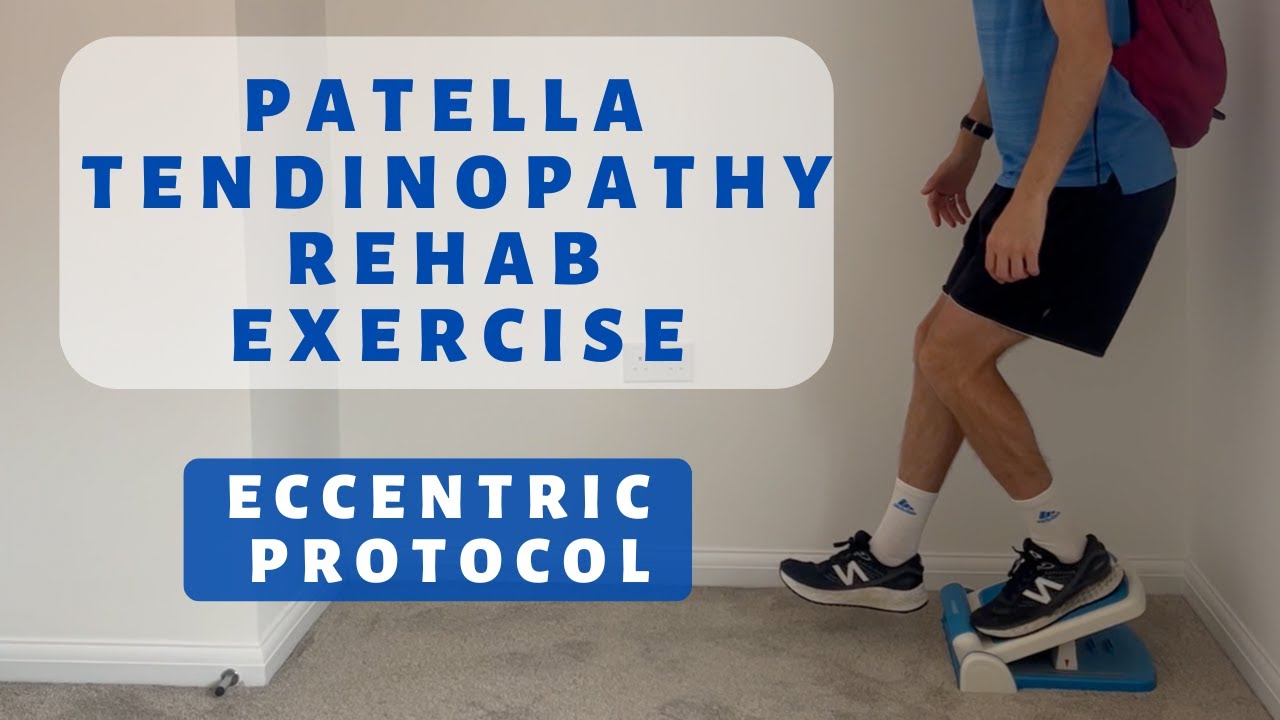
This video outlines an eccentric exercise protocol for managing patellar tendinopathy, a common knee condition. It details the use of a decline board to increase tendon load, emphasizing a slow lowering phase on the affected leg and a controlled return with both legs. The protocol suggests a specific angle, depth, and tolerance for discomfort, with recommendations for sets, repetitions, and frequency. It also presents modifications for patients who cannot tolerate the full eccentric load, including regressions to double-leg exercises and the use of isometric holds for pain relief. The importance of progressive overload through added weight is also highlighted.
How was this?
Save this permanently with flashcards, quizzes, and AI chat
Chapters
- Utilize a decline board set at a 25° angle to increase forces on the patellar tendon during the exercise.
- Perform the lowering phase slowly (2 seconds) on the affected leg, and return to the starting position using both legs for support.
- Maintain an upright spinal posture throughout the movement.
- The depth of the knee bend should be tolerated, aiming for approximately 90° if possible, and moderate discomfort is acceptable.
Proper setup and execution are crucial for effectively targeting the patellar tendon and promoting healing while managing discomfort.
Lowering the affected leg down for 2 seconds while keeping the back straight, then pushing back up with both legs.
- Traditional eccentric protocols suggest performing exercises twice daily for 15 repetitions.
- Recent findings indicate that three times a week may be sufficient if exercises are progressed appropriately and patients are pushed to their tolerance limits.
- The rehabilitation process should involve progressive overload, gradually increasing the load on the patellar tendon over time.
Understanding the appropriate frequency and progression allows for effective tendon healing and adaptation without overstressing the injured tissue.
Initially performing exercises without added weight, then progressing to holding dumbbells or wearing a backpack as the tendon tolerates more load.
- If the full eccentric exercise is not tolerated, regress to double-leg exercises.
- Incorporate static holds (isometrics) at varying knee bend angles to help manage pain.
- Isometrics are thought to act as pain analgesics, reducing discomfort associated with tendinopathy.
Modifications and pain management strategies ensure that the exercise protocol remains accessible and beneficial even for individuals with higher levels of irritability.
Holding a squat position at a comfortable depth for a set duration to alleviate pain before returning to eccentric loading.
Key takeaways
- Eccentric exercises, particularly on a decline board, are a primary approach for patellar tendinopathy management.
- The exercise involves a slow, controlled lowering phase on the affected leg and a supported return.
- Moderate discomfort is acceptable and often necessary for tendon adaptation during eccentric training.
- Progressive overload by adding weight is essential for long-term tendon strengthening.
- Isometric holds can be used as a pain-relief strategy within the rehabilitation program.
- Regressions to double-leg exercises are available for individuals who cannot tolerate the full eccentric load.
Key terms
Patellar TendinopathyEccentric ExerciseDecline BoardProgressive OverloadIsometric HoldsRehabilitation ProtocolPain Analgesics
Test your understanding
- How does using a decline board specifically benefit exercises for patellar tendinopathy?
- What is the recommended technique for the lowering and return phases of the eccentric exercise?
- Why is moderate discomfort considered acceptable during this type of exercise?
- What are two alternative strategies if a patient cannot tolerate the standard eccentric exercise?
- How can progressive overload be implemented within this exercise protocol?