Brief History of the Renaissance | 5 MINUTES
5 MINUTES
Overview
The Renaissance, spanning the 14th to 16th centuries, marked a pivotal period in European history, primarily in Italy, signifying a 'rebirth' of classical Greek and Roman arts and philosophy after the Middle Ages. Central to this era was humanism, which shifted focus from the divine to human creativity and individual achievement. Originating in Florence, fueled by trade and patronage from families like the Medici, the movement spread across Europe, amplified by Gutenberg's printing press. This period witnessed an unparalleled flourishing of the arts, with masters like Leonardo da Vinci, Michelangelo, and Raphael creating iconic works. Societally, feudalism declined, capitalism rose, and the middle class emerged, leading to questioning of the Catholic Church's authority and the Protestant Reformation. The Age of Exploration and scientific advancements, like Copernicus's heliocentric model, also defined this transformative era. While its direct impact on the masses is debated, the Renaissance's legacy of humanism and individualism profoundly shaped the modern world.
Save this permanently with flashcards, quizzes, and AI chat
Chapters
- Period in European history (14th-16th century), mainly in Italy.
- Means 'rebirth' of classical Greek and Roman arts and philosophy.
- Bridged the Middle Ages and modern civilization.
- Contrasted with the Middle Ages' perceived decline and pandemics.
- Humanism: philosophy celebrating human creativity and individual achievement.
- Inspired by classical Greek and Roman texts.
- Shifted focus from divine-centered medieval philosophy to human-centered.
- Renaissance began in Florence, Italy, due to wealth from trade.
- Theories for origins: reintroduction of classical texts (fall of Constantinople, Crusaders).
- The wealthy Medici family of Florence were key patrons of the arts.
- Movement spread to other Italian city-states and then Northern Europe.
- Gutenberg's printing press facilitated distribution of humanist texts.
- Literature became important, with works like Dante's Divine Comedy and Shakespeare's Hamlet.
- The High Renaissance saw peak artistic talent: Leonardo da Vinci, Raphael, Michelangelo.
- Art featured anatomically accurate bodies, complex poses, and emotional depth.
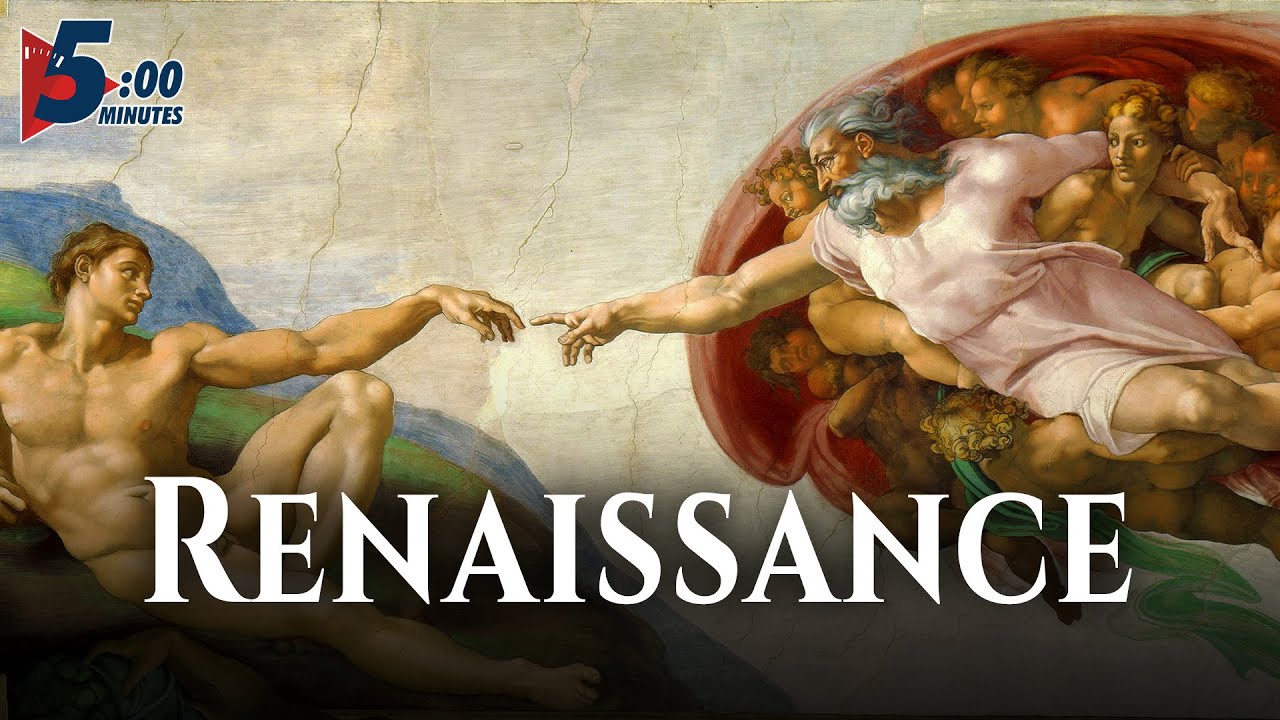
- Notable artworks include the Mona Lisa, Statue of David, and The Creation of Adam.
- Decline of feudalism and rise of a capitalist market economy.
- Emergence of a middle class due to trade and labor shortages (Black Death).
- Increased questioning of the Catholic Church's authority.
- Led to the Protestant Reformation initiated by Martin Luther.
- Age of Exploration driven by desire for new trade routes (spices, gold).
- Columbus discovered the Americas; Magellan circumnavigated the globe.
- Copernicus proposed the heliocentric model of the solar system.
- Galileo provided evidence for heliocentrism and improved the telescope.
- Renaissance waned due to invasions, Church censorship, and the Inquisition.
- Debate exists on whether it was a distinct period or an arts movement.
- Its direct impact on the majority (peasants) is questioned.
- Legacy lies in humanism and individualism influencing the modern world.
Key takeaways
- The Renaissance was a 'rebirth' of classical ideas, shifting focus from the divine to human potential.
- Humanism, emphasizing individual achievement and creativity, was central to the Renaissance mindset.
- Florence, Italy, was the birthplace, supported by trade wealth and patronage like the Medici family.
- Art and literature flourished, producing iconic works and artists that defined the era.
- The Renaissance contributed to the decline of feudalism, the rise of capitalism, and the emergence of a middle class.
- It spurred significant religious change through the Protestant Reformation and scientific inquiry during the Age of Exploration.
- While its direct impact on the masses is debated, its core values of humanism and individualism profoundly shaped Western civilization.