AI-Generated Video Summary by NoteTube
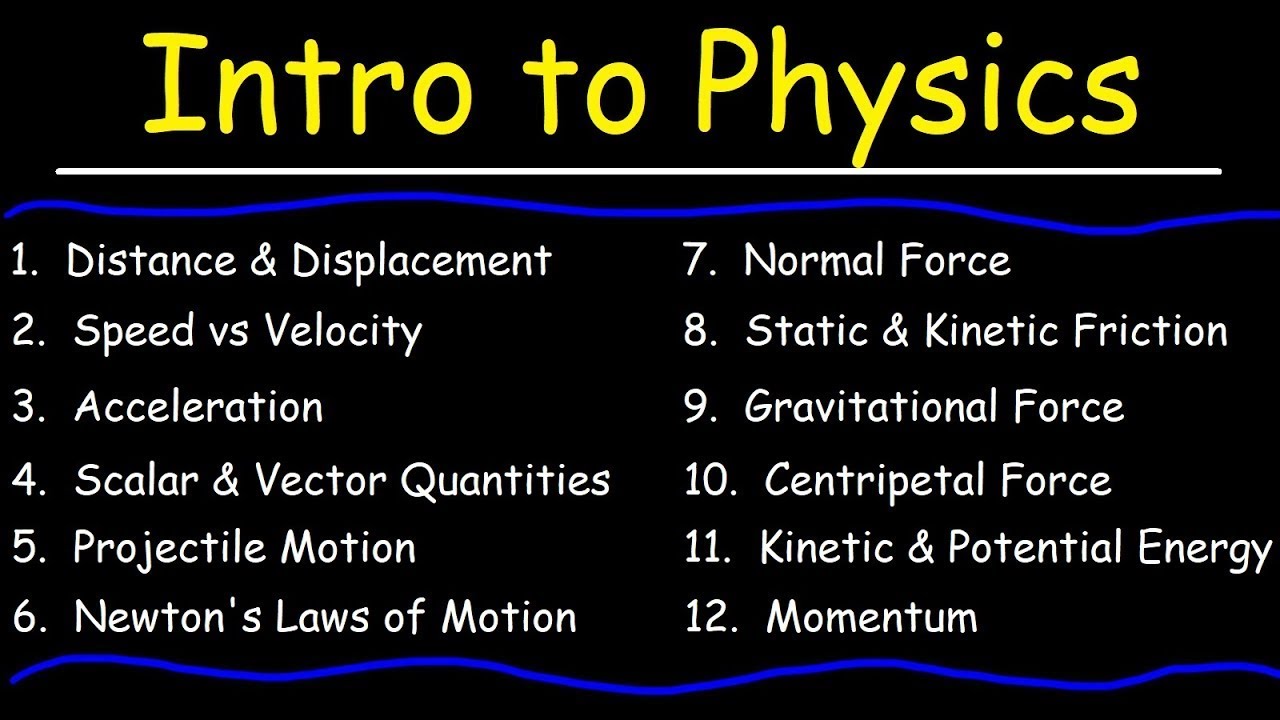
Physics - Basic Introduction
The Organic Chemistry Tutor
Overview
This video provides a foundational introduction to key physics concepts, starting with the distinction between distance and displacement, and speed and velocity. It explains scalar and vector quantities, emphasizing direction's role in displacement and velocity. The video then delves into acceleration, defining it as the rate of change of velocity and illustrating its effects with examples. It introduces projectile motion, breaking down motion into horizontal and vertical components and explaining how gravity affects only the vertical aspect. Finally, Newton's three laws of motion are presented: the law of inertia, the relationship between force, mass, and acceleration (F=ma), and the concept of action-reaction pairs, laying the groundwork for understanding how objects move and interact.
Want AI Chat, Flashcards & Quizzes from this video?
Sign Up FreeChapters
- •Distance is the total path length traveled; it's a scalar quantity (magnitude only).
- •Displacement is the change in position from start to end; it's a vector quantity (magnitude and direction).
- •Example: Walking 8m East then 3m West results in 11m distance but 5m displacement.
- •Speed is the rate of change of distance; it's a scalar quantity (always positive).
- •Velocity is the rate of change of displacement; it's a vector quantity (can be positive or negative, indicating direction).
- •Average speed = Total distance / Total time.
- •Average velocity = Total displacement / Total time.
- •Acceleration is the rate at which velocity changes.
- •Formula: a = (V_final - V_initial) / time.
- •Positive acceleration increases velocity in the direction of motion.
- •Negative acceleration decreases velocity or increases it in the opposite direction.
- •An object speeds up if acceleration and velocity have the same sign; it slows down if they have opposite signs.
- •On Earth, gravitational acceleration (g) is approximately -9.8 m/s².
- •This acceleration acts only in the vertical (y) direction.
- •It affects the vertical component of velocity (Vy) but not the horizontal component (Vx).
- •The negative sign indicates the acceleration is downwards.
- •An object moving under the influence of gravity is a projectile.
- •Projectile motion can be analyzed in two dimensions: horizontal (x) and vertical (y).
- •Horizontal velocity (Vx) is constant if air resistance is ignored (ax = 0).
- •Vertical velocity (Vy) changes due to gravitational acceleration (ay = -9.8 m/s²).
- •The path of a projectile is called its trajectory.
- •An object at rest stays at rest, and an object in motion stays in motion with the same speed and in the same direction unless acted upon by an unbalanced force.
- •This is also known as the law of inertia.
- •Forces are pushes or pulls.
- •The acceleration of an object is directly proportional to the net force acting on it and inversely proportional to its mass.
- •Formula: Net Force (F) = mass (m) × acceleration (a).
- •A larger force produces greater acceleration; a larger mass requires more force for the same acceleration.
Key Takeaways
- 1Understand the difference between distance (scalar) and displacement (vector).
- 2Distinguish between speed (scalar) and velocity (vector), noting direction is key for velocity.
- 3Acceleration is the rate of change of velocity and can cause speeding up or slowing down.
- 4Gravitational acceleration (-9.8 m/s² on Earth) affects only the vertical motion of objects.
- 5In projectile motion, horizontal velocity is constant, while vertical velocity changes due to gravity.
- 6Newton's First Law states objects maintain their state of motion unless an external force acts on them.
- 7Newton's Second Law (F=ma) quantifies the relationship between force, mass, and acceleration.
- 8Physics concepts build upon each other, with understanding of basic terms crucial for more complex topics.