31:22
Periodic Table of Elements Explained - Metals, Nonmetals, Valence Electrons, Charges
The Organic Chemistry Tutor
Overview
This video explains the periodic table of elements, focusing on the properties and classifications of metals, nonmetals, and metalloids. It details how elements are organized into groups and periods, and how their position relates to their valence electrons, tendency to form ions (cations and anions), and reactivity. The video also covers key concepts like atomic number, atomic mass, isotopes, and the forces within an atom, concluding with practical examples and quizzes on identifying element properties and symbols.
How was this?
Save this permanently with flashcards, quizzes, and AI chat
Chapters
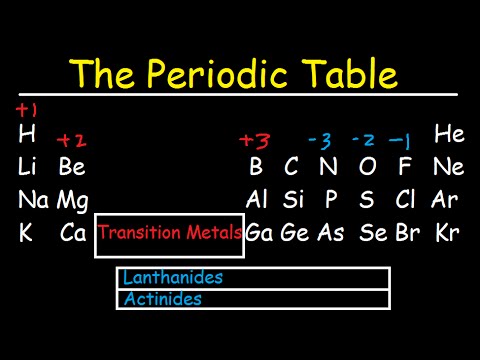
- The first column (Group 1A), known as alkali metals (except hydrogen), are highly reactive metals that readily lose one valence electron to form +1 ions (cations).
- Hydrogen, despite being in Group 1, is a nonmetal.
- Alkali metals like lithium, sodium, and potassium are very reactive, especially with water.
Understanding Group 1 elements introduces the concept of alkali metals, their high reactivity, and their tendency to form positive ions, which is fundamental to predicting chemical behavior.
Lithium, sodium, and potassium are examples of alkali metals that are very reactive.
- Group 2 elements, the alkaline earth metals, have two valence electrons and tend to lose them to form +2 ions.
- Alkaline earth metals are reactive, but less so than alkali metals.
- Transition metals (middle block) have varied reactivity and include common elements like iron, copper, silver, and gold.
This section expands on metallic properties by introducing alkaline earth metals and the diverse group of transition metals, highlighting differences in reactivity and common examples.
Zinc, copper, iron (Fe), silver (Ag), and gold (Au) are common transition metals.
- Noble gases (Group 8A/18) are chemically inert and stable because they have a full outer electron shell (2 for Helium, 8 for others).
- Halogens (Group 7A/17) have seven valence electrons and are highly reactive nonmetals that readily gain one electron to form -1 ions (anions).
- Halogens are the most reactive nonmetals.
Understanding noble gases and halogens illustrates the extremes of chemical reactivity: inertness versus high reactivity, and the nonmetal tendency to gain electrons.
Fluorine (F), chlorine (Cl), bromine (Br), and iodine (I) are halogens.
- Chalcogens (Group 6A/16) have six valence electrons and typically form -2 ions.
- Elements in Group 5A/15 have five valence electrons and typically form -3 ions.
- Elements in Group 4 (like carbon and silicon) have four valence electrons, and their charges can vary (+4 or +2 for tin and lead).
- Metalloids, found near the 'staircase' line, have properties intermediate between metals and nonmetals, with conductivity that increases with temperature.
This chapter covers elements with intermediate electron configurations and introduces metalloids, which bridge the gap between metals and nonmetals, explaining their unique properties.
Silicon (Si) and germanium (Ge) are common metalloids whose electrical conductivity increases with temperature.
- Metals, located on the left side of the periodic table, conduct heat and electricity, are malleable (can be hammered into sheets), and ductile (can be drawn into wires).
- Metals tend to lose electrons, making them electropositive and forming positive ions (cations).
- Nonmetals, on the upper right, are insulators, tend to gain electrons (electronegative), and form negative ions (anions).
- Francium is a highly electropositive metal, while Fluorine is the most electronegative element.
This section consolidates the defining characteristics of metals and nonmetals, emphasizing their contrasting physical properties and electron behavior, which dictates their chemical interactions.
Metals like potassium conduct electricity well, while nonmetals like chlorine do not.
- The atomic number (smaller number on the periodic table symbol) equals the number of protons.
- The atomic mass (larger number) is the sum of protons and neutrons.
- In a neutral atom, the number of electrons equals the number of protons (atomic number).
- Valence electrons are the electrons in the outermost energy level and determine an element's chemical behavior.
- Core electrons are those in inner energy levels.
Understanding atomic structure, including protons, neutrons, electrons, and valence electrons, is crucial for explaining why elements behave the way they do and how they form bonds.
Lithium has an atomic number of 3 (3 protons) and an atomic mass of about 7 (3 protons + 4 neutrons), with 1 valence electron.
- Ions are atoms that have gained or lost electrons, resulting in a net charge.
- To find the number of neutrons: Mass Number - Atomic Number.
- To find the number of electrons in an ion: Atomic Number - Charge.
- The strong nuclear force holds protons together in the nucleus, overcoming electrostatic repulsion.
This chapter provides the practical skills to calculate the number of protons, neutrons, and electrons for both neutral atoms and ions, essential for quantitative chemistry.
An aluminum ion (Al+3) has 13 protons, 14 neutrons, and 10 electrons (13 - 3).
- Familiarity with element symbols (e.g., Fe for iron, Au for gold) and names is essential for chemistry.
- Elements can be classified by their properties: alkali metals, alkaline earth metals, transition metals, halogens, chalcogens, noble gases, and metalloids.
- Most metals are solid at room temperature, but mercury is a liquid.
- Seven elements (H, N, O, F, Cl, Br, I) exist as diatomic molecules.
- Bromine is a liquid, while iodine is a solid at room temperature.
This section emphasizes practical application by quizzing on element symbols and properties, and introduces the physical states of elements, which are important for understanding reactions.
Carbon, in its graphite allotrope, is a nonmetal that can conduct electricity, unlike most nonmetals.
Key takeaways
- The periodic table organizes elements based on recurring properties, which are largely determined by their electron configurations.
- Metals tend to lose electrons and form positive ions (cations), while nonmetals tend to gain electrons and form negative ions (anions).
- Valence electrons are the key to an element's reactivity and the types of bonds it can form.
- Noble gases are inert due to a stable, full outer electron shell, representing a benchmark of stability.
- Metalloids exhibit properties of both metals and nonmetals, making them useful in semiconductor technology.
- Understanding atomic number, mass number, and charge allows for the calculation of protons, neutrons, and electrons in any atom or ion.
- Reactivity generally increases across a period towards the halogens and decreases across a period away from the alkali metals, and increases down a group for metals and up a group for nonmetals.
Key terms
Periodic TableAlkali MetalsAlkaline Earth MetalsTransition MetalsNoble GasesHalogensChalcogensMetalloidsValence ElectronsCationAnionAtomic NumberAtomic MassDiatomic MoleculesElectronegativityElectropositive
Test your understanding
- How does the number of valence electrons in an element influence its tendency to form positive or negative ions?
- What is the difference between an atom and an ion, and how does this difference affect the number of electrons?
- Why are noble gases considered chemically inert, and how does this relate to their electron configuration?
- Explain the unique properties of metalloids and how they differ from both metals and nonmetals.
- How can you determine the number of protons, neutrons, and electrons in an element given its symbol and position on the periodic table?