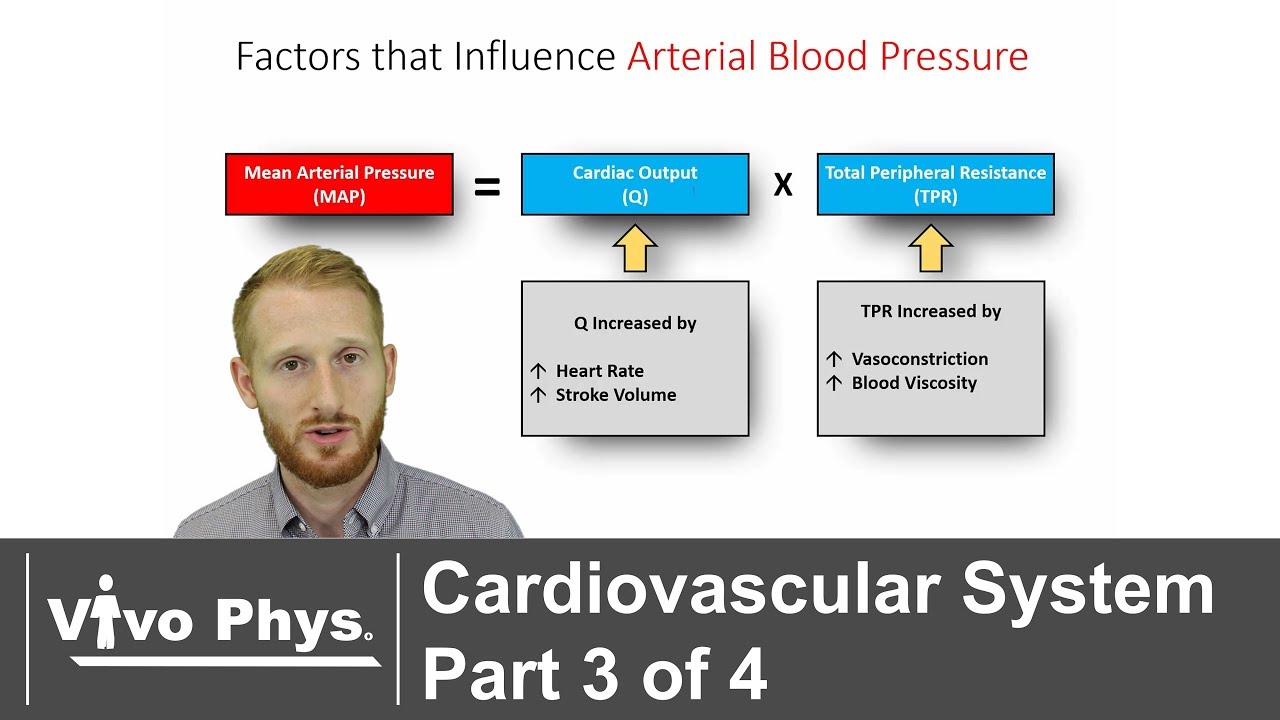
Cardiovascular System Part 3 of 4 - Blood Pressure
Vivo Phys - Evan Matthews
Overview
This video explains the concepts of blood pressure, its measurement, and its regulation. It details the cardiac cycle, distinguishing between diastole (relaxation) and systole (contraction), and how these phases affect blood flow. The video defines systolic and diastolic blood pressure, pulse pressure, and mean arterial pressure, explaining how they are measured and calculated. It also discusses hypertension, its classification, causes (primary vs. secondary), and consequences like heart and kidney damage. Finally, it explores how blood pressure changes during exercise and the mechanisms, both short-term (baroreflex) and long-term (kidneys), that control blood pressure.
Save this permanently with flashcards, quizzes, and AI chat
Chapters
- Diastole is the relaxation phase where ventricles fill with blood due to low pressure, opening AV valves.
- Systole is the contraction phase where ventricles pump blood out, closing AV valves and opening pulmonary/aortic valves.
- During systole, about two-thirds of the blood is ejected, leaving one-third behind (normal ejection fraction is typically 50-70%).
- Ventricular diastole and systole occur out of sync with atrial diastole and systole.
- Blood pressure measures the outward force of blood against artery walls, typically in the brachial artery.
- Systolic pressure (higher number, e.g., 120 mmHg) is the pressure during ventricular contraction.
- Diastolic pressure (lower number, e.g., 80 mmHg) is the pressure during ventricular relaxation.
- Pulse pressure is the difference between systolic and diastolic pressure (e.g., 120 - 80 = 40 mmHg).
- Mean arterial pressure (MAP) is a time-averaged pressure, calculated as (1/3 * systolic) + (2/3 * diastolic), reflecting the pressure driving blood flow.
- Normal blood pressure is generally below 120/80 mmHg.
- Hypertension is now classified as consistently above 130/80 mmHg (as of July 2018).
- Primary (essential) hypertension, with unknown causes, accounts for about 90% of cases.
- Secondary hypertension, caused by identifiable conditions (e.g., kidney issues, narrowed arteries), is less common but treatable.
- Uncontrolled hypertension can lead to serious health problems like left ventricular hypertrophy, atherosclerosis, heart attack, stroke, and kidney damage.
- Short-term blood pressure control is managed by the nervous system, primarily through the baroreflex.
- Baroreceptors (stretch-sensitive neurons in the aorta and carotid arteries) detect pressure changes.
- An increase in blood pressure stretches baroreceptors, signaling the brain to decrease sympathetic activity, leading to vasodilation and lower pressure.
- A decrease in blood pressure reduces stretch, increasing sympathetic activity, causing vasoconstriction and higher pressure.
- Long-term blood pressure regulation is largely controlled by the kidneys, involving the renin-angiotensin-aldosterone (RAAS) system, which affects blood volume and vessel constriction.
- During aerobic exercise, systolic blood pressure increases linearly with intensity, primarily due to increased stroke volume.
- Diastolic blood pressure generally remains stable or slightly decreases during aerobic exercise.
- Mean arterial pressure increases during aerobic exercise because systolic pressure rises while diastolic pressure does not.
- The Rate Pressure Product (Heart Rate x Systolic Blood Pressure) is an indicator of the heart's workload and oxygen demand, useful in cardiac rehabilitation.
Key takeaways
- The cardiac cycle's diastole and systole are critical for filling and emptying the heart chambers, directly influencing blood pressure.
- Blood pressure is a dynamic measure reflecting the force blood exerts on artery walls, with systolic and diastolic values providing key insights.
- Mean arterial pressure offers a more representative measure of average arterial pressure over time, crucial for tissue perfusion.
- Hypertension is a significant health risk, and its classification has recently been updated, potentially diagnosing more individuals.
- Both rapid (nervous system/baroreflex) and slow (kidneys/RAAS) mechanisms work to maintain blood pressure homeostasis.
- Aerobic exercise increases systolic blood pressure and mean arterial pressure due to increased cardiac output, while diastolic pressure is more stable.
- The Rate Pressure Product is a valuable tool for assessing cardiac workload during exercise.
Key terms
Test your understanding
- What is the primary difference between diastole and systole in the cardiac cycle, and how does each phase affect ventricular pressure?
- How are systolic and diastolic blood pressures defined, and what do they represent in terms of the heart's action and arterial wall force?
- Why is mean arterial pressure calculated using a weighted average of systolic and diastolic pressures, rather than a simple average?
- What are the main consequences of untreated hypertension on the cardiovascular system and other organs?
- How does the baroreflex respond to a sudden drop in blood pressure, and what physiological changes occur to counteract it?
- Explain how increasing aerobic exercise intensity affects systolic, diastolic, and mean arterial pressure.