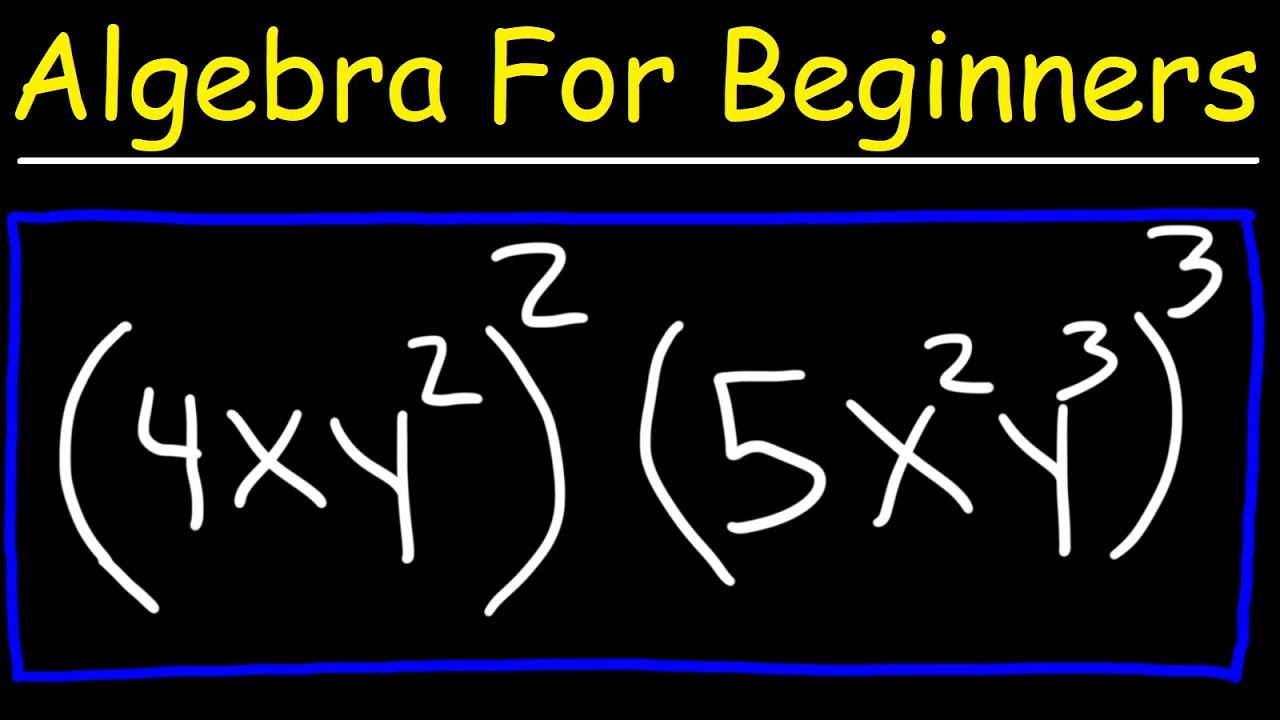
Algebra For Beginners - Basic Introduction
The Organic Chemistry Tutor
Overview
This video provides a foundational introduction to algebra, covering essential operations and concepts for beginners. It begins with adding and subtracting like terms in binomials and trinomials, then moves to multiplying and dividing monomials. The explanation of exponents, including rules for multiplication, division, and negative exponents, is detailed. The video also covers multiplying various polynomial combinations (monomial by binomial, binomial by binomial, binomial by trinomial, trinomial by trinomial) and introduces factoring techniques such as finding the greatest common factor (GCF), factoring the difference of perfect squares, and factoring by grouping. Finally, it touches upon the order of operations with exponents and distinguishing between negative bases and negative signs.
Save this permanently with flashcards, quizzes, and AI chat
Chapters
- Like terms are terms that have the same variable raised to the same power.
- To add or subtract like terms, combine their coefficients while keeping the variable part the same.
- Binomials have two terms, trinomials have three terms, and monomials have one term.
- When subtracting polynomials, distribute the negative sign to all terms in the second polynomial before combining like terms.
- When multiplying monomials with the same base, add their exponents (e.g., x^a * x^b = x^(a+b)).
- When dividing monomials with the same base, subtract the exponent of the denominator from the exponent of the numerator (e.g., x^a / x^b = x^(a-b)).
- A negative exponent indicates a reciprocal; x^-n = 1/x^n.
- When multiplying monomials, multiply the coefficients and combine the variables using exponent rules.
- When dividing monomials, divide the coefficients and combine the variables using exponent rules.
- A variable (like 'x') represents an unknown value in an equation.
- An exponent indicates how many times a base number or variable is multiplied by itself.
- Raising an exponent to another exponent involves multiplying the exponents (e.g., (x^a)^b = x^(a*b)).
- When a number or variable inside parentheses is raised to an exponent, that exponent applies to both the coefficient and the variable.
- To multiply a monomial by a binomial or trinomial, distribute the monomial to each term in the other polynomial.
- To multiply two binomials, use the FOIL method (First, Outer, Inner, Last) or distribute each term of the first binomial to each term of the second.
- When multiplying polynomials, the initial number of terms is the product of the number of terms in each polynomial.
- Always combine like terms after multiplying polynomials to simplify the expression.
- Factoring is the reverse process of multiplication; it breaks down an expression into its factors.
- The Greatest Common Factor (GCF) is the largest factor that divides into all terms of an expression; factoring out the GCF is often the first step.
- The difference of perfect squares (a^2 - b^2) factors into (a + b)(a - b).
- Factoring by grouping is used for polynomials with four terms, where pairs of terms are grouped and their GCFs are factored out.
- Anything raised to the power of zero equals one (x^0 = 1).
- Distinguish between a negative base raised to an exponent (e.g., (-2)^3 = -8) and a negative sign applied to a base (e.g., -2^3 = -8).
- When a negative sign is outside parentheses with an exponent, it remains negative if the exponent is odd and becomes positive if the exponent is even.
- When a negative sign is inside parentheses with an exponent, the sign of the result depends on the parity of the exponent.
Key takeaways
- Algebraic simplification relies on consistently applying rules for combining like terms and manipulating exponents.
- The ability to distribute a term across a sum or difference is fundamental to polynomial multiplication.
- Factoring is a critical skill that reverses multiplication, enabling equation solving and expression simplification.
- Recognizing patterns like the difference of perfect squares can significantly speed up factoring.
- Factoring by grouping is a powerful technique for polynomials with four terms.
- Understanding the behavior of negative signs and exponents is crucial for accurate calculations.
- The order of operations, especially with exponents and parentheses, must be followed precisely.
Key terms
Test your understanding
- How do you identify and combine like terms in an algebraic expression?
- What is the rule for multiplying and dividing terms with the same base and different exponents?
- Explain the process of factoring a polynomial using the difference of perfect squares formula.
- How does factoring by grouping work, and when is it applicable?
- What is the difference between (-a)^n and -a^n when n is an even or odd integer?