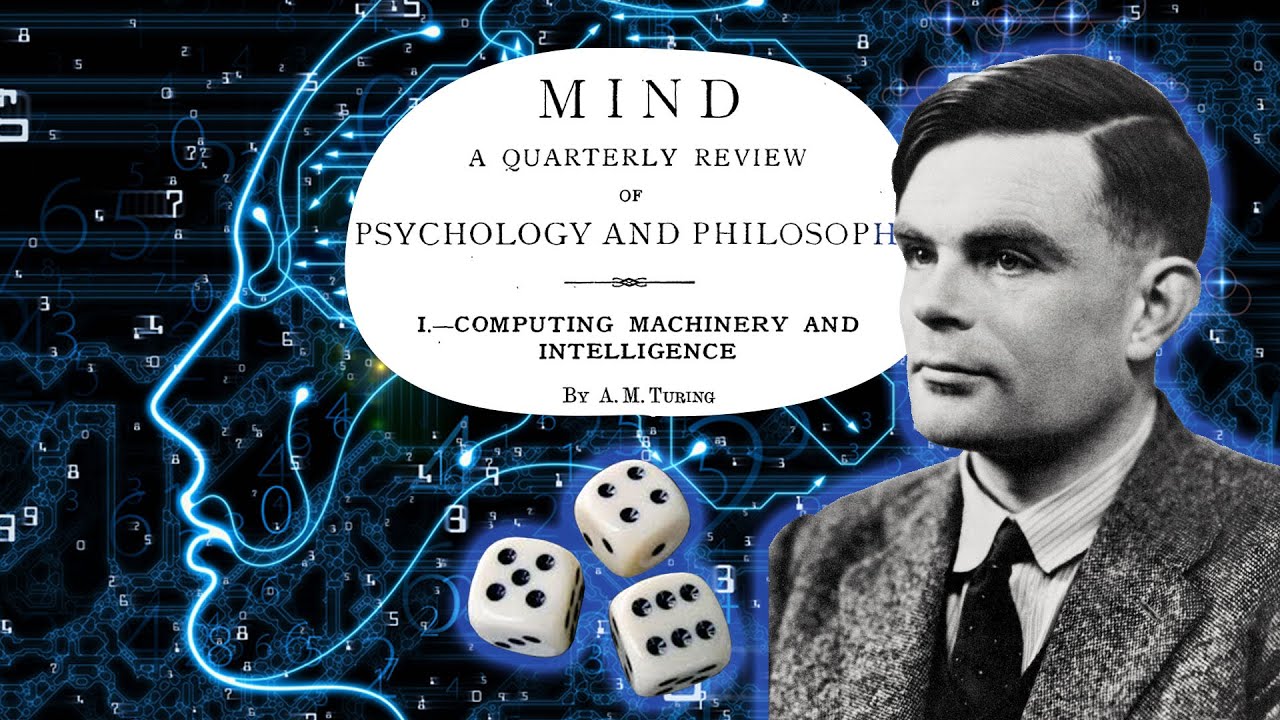
Alan Turing | Computing Machinery and Intelligence
Aleksa Gordić - The AI Epiphany
Overview
This video explores Alan Turing's seminal 1950 paper, "Computing Machinery and Intelligence," which posed the question, "Can machines think?" It introduces the Turing Test (originally the imitation game) as a method for assessing machine intelligence, where a machine attempts to fool a human interrogator into believing it is human. The video discusses Turing's definitions of 'machine' and 'thinking,' his predictions for AI development, and addresses several objections to machine intelligence, including theological, mathematical, consciousness, and learning-based arguments. It also touches upon the idea of machine learning and compares it to child development and evolution.
Save this permanently with flashcards, quizzes, and AI chat
Chapters
- Alan Turing is a foundational figure in computer science and artificial intelligence.
- His 1950 paper, "Computing Machinery and Intelligence," begins by asking, "Can machines think?"
- Turing acknowledged the difficulty in defining 'thinking' and 'intelligence'.
- The Turing Test, or imitation game, involves a judge interacting via text with a human and a machine.
- The goal for the machine is to convince the judge it is human.
- Communication is limited to text to avoid biases based on voice or appearance.
- Turing proposed a 'telepathy-proof room' to eliminate paranormal advantages for humans.
- Turing predicted that within 50 years, computers with 1 gigabit of storage could fool an average interrogator 70% of the time in a 5-minute test.
- He suggested that machines might perform actions that can be described as thinking, even if different from human thought.
- The analogy of airplanes not flying like birds, or cars not running like cheetahs, illustrates that functional equivalence doesn't require identical mechanisms.
- Turing clarified that 'machine' refers to a digital computer, not genetically engineered humans or other non-computational entities.
- Digital computers can be implemented mechanically (like Babbage's Analytical Engine), electronically, or even photonically.
- Universal Turing Machines can compute anything that is computationally solvable, forming the basis of modern computing.
- Unlike early single-purpose machines, modern digital computers are versatile and can perform many tasks.
- Turing hypothesized that the human mind could be modeled as a discrete state machine, implying thoughts are computations.
- This aligns with the idea of the mind as software running on the brain's hardware.
- This computationalist view contrasts with theories suggesting consciousness requires biological processes (e.g., Penrose's microtubule theory).
- Simple rules can generate complex phenomena, as seen in Conway's Game of Life or fractals.
- Theological objection: Machines lack souls, thus cannot think (Turing dismisses this as dogma).
- Heads in the sand objection: It's scary if machines can think, so they can't (Turing sees this as an opinion, not an argument).
- Mathematical objection: Computers have limitations (e.g., halting problem), but human intellect might too.
- Argument from consciousness: Machines lack subjective experience (Turing argues we can't prove others have consciousness either).
- Argument from various disabilities: Machines can't do X (love, learn, be creative) (Turing believes these capabilities will emerge).
- Lady Lovelace's objection: Machines only do what they are programmed to do (Turing suggests they will surprise us, though his initial example is weak).
- Turing proposed that instead of programming a full mind, we could create a 'child machine' and educate it.
- This concept foreshadows machine learning, comparing education to evolution (heredity, mutation, selection).
- He also hinted at reinforcement learning through reward and punishment mechanisms.
- John Searle's Chinese Room argument is mentioned as a later refutation of strong AI.
Key takeaways
- The Turing Test provides a behavioral benchmark for machine intelligence, focusing on indistinguishability from humans.
- Turing believed that machines could exhibit 'thinking' even if their internal processes differed from human cognition.
- The concept of a Universal Turing Machine underpins the idea that digital computers are fundamentally capable of any computable task.
- The debate around machine intelligence touches upon deep philosophical questions about consciousness, the mind-body problem, and the nature of thought.
- Many objections to machine intelligence, such as the inability to learn or be creative, have been challenged by advancements in machine learning and AI.
- Turing's vision extended beyond programming intelligence to cultivating it through learning processes, anticipating modern machine learning paradigms.
Key terms
Test your understanding
- How does the Turing Test operationalize the concept of 'thinking' in machines?
- What is the significance of Turing's definition of a 'machine' in the context of his test?
- Explain the analogy Turing used to argue that machines don't need to think like humans to be considered intelligent.
- What are two major objections Turing anticipated against machine intelligence, and how did he address them?
- How did Turing's ideas about 'child machines' and education foreshadow modern machine learning?