9:04
How does your mobile phone work? | ICT #1
Sabin Civil Engineering
Overview
This video explains the fundamental workings of a mobile phone, from how your voice is converted into digital signals and transmitted as electromagnetic waves, to the crucial role of cellular networks and mobile switching centers in connecting calls. It details how geographic areas are divided into cells, each with a tower, and how these towers communicate through wired infrastructure like optical fibers. The summary also touches upon the importance of frequency spectrum management and the evolution of mobile technology through different generations (1G to 5G), highlighting key advancements in data speed and capabilities.
How was this?
Save this permanently with flashcards, quizzes, and AI chat
Chapters
- Your voice is captured by a microphone and converted into a digital signal (zeros and ones) using sensors and integrated circuits.
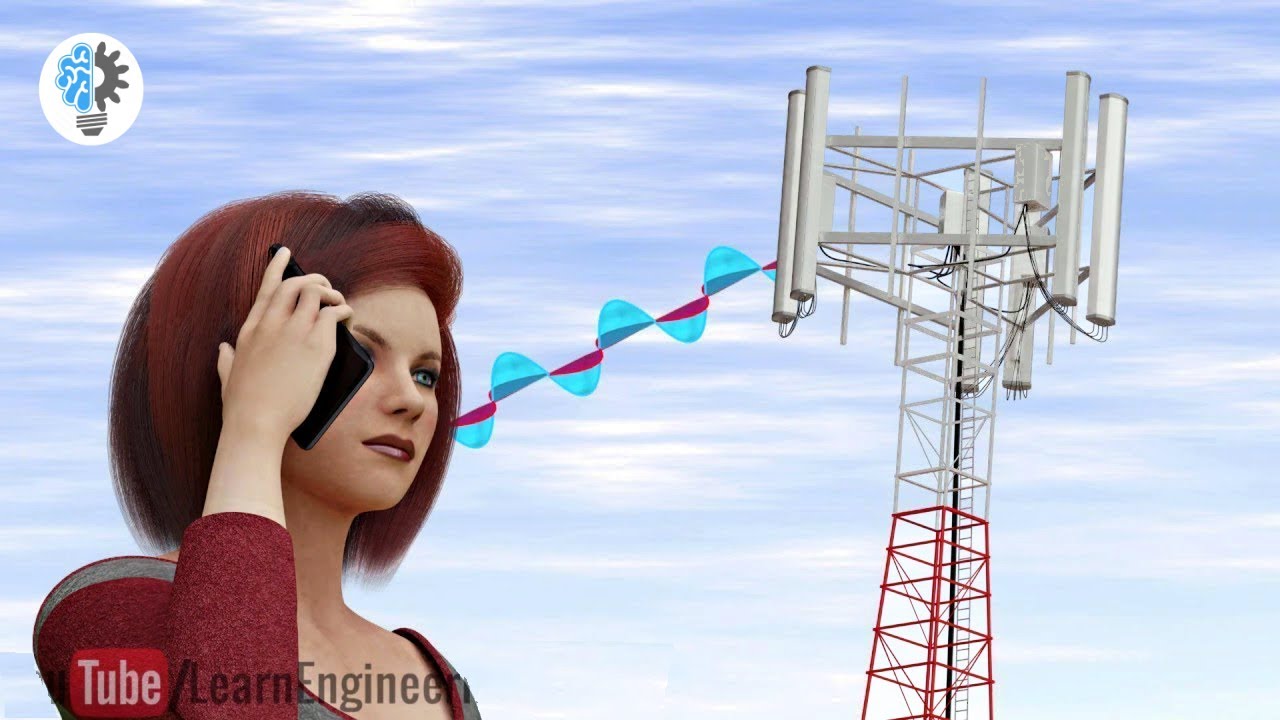
- The phone's antenna transmits this digital signal as electromagnetic waves, encoding information by altering wave characteristics like amplitude or frequency.
- Electromagnetic waves lose strength over distance due to physical objects and environmental factors, and the Earth's curvature limits their range.
Understanding this initial conversion and transmission process is key to grasping how sound becomes a signal that can travel, albeit with limitations.
Transmitting a 'zero' using a low frequency and a 'one' using a high frequency within an electromagnetic wave.
- Cellular technology divides geographic areas into hexagonal cells, each served by a tower and assigned specific frequency slots to manage signal transmission.
- Cell towers are interconnected, typically via high-speed optical fiber cables, enabling national and international communication.
- When you make a call, your phone's signal is received by a local tower, converted to light pulses for fiber transmission, processed, and then sent to the destination tower.
This chapter explains the infrastructure that overcomes the distance limitations of individual phone signals, making widespread mobile communication possible.
Optical fiber cables laid underground or under the ocean to connect cell towers across vast distances.
- Mobile Switching Centers (MSCs) act as central hubs for groups of cell towers, managing subscriber information and call routing.
- Your 'home MSC' stores your subscription details, current location, and status; a 'foreign MSC' handles your connection when you are outside your home area.
- MSCs track your location through periodic updates, tower crossings, or when your phone is turned on, ensuring calls reach the correct device.
This system is crucial for knowing where a subscriber is located within the network, enabling calls to be directed accurately even when users are mobile.
When Emma calls John, her home MSC forwards the request to John's home MSC, which then determines John's current location (whether home or foreign MSC) to connect the call.
- The limited frequency spectrum is divided into ranges allocated to individual subscribers for digital communication.
- Efficient use of this limited spectrum is achieved through frequency slot distribution among different cell towers.
- Multiple access techniques further optimize spectrum use by sharing allocated frequency slots among all active users within a cell.
Understanding frequency management highlights the engineering challenges and solutions required to support billions of users on a finite resource.
Allocating different frequency ranges to different cell towers and then sharing those frequencies among users within a single cell.
- 1G was analog, offering basic mobile voice calls but suffering from poor quality and security.
- 2G introduced digital signals, improving quality and security, and enabled SMS and basic internet browsing using technologies like TDMA/CDMA.
- 3G increased data transfer speeds significantly (up to 2 Mbps) with WCDMA, facilitating richer applications like video and GPS, and paving the way for smartphones.
- 4G achieved much higher speeds (20-100 Mbps) using OFDMA and MIMO, suitable for high-definition streaming and advanced mobile internet.
- 5G aims for even greater speed and connectivity, supporting the Internet of Things (IoT) with technologies like enhanced MIMO and millimeter waves.
This progression shows how mobile technology has continuously evolved to meet increasing demands for speed, data capacity, and new applications.
The jump from 3G, which enabled video calls, to 4G, which made streaming high-definition movies on your phone seamless.
Key takeaways
- Mobile phones convert voice into digital signals (zeros and ones) that are transmitted wirelessly as electromagnetic waves.
- Cellular networks use interconnected towers divided into cells to extend signal range and manage communication.
- Mobile Switching Centers are essential for tracking user locations and routing calls accurately across the network.
- Efficient management of the limited radio frequency spectrum is critical for supporting a vast number of mobile users.
- Each generation of mobile technology (1G through 5G) represents significant improvements in data speed, capacity, and capabilities.
- Mobile communication relies on a combination of wireless transmission (phone to tower) and wired infrastructure (towers to network).
Key terms
Electromagnetic wavesCellular technologyCell towersOptical fiber cablesMobile Switching Center (MSC)Frequency spectrumAnalog signalDigital signal1G2G3G4G5GMIMO
Test your understanding
- How does your mobile phone convert your voice into a signal that can be transmitted?
- What problem do cell towers and cellular technology solve in mobile communication?
- What is the role of a Mobile Switching Center (MSC) in connecting a call?
- Why is the management of the frequency spectrum important for mobile phone networks?
- What are the key differences and advancements between 3G, 4G, and 5G technologies?