7:46
What are the Key Features of Democracy?
Civics Academy SA
Overview
This video outlines six key features that define a successful democracy. It explains that democracy empowers ordinary people by giving them a say in governance through elected representatives. The core features discussed are respect for basic human rights, a multi-party system with political tolerance, a democratic voting system with universal suffrage and fair elections, adherence to the rule of law where no one is above it, democratic governance characterized by separation of powers and checks and balances, and active citizen participation. Upholding these features leads to a society that values freedom, justice, and accountability.
How was this?
Save this permanently with flashcards, quizzes, and AI chat
Chapters
- Democracy is a system of government where citizens have a significant say in who governs and how.
- It is typically exercised through elected representatives, allowing ordinary people to influence national decisions.
- While diverse, all democracies share fundamental principles for effective governance.
Understanding the fundamental purpose of democracy helps learners appreciate why specific features are crucial for its success and for empowering citizens.
The video mentions that democracy allows ordinary people a decisive say in who governs a country and how they govern it.
- A cornerstone of democracy is the protection of fundamental human rights, often enshrined in a constitution.
- These rights include freedom of speech, assembly, religion, the right to vote, and equality.
- These rights are essential for citizens to participate freely and safely in the democratic process.
This feature ensures that individuals can express themselves and participate in civic life without fear, which is vital for a functioning democracy.
Examples of basic rights include the right to vote, freedom of speech and assembly, and freedom of religion.
- A multi-party system, or at least a two-party system, provides voters with genuine choices and diverse representation.
- Strong opposition parties hold the ruling party accountable by monitoring and debating their actions.
- Political tolerance is essential, meaning accepting and respecting differing viewpoints and allowing free expression as long as rights are not infringed.
This feature fosters a healthy political environment where diverse ideas can be debated, and power is checked, preventing the concentration of authority.
Political tolerance means accepting and respecting the views of individuals and groups whose viewpoints differ from one's own.
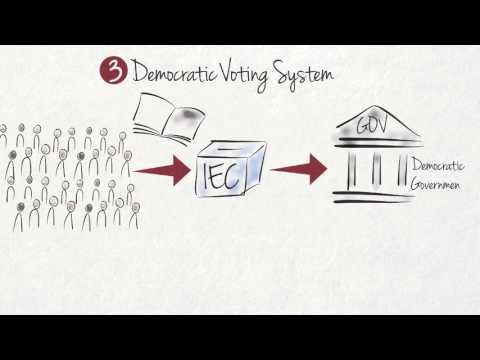
- Democratic voting systems rely on universal suffrage, ensuring all adult citizens have an equal right to vote.
- Elections must be held at regular, known intervals and must be free and fair.
- The principle of majority rule dictates that the party or coalition with the most votes forms the government.
A fair and accessible voting system is the primary mechanism through which citizens exercise their power and choose their representatives.
Universal suffrage means that all adult citizens have an equal right to vote in a country's elections.
- The rule of law means that all individuals and public officials are subject to and accountable under the law.
- Power can only be exercised if authorized by clear, publicized, and stable laws, not arbitrarily.
- Independent courts are crucial for upholding the rule of law, protecting citizens from abuse of power, and ensuring laws are applied fairly.
This principle guarantees that government actions are predictable and lawful, protecting citizens' rights and ensuring a stable society.
Public officials cannot act arbitrarily and must act in terms of laws that are clear, publicized, stable, and evenly applied.
- Democratic governance involves organizing government functions through a separation of powers into executive, legislative, and judicial branches.
- Each branch acts as a check on the others, creating a balance of power to prevent any one branch from becoming too dominant.
- Transparency, responsiveness, effectiveness, and efficiency are vital for accountability to the electorate.
The separation of powers and checks and balances are designed to prevent tyranny and ensure that the government serves the people effectively and accountably.
The legislature passes laws, the executive implements them, and the judiciary interprets and enforces them, with each branch checking the others.
- Democracy thrives on active citizen participation beyond just voting.
- Individuals can contribute by joining political parties, monitoring government performance, and mobilizing others on important issues.
- Active citizens are essential for shaping the country's future and upholding democratic values.
This feature highlights that democracy is a shared responsibility, requiring ongoing engagement from citizens to remain vibrant and effective.
Taking part in elections by voting or joining a political party are practical ways citizens can participate.
Key takeaways
- Democracy empowers citizens by giving them a voice in their government through representation.
- Fundamental human rights are the bedrock upon which democratic societies are built, enabling participation and freedom.
- A multi-party system, coupled with tolerance for diverse views, ensures accountability and robust political debate.
- Fair elections with universal suffrage and majority rule are the primary tools for citizen selection of leaders.
- The rule of law ensures that everyone, including government officials, is accountable to clear and consistently applied laws.
- Separation of powers and checks and balances prevent the abuse of governmental authority.
- Active and informed citizen participation is crucial for the health and success of any democracy.
Key terms
DemocracyElected RepresentativesHuman RightsFreedom of SpeechMulti-party SystemPolitical ToleranceUniversal SuffrageRule of LawSeparation of PowersCitizen Participation
Test your understanding
- What is the fundamental difference between democracy and other forms of government regarding citizen influence?
- Why is political tolerance a necessary component of a multi-party system in a democracy?
- How does the principle of universal suffrage contribute to the fairness of a democratic voting system?
- What is the role of independent courts in upholding the rule of law within a democracy?
- Explain how the separation of powers between the executive, legislative, and judicial branches prevents the abuse of power.