These 7 Daily Habits Are Reshaping Your Brain Right Now
Simple Ways of Life
Overview
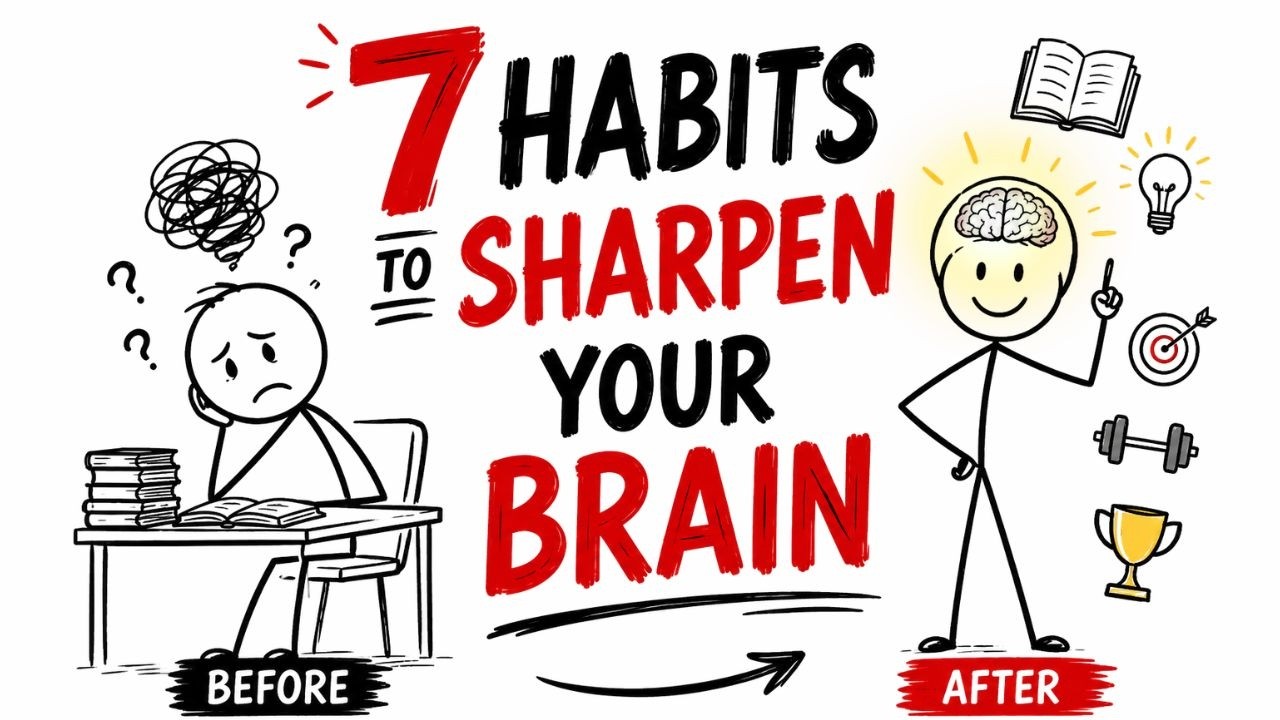
This video explores seven neuroscience-backed daily habits that actively reshape your brain, enhancing focus, memory, emotional intelligence, and discipline. It debunks the myth of fixed intelligence, emphasizing that consistent actions strengthen specific neural pathways, literally altering brain structure. The habits discussed include training focus, prioritizing sleep, engaging in challenging reading, exercising, managing dopamine intake, developing emotional control, and prioritizing consistency over motivation. By adopting these practices, individuals can move from a brain adapted to distraction and overstimulation to one that is sharp, resilient, and capable of achieving greater success and life transformation.
Save this permanently with flashcards, quizzes, and AI chat
Chapters
- Your brain's structure and capabilities are not fixed; they change based on your daily actions and habits.
- Consistent behaviors strengthen specific neural pathways, while neglecting others leads to their weakening.
- A lifestyle filled with distractions, poor sleep, and lack of discipline leads to a brain adapted for distraction.
- Conversely, a life of focus, learning, emotional control, and intentional habits builds a stronger, more resilient brain.
- Declining attention spans are a major cause of perceived mental weakness, impacting productivity, memory, and emotional regulation.
- Constant task-switching incurs a 'switching cost,' reducing efficiency and causing mental fatigue.
- Practice focused work for short, uninterrupted periods (e.g., 20 minutes) daily, eliminating distractions like phones and notifications.
- This focused practice strengthens concentration, leading to clearer thinking, faster learning, improved memory, and increased calmness.
- Sleep is essential for brain maintenance, including waste removal, memory consolidation, emotional regulation, and neural repair.
- Insufficient sleep impairs focus, memory, emotional intelligence, decision-making, and self-discipline.
- Sleep deprivation weakens the prefrontal cortex, responsible for self-control, leading to impulsive behavior.
- Establish consistent sleep schedules, reduce pre-bed screen time, and avoid late-night stimulation for optimal brain function.
- Much of modern content is designed for passive entertainment, leading to shallow thinking.
- Reading actively engages the brain, improving memory, focus, comprehension, imagination, and analytical skills.
- Choose material slightly above your current comfort level to stimulate deeper thinking.
- Actively reflect on what you read by asking questions about the main ideas and real-world applications to build critical thinking.
- Exercise significantly boosts brain health by increasing blood flow, promoting the release of memory and learning chemicals, and reducing stress hormones.
- Consistent, moderate physical activity (e.g., 20-30 minutes daily) improves mood, focus, and cognitive performance.
- Exercise builds self-discipline by training you to act despite a lack of motivation, a skill transferable to all life areas.
- Regular movement strengthens the connection between physical action and mental resolve.
- Modern life bombards us with constant, high-dopamine stimuli (social media, fast-paced content), making normal activities feel boring.
- This overstimulation leads to a brain adapted for instant gratification, hindering focus and motivation for less stimulating tasks.
- Reduce unnecessary dopamine intake by setting boundaries: limit constant scrolling, allow silence, take walks without devices, and work without constant tab-switching.
- Reducing overstimulation allows focus to return, motivation to stabilize, and simple activities to become enjoyable again.
- Emotional stability is as crucial as intelligence for success; uncontrolled emotions like anger or fear can derail opportunities.
- Strong emotional regulation improves decision-making and reduces mental chaos.
- Practice pausing before reacting to emotional triggers to allow rational thought to engage.
- Observe emotions non-judgmentally (e.g., 'I notice anger' instead of 'I am angry') to create mental distance and reduce reactivity.
- Relying on motivation is unsustainable because it fluctuates; habits must be built on consistency.
- The brain changes through repetition, strengthening neural pathways with small, repeated actions.
- Consistent daily efforts, even small ones, are more effective for brain training than infrequent, intense bursts.
- Consistency builds identity and makes discipline feel more natural, leading to lasting transformation.
Key takeaways
- Your brain is constantly adapting; your daily habits are actively shaping its structure and function.
- Focus is a trainable skill that underpins memory, learning, and emotional regulation.
- Quality sleep is non-negotiable for brain health, impacting cognitive performance and emotional stability.
- Engaging with challenging content and actively reflecting on it builds critical thinking skills.
- Exercise benefits the brain as much as the body, improving cognition and fostering self-discipline.
- Reducing constant digital stimulation is crucial for regaining focus and making everyday tasks feel rewarding.
- Emotional regulation enhances decision-making and mental clarity, requiring conscious practice.
- Sustainable progress comes from consistent daily actions, not from sporadic bursts of motivation.
Key terms
Test your understanding
- How does consistent practice of focused work physically change your brain?
- Why is sleep considered essential brain maintenance rather than just rest?
- What is the 'switching cost' of multitasking, and how does it affect cognitive performance?
- How can deliberately consuming slightly challenging reading material improve your thinking skills?
- Explain the relationship between physical exercise, self-discipline, and cognitive function.