1:12:09
EDEXCEL Topic 17 Organic Chemistry II REVISION
Allery Chemistry
Overview
This video covers key concepts in Edexcel's Organic Chemistry Topic 17, focusing on chirality, carbonyl compounds, and carboxylic acids. It explains optical isomerism, including enantiomers and chiral centers, and how plane-polarized light is used to detect them. The video also details the formation and properties of aldehydes and ketones, their distinction using chemical tests, and their reduction. Finally, it delves into carboxylic acids, their naming, properties, synthesis, and reactions, including esterification and hydrolysis, and introduces polyesters as an application of ester chemistry.
How was this?
Save this permanently with flashcards, quizzes, and AI chat
Chapters
- Optical isomerism is a type of stereoisomerism where molecules have the same structural formula but different spatial arrangements of atoms.
- Optical isomers are non-superimposable mirror images of each other, called enantiomers.
- Chirality, the property of having a non-superimposable mirror image, arises from a chiral center, typically a carbon atom bonded to four different groups.
- Optically active compounds rotate plane-polarized light; one enantiomer rotates it clockwise, and the other rotates it counter-clockwise by the same degree.
Understanding optical isomerism is crucial because different enantiomers can have vastly different biological effects, as seen in pharmaceuticals, making it vital for drug development and safety.
Human hands serve as a non-superimposable mirror image analogy for enantiomers, illustrating the concept of chirality.
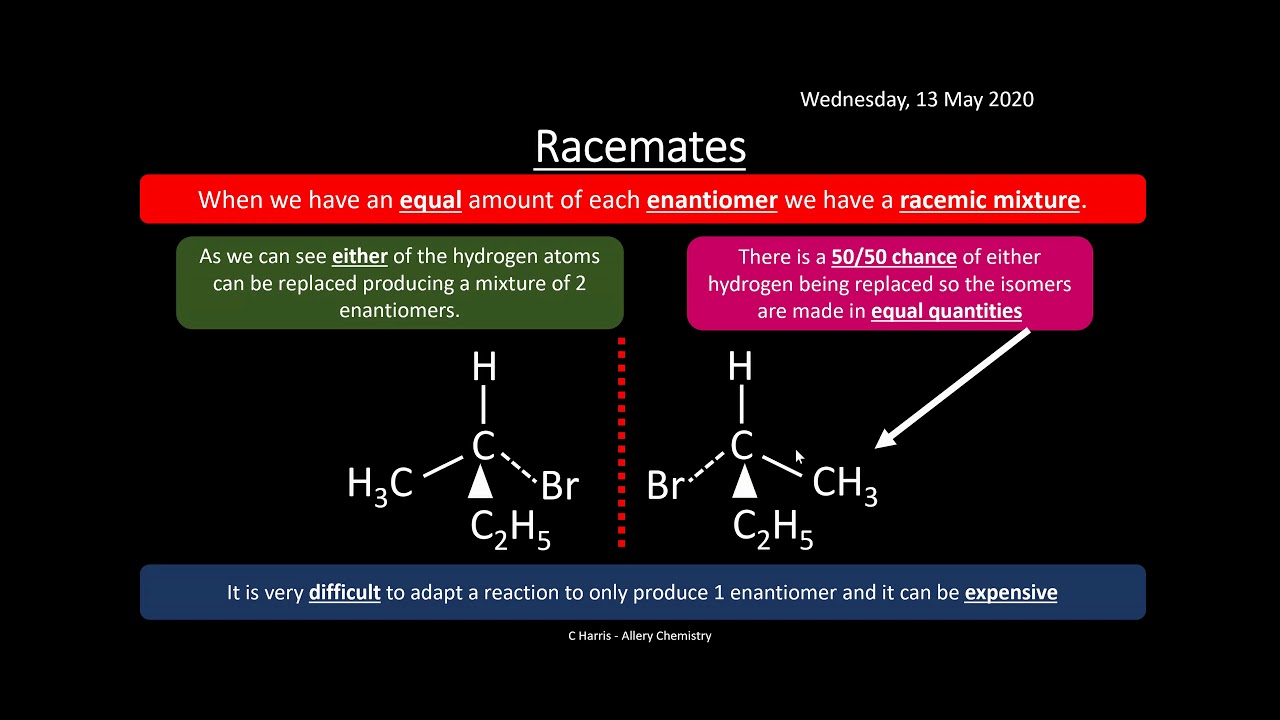
- A racemic mixture contains equal amounts of two enantiomers, resulting in no net rotation of plane-polarized light as the rotations cancel each other out.
- Racemic mixtures are often formed in reactions involving a chiral center where a planar intermediate, like a carbocation in SN1 reactions, can be attacked from either side with equal probability.
- SN2 reactions, typically involving primary haloalkanes, produce a single enantiomer (or invert the configuration) because the nucleophile attacks from the opposite side of the leaving group in a single step.
- The planar nature of carbocations in SN1 reactions leads to a racemic mixture because the nucleophile can attack from either the top or bottom face with equal probability.
Distinguishing between SN1 and SN2 reaction mechanisms is important because they lead to different stereochemical outcomes, affecting whether a single enantiomer or a racemic mixture is produced.
In an SN1 reaction, a nucleophile (Y-) can attack a planar carbocation intermediate from either the top or bottom, leading to a 50/50 mixture of enantiomers (a racemic mixture).
- Aldehydes and ketones are characterized by the carbonyl group (C=O).
- Aldehydes have the carbonyl group at the end of a carbon chain and are named with the suffix '-al' (e.g., propanal).
- Ketones have the carbonyl group within the carbon chain and are named with the suffix '-one', often requiring a number to indicate the carbonyl group's position (e.g., pentan-2-one).
- Aldehydes and ketones have lower boiling points than alcohols of similar molecular mass due to weaker intermolecular forces (dipole-dipole and London forces, lacking hydrogen bonding between themselves).
Understanding the structural differences between aldehydes and ketones allows for their identification and prediction of their physical properties, such as boiling point and solubility.
Propanal (an aldehyde) has the carbonyl group on the terminal carbon, while propanone (a ketone) has it on the middle carbon.
- Acidified potassium dichromate (K2Cr2O7) is a mild oxidizing agent that oxidizes aldehydes to carboxylic acids but does not oxidize ketones, causing a color change from orange to green.
- Tollens' reagent (a solution of diamminesilver(I) complex) oxidizes aldehydes to carboxylate ions, forming a silver mirror on the test tube, while ketones remain unchanged.
- Fehling's or Benedict's solution (containing copper(II) ions) oxidizes aldehydes to carboxylate ions, producing a brick-red precipitate of copper(I) oxide, while ketones do not react.
- These tests are useful for distinguishing between aldehydes and ketones based on observable color changes or precipitate formation.
These specific chemical tests provide a practical way to differentiate between aldehydes and ketones in a laboratory setting, crucial for qualitative analysis.
When Tollens' reagent is added to an aldehyde and warmed, a silver mirror forms on the inside of the test tube, indicating a positive test.
- Aldehydes and ketones can be reduced to primary and secondary alcohols, respectively, using reducing agents like sodium borohydride (NaBH4) or lithium aluminum hydride (LiAlH4), often represented by [H].
- Potassium cyanide (KCN) reacts with aldehydes and ketones via nucleophilic addition to form hydroxy nitriles.
- This reaction with cyanide is crucial as it can create a new chiral center, potentially leading to enantiomers if the starting carbonyl compound is unsymmetrical (except for methanol).
- Brady's reagent (2,4-dinitrophenylhydrazine) reacts with both aldehydes and ketones to form a precipitate, used to identify the presence of a carbonyl group.
The reactions of carbonyl compounds, such as reduction and nucleophilic addition, are fundamental transformations in organic synthesis, allowing for the creation of new functional groups and complex molecules.
The reaction of a ketone with potassium cyanide and acid produces a hydroxy nitrile, which contains both a hydroxyl (-OH) group and a nitrile (-CN) group.
- Carboxylic acids contain the carboxyl group (-COOH), which combines a carbonyl (C=O) and a hydroxyl (-OH) group.
- They are named by adding '-oic acid' to the parent alkane name, with the carboxyl carbon always designated as carbon 1.
- Carboxylic acids are weak acids, partially dissociating in water to form carboxylate ions and H+ ions.
- They can form hydrogen bonds with water, making smaller carboxylic acids soluble, and can also form dimers through hydrogen bonding between themselves, increasing their boiling points.
- Carboxylic acids can be synthesized by oxidizing primary alcohols and aldehydes, or by the hydrolysis of nitriles.
Carboxylic acids are versatile compounds that act as weak acids and can be synthesized through various routes, forming the basis for many other organic compounds.
Ethanoic acid (acetic acid) is a common carboxylic acid, formed by the oxidation of ethanol.
- Carboxylic acids react with carbonates and hydrogen carbonates to produce salts, carbon dioxide, and water.
- They react with strong bases like sodium hydroxide to form salts and water.
- Carboxylic acids can be reduced to primary alcohols using strong reducing agents like LiAlH4.
- Reaction with phosphorus pentachloride (PCl5) converts carboxylic acids into acyl chlorides.
- Esterification, the reaction between a carboxylic acid and an alcohol (often catalyzed by acid), produces an ester and water.
The diverse reactions of carboxylic acids, including salt formation, reduction, and esterification, highlight their importance as building blocks in organic chemistry and industry.
Reacting ethanoic acid with sodium carbonate produces sodium ethanoate, water, and carbon dioxide.
- Esters contain the ester functional group (-COO-) and are formed from the reaction of carboxylic acids with alcohols (esterification).
- Esters are named based on the alcohol and carboxylic acid used: the alkyl group from the alcohol comes first, followed by the carboxylate name from the acid (e.g., ethyl propanoate).
- Esters are commonly used as solvents, in perfumes, and as flavorings due to their often sweet smell and volatility.
- Polyesters are polymers formed by the esterification reaction between dicarboxylic acids and diols, creating repeating ester linkages.
- Hydrolysis (acid or base catalyzed) can break down esters back into carboxylic acids and alcohols.
Esters are widely used in consumer products for their pleasant aromas and solvent properties, while polyesters are essential materials in the plastics and textile industries.
Terylene (PET) is a common polyester made from benzene-1,4-dicarboxylic acid and ethane-1,2-diol, used in plastic bottles and clothing.
Key takeaways
- Chirality is a fundamental property in organic chemistry, leading to enantiomers that can have different biological and chemical effects.
- The distinction between SN1 and SN2 reaction mechanisms is critical for predicting the stereochemical outcome of reactions.
- Aldehydes and ketones can be reliably distinguished from each other and identified using specific chemical reagents like acidified dichromate, Tollens', or Fehling's solutions.
- Carboxylic acids exhibit weak acidic properties and undergo characteristic reactions such as salt formation, reduction, and esterification.
- Esters are formed through esterification and have widespread applications in fragrances, flavors, and as solvents, while polyesters are important synthetic polymers.
- Understanding the structure-property relationships of organic functional groups is key to predicting their behavior and applications.
- The ability to name and draw organic compounds, including stereoisomers, is a core skill in organic chemistry.
Key terms
Chiral centerEnantiomersNon-superimposable mirror imagesPlane-polarized lightRacemic mixtureSN1 reactionSN2 reactionCarbocationAldehydeKetoneCarbonyl groupTollens' reagentFehling's solutionCarboxylic acidEsterificationEsterHydrolysisPolyesterNucleophilic addition
Test your understanding
- What is the defining characteristic of a chiral center, and how does it lead to optical isomerism?
- How can plane-polarized light be used to distinguish between enantiomers and a racemic mixture?
- What are the key differences in structure and reactivity between aldehydes and ketones, and how can these differences be exploited in chemical tests?
- Describe the process of esterification and explain how the resulting ester is named.
- Why are SN1 reactions more likely to produce racemic mixtures compared to SN2 reactions?