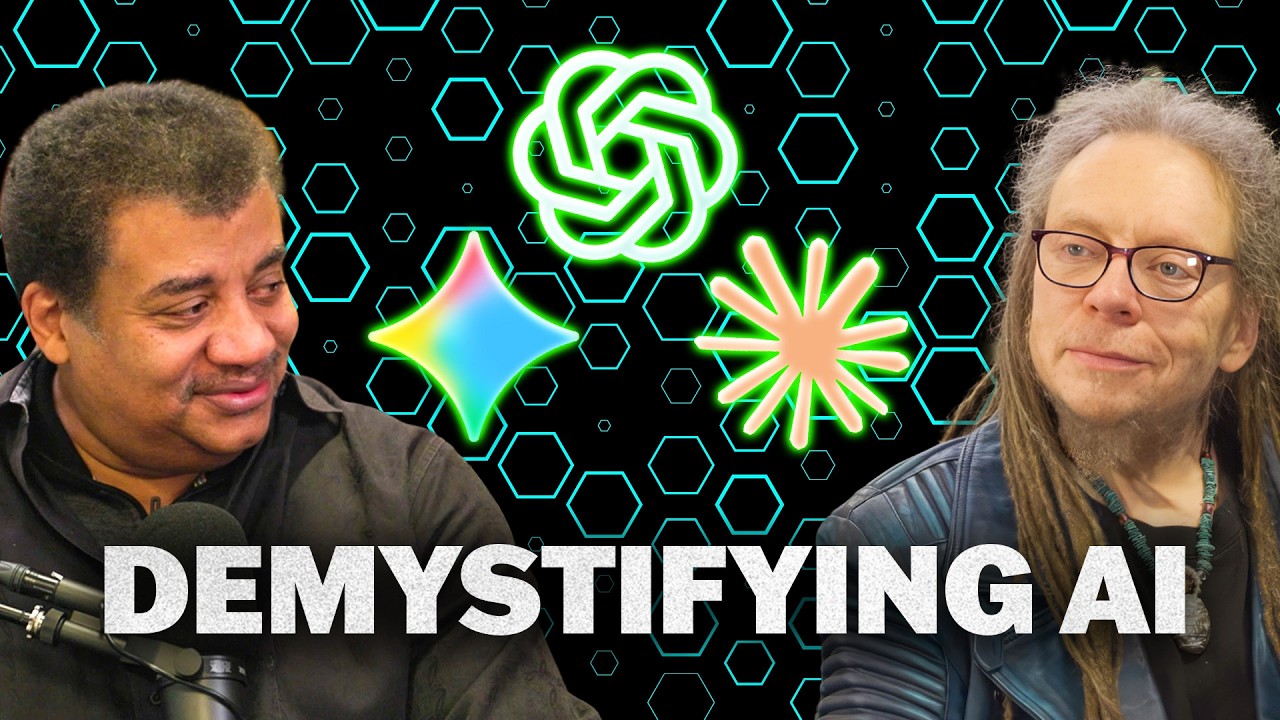
There Is No AI, Really (It’s Just People), with Jaron Lanier
StarTalk
Overview
Jaron Lanier argues that Artificial Intelligence (AI) is not a new, independent entity but rather a complex collaboration of human effort and data. He critiques the prevailing ideology that treats AI as a mystical creature, emphasizing that information, or 'bits,' are physical and require significant energy and work. Lanier also discusses the problematic nature of current social media platforms, their addictive algorithms, and the narrow business models that drive them. He advocates for a shift in perspective towards viewing AI as a human endeavor, promoting 'data dignity' and exploring alternative, more equitable business models to foster genuine creativity and avoid societal degradation.
Save this permanently with flashcards, quizzes, and AI chat
Chapters
- Information, represented by 'bits,' is not ethereal or infinite; it is physical and requires energy, as evidenced by large data centers.
- Current large language model AI can be understood as a vast aggregation of human work, not an independent creature.
- The perception of AI as a distinct entity, rather than a human collaboration, is driven by ego and a science fiction-influenced worldview.
- The concept of 'data dignity' asserts that data originates from human labor and should be valued accordingly.
- Jaron Lanier, a pioneer in VR, initially envisioned it as a tool to enhance appreciation of reality through contrast, not as an escape from it.
- The VR industry has largely failed to develop its potential, focusing on replicating existing experiences like social networks or games, rather than novel applications like 3D design.
- A significant issue in VR development is the failure to address motion sickness, particularly among specific demographic groups (women, non-white individuals), due to narrow testing and development teams.
- The immense investment in VR has not yielded its full potential due to companies prioritizing their existing business models over true VR innovation.
- Social media platforms are designed with addictive algorithms, a concern recognized since the early days of computing (Norbert Wiener).
- The 'network effect' in digital platforms leads to hyper-centralization of power and influence around dominant nodes (e.g., Meta, Google).
- The primary business model in Silicon Valley, 'influence generation,' incentivizes outrage and emotional manipulation, leading to a 'fast brain' response.
- The constant activation of the 'fight or flight' response by algorithms can lead to paranoia, anxiety, and a degradation of personality, turning users into 'victims' of the system.
- Viewing AI as a collaboration of people, rather than a new entity, opens up more profound and practical avenues for understanding and development.
- The desire to see AI as a creature is often fueled by youthful ego, a diet of dystopian science fiction, and a lack of positive future narratives.
- AI can be a powerful tool for collaboration, such as speeding up code development, but its potential is often overshadowed by theatrical claims and a 'winner-take-all' mentality.
- The 'black box' nature of current AI models obscures the human effort and data behind them, hindering security and quality improvements.
- The current digital landscape is dominated by a binary choice: free (but exploitative) or prohibitively expensive software.
- There is a need for 'affordable' business models that allow for fair compensation of creators and developers, fostering a sustainable ecosystem.
- Data dignity emphasizes that data originates from people's work and should be treated as such, countering the idea of bits as free and ethereal.
- A constructive transformation of the tech industry requires exploring alternative business models and recognizing the physical, human-driven nature of information.
Key takeaways
- AI is not a new sentient being, but a complex product of human labor and data, and should be viewed as a collaboration.
- Information is physical; the idea of 'free' digital bits ignores the energy, work, and infrastructure required to create and maintain them.
- Social media platforms exploit psychological vulnerabilities through addictive algorithms, leading to societal issues like outrage amplification and personality degradation.
- The dominant 'influence generation' business model in tech incentivizes negative engagement and hinders the development of truly beneficial technologies like VR.
- A shift towards 'data dignity' is necessary, recognizing that data is derived from human work and deserves fair compensation.
- Alternative, affordable business models are needed to support creators and foster innovation, moving beyond the 'free or expensive' binary.
- Positive, collaborative visions of the future, like those in '90s Star Trek, are vital counterpoints to dystopian narratives that fuel fear and anxiety about technology.
Key terms
Test your understanding
- How does Jaron Lanier propose we reframe our understanding of AI to foster more responsible development?
- What are the core arguments against viewing information (bits) as ethereal and free?
- Why does Lanier believe social media platforms have become detrimental, and what is the underlying business model driving this?
- What is the significance of 'data dignity,' and how does it challenge current digital practices?
- What alternative business models does Lanier suggest could lead to a healthier tech ecosystem?