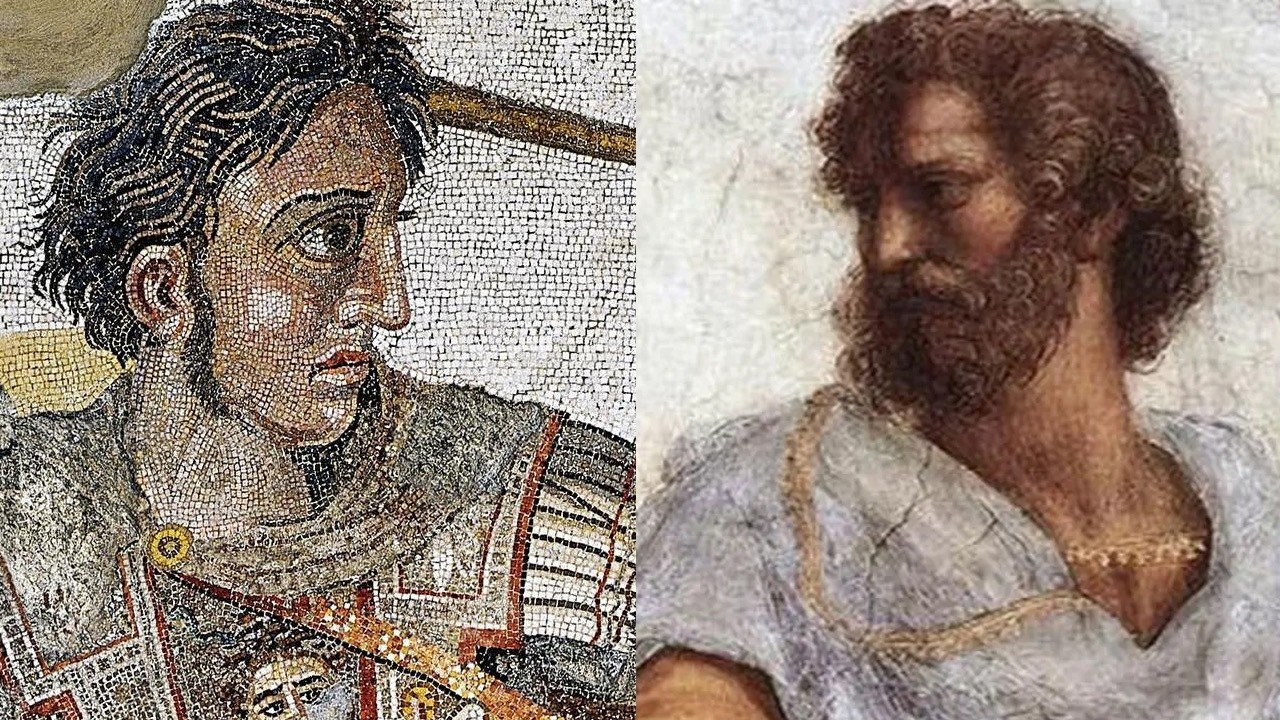
What did Aristotle teach Alexander the Great?
Agora
Overview
This video explores the profound intellectual relationship between Aristotle and his student, Alexander the Great. While the exact curriculum is unknown, the summary analyzes how Aristotle's philosophical framework likely shaped Alexander's approach to governance, ethics, and understanding the world. It highlights Aristotle's emphasis on reason, causality, virtue, political structures, and rhetoric, and how these concepts might have been adapted by Alexander in his vast empire. The video also considers the limitations of philosophical instruction when confronted with real-world challenges, individual personality, and the complexities of ruling a diverse empire, ultimately illustrating the dynamic interplay between abstract ideas and practical application in leadership.
Save this permanently with flashcards, quizzes, and AI chat
Chapters
- Aristotle's philosophy emphasizes understanding reality through observation, reason, and categorization.
- His focus on causality encourages awareness of underlying factors and long-term consequences in decision-making.
- This systematic approach provided a structured way for Alexander to interpret the world and its complexities.
- Aristotle defined virtue as a habit cultivated through consistent, balanced action, avoiding extremes.
- The 'golden mean' suggests moderation is key to virtuous behavior, applicable to qualities like courage and generosity.
- This ethical framework likely served as a reference point for Alexander's conduct, though not always strictly followed.
- Aristotle viewed the state as natural, aiming to facilitate the 'good life' for its citizens.
- His analysis of governance stressed stability, justice, and balanced power structures, advocating for the rule of law.
- These principles offered Alexander a conceptual basis for managing his vast empire, adapting Greek ideas to a larger scale.
- Aristotle held a hierarchical view of cultures, often seeing Greek civilization as superior.
- This perspective might have initially influenced Alexander's view of non-Greek peoples.
- However, Aristotle's broad education also included science, rhetoric, and literature, fostering intellectual curiosity and an appreciation for diverse knowledge.
- Rhetoric, the art of effective communication and persuasion, was central to Aristotle's political thought.
- Aristotle taught that effective leadership requires appealing to both reason and emotion, integrating feelings into rational action.
- This skill was crucial for Alexander in inspiring loyalty, negotiating alliances, and articulating his vision.
- Aristotle's concept of teleology suggests that phenomena have inherent purposes or ends.
- Applied to human action, this encourages aligning decisions with ultimate goals and a broader vision.
- This perspective likely shaped Alexander's ambition, driving him to pursue objectives beyond immediate gains, such as legacy or glory.
- Philosophical education provides a framework, but its application is limited by individual personality and unique circumstances.
- Alexander's career, marked by constant warfare and diverse cultures, demanded adaptation and improvisation beyond strict principles.
- The transmission of ideas is dynamic, involving reinterpretation and resistance based on personal experience and context.
Key takeaways
- Aristotle's education likely provided Alexander with a structured, rational framework for understanding the world and making decisions.
- The concept of virtue, emphasizing balance and moderation (the 'golden mean'), offered ethical guidance for Alexander's conduct.
- Aristotle's political philosophy provided principles for governance, stability, and justice that could be adapted to an empire.
- Rhetoric was a crucial skill Aristotle likely taught, enabling Alexander to persuade, inspire, and lead effectively.
- The idea of teleology suggests Aristotle may have instilled in Alexander a sense of purpose and long-term vision for his actions.
- Real-world application of philosophical teachings is complex, influenced by individual personality, context, and the dynamic interplay between theory and practice.
- The relationship highlights the potential impact of intellectual guidance on political power, but also its inherent limitations.
Key terms
Test your understanding
- How did Aristotle's emphasis on causality likely influence Alexander's approach to decision-making?
- What is the 'golden mean,' and how might it have guided Alexander's ethical conduct?
- In what ways could Aristotle's political philosophy have been adapted by Alexander to govern a vast empire?
- Why is understanding the limitations of philosophical instruction important when analyzing Aristotle's influence on Alexander?
- How did Aristotle's teachings on rhetoric likely contribute to Alexander's success as a leader?