8:37
Signal Transmission and Gene Expression
Bozeman Science
Overview
This video explains how cells communicate with each other and their environment through signal transmission, focusing on the 'fight or flight' response triggered by epinephrine (adrenaline). It details the process of signal transduction, where an external signal like epinephrine binds to a cell receptor and initiates a cascade of internal events. This cascade can lead to rapid cellular responses, such as releasing glucose, or slower, more sustained responses like altering gene expression to produce new proteins. The video emphasizes how these pathways amplify signals and allow a small initial stimulus to have a significant impact on cell function.
How was this?
Save this permanently with flashcards, quizzes, and AI chat
Chapters
- Signal transmission involves chemicals moving between and within cells to communicate information.
- Epinephrine (adrenaline) is a chemical signal that triggers the 'fight or flight' response, causing physiological changes like increased heart rate and alertness.
- This response is mediated by a series of molecular events within cells, initiated by epinephrine binding to receptors.
- The ultimate effects of epinephrine can include altering cell function (e.g., releasing glucose) and changing gene expression.
Understanding how signals like adrenaline travel and affect cells is fundamental to comprehending physiological responses to stress and the basic mechanisms of cellular communication.
The feeling of heightened alertness and a racing heart after a near-car accident is a direct result of epinephrine signaling.
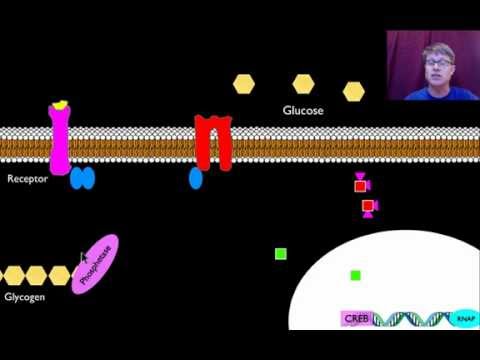
- Epinephrine binds to a specific receptor protein on the cell surface, changing its shape.
- This change activates a G protein, which in turn activates an enzyme that produces cyclic AMP (cAMP) from ATP.
- cAMP acts as a second messenger, activating a protein kinase.
- The active protein kinase phosphorylates (adds a phosphate group to) an enzyme called phosphorylase, which then breaks down stored glycogen into glucose.
This pathway demonstrates how a signal from outside the cell can trigger a cascade of internal events, leading to a specific cellular action like energy mobilization.
Epinephrine binding to a liver cell receptor initiates a chain reaction that ultimately causes the liver to release glucose into the bloodstream.
- Signal transduction pathways are designed to amplify the initial signal.
- At each step, one molecule can activate multiple downstream molecules (e.g., one G protein activating many enzymes, one enzyme producing many cAMP molecules).
- This amplification allows a small amount of epinephrine to result in the production of a very large amount of glucose.
Amplification is crucial for efficient cellular response, ensuring that even weak or distant signals can elicit a significant and rapid effect.
A single epinephrine molecule can ultimately lead to the release of billions of glucose molecules from the liver.
- Beyond immediate cell function changes, signal transduction can also alter gene expression.
- The activated protein kinase in the pathway can activate transcription factors, such as CREB.
- Activated transcription factors bind to DNA and initiate the process of making new proteins, like those involved in glucose metabolism.
- This allows for longer-term cellular adaptations and responses.
Altering gene expression provides a mechanism for cells to adapt and respond to signals over longer timescales, enabling more complex and sustained physiological changes.
Epinephrine signaling can activate the CREB transcription factor, which then signals the DNA to produce more proteins needed for glucose release.
Key takeaways
- Cells communicate using chemical signals that travel through the body and within cells.
- Signal transduction pathways are multi-step processes that convert an external signal into an internal cellular response.
- Second messengers like cAMP play a vital role in relaying signals within the cell.
- Signal transduction pathways amplify initial signals, making cellular responses more potent.
- These pathways can lead to rapid changes in cell function (like enzyme activation) and slower changes in gene expression.
- The 'fight or flight' response is a classic example of how signal transmission and transduction prepare the body for action.
Key terms
Signal TransmissionEpinephrineAdrenalineFight or Flight ResponseSignal Transduction PathwayReceptor ProteinG ProteinCyclic AMP (cAMP)Protein KinasePhosphorylationGlycogenGlucoseGene ExpressionTranscription FactorCREB
Test your understanding
- What is the role of epinephrine in the 'fight or flight' response?
- How does a signal like epinephrine binding to a cell receptor initiate a cascade of events inside the cell?
- Explain the concept of signal amplification within a signal transduction pathway.
- How can signal transduction pathways lead to changes in gene expression, and why is this important for cellular function?
- What is the difference between a direct cellular response (like glucose release) and a change in gene expression triggered by a signal?