54:45
Winpe Women on Boards: Digital Personal Data Protection Act: Board Level Governance & Compliance
Winpe Forum
Overview
This video provides a board-level perspective on India's Digital Personal Data Protection Act (DPDP Act), emphasizing governance and compliance. It clarifies the act's scope, key definitions, and compliance timelines, highlighting the significant responsibilities for organizations and their boards. The discussion covers various related legislations, sector-specific regulations, and the implications for data fiduciaries and processors, particularly significant data fiduciaries. It stresses the importance of robust consent mechanisms, data subject rights, and the substantial penalties for non-compliance, urging proactive measures and strategic planning for board members.
How was this?
Save this permanently with flashcards, quizzes, and AI chat
Chapters
- The DPDP Act is a crucial regulation reshaping data governance, accountability, and risk oversight for organizations.
- Boards and senior leaders must understand the strategic implications and new responsibilities concerning personal data stewardship.
- The law shifts the assumption, expecting boards to be knowledgeable about and actively monitor data privacy policies and compliance.
- The session aims to provide practical insights for board members and professionals on navigating data protection and compliance.
Understanding the DPDP Act is essential for board members to fulfill their fiduciary duties and ensure the organization's compliance, thereby mitigating significant legal and financial risks.
The speaker highlights that boards may be asked by regulators: 'What did the board know, what did the board actually ask, and how was the board monitoring it?'
- The DPDP Act is the primary legislation for informational privacy in India, but it's not the only one.
- Other relevant laws include the Information Technology Act, SPDI Rules (though expected to become obsolete), and CERT-In directions for data breach reporting.
- Sector-specific regulations (e.g., for broadcasters, insurance, health services) also impose data protection obligations that apply in tandem with the DPDP Act.
- Understanding this horizontal and sector-specific regulatory framework is critical for comprehensive compliance.
A holistic understanding of all applicable data protection laws, not just the DPDP Act, is necessary to avoid compliance gaps and potential penalties across different business operations.
The IDI (Insurance Regulatory and Development Authority) guidelines were recently amended, requiring board-level oversight on cybersecurity and privacy obligations for insurance providers.
- Digital personal data is any personal data in digital form; the Act specifically governs this type of data.
- A 'data principal' is the individual to whom the personal data relates.
- A 'data fiduciary' is the entity deciding the purpose and means of processing personal data.
- A 'consent manager' acts as an intermediary between the data principal and the data fiduciary.
- The Act's definition of 'processing' is broad, encompassing almost any action taken with personal data, and applies to processing within India and certain activities outside India.
Accurately identifying these roles and understanding the broad scope of 'processing' is fundamental to determining an organization's obligations and liabilities under the DPDP Act.
Physical data, like a visitor sign-in register, becomes digital personal data once digitized and stored, thus falling under the Act's purview.
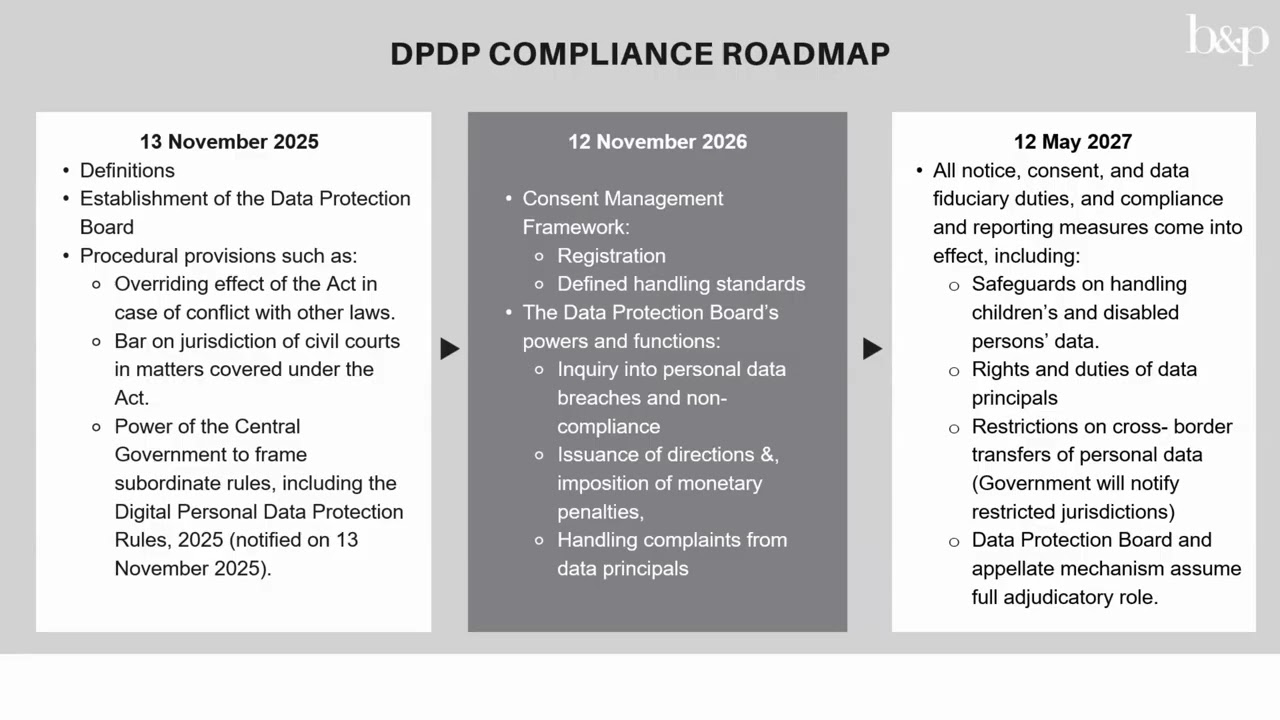
- The DPDP Act provides a phased compliance period, with full enforcement expected by May 2027.
- Key milestones include the operationalization of provisions (Nov 2025), the consent manager framework, and the Data Protection Board's powers (Nov 2026).
- Organizations must establish robust consent management systems, respecting data principal rights, and have clear breach reporting procedures in place by May 2027.
- Consent is viewed as a continuous cycle: collection, validation, updates, renewal, and deletion upon withdrawal.
Understanding the compliance timeline allows organizations to strategically plan and allocate resources to meet the stringent requirements before the final deadline, avoiding penalties.
By May 2027, boards need to be fully updated on how the company will address data breaches, honor data principal rights, and fulfill processor duties.
- Significant Data Fiduciaries (SDFs) are entities processing large volumes of personal data or sensitive data, potentially designated by the government.
- SDFs have additional obligations, including appointing a Data Protection Officer (DPO) based in India who reports directly to the board.
- SDFs must conduct Data Protection Impact Assessments (DPIAs) and periodic independent data audits.
- While no entities are currently designated as SDFs, fintech, healthtech, and insurance companies are likely candidates.
The designation of an SDF triggers heightened scrutiny and specific governance requirements, including direct board-level oversight of data operations, necessitating proactive preparation.
The DPDPA mandates that a Data Protection Officer for a significant data fiduciary must be located in India and report directly to the board.
- Penalties for breaches under the DPDP Act can be substantial, up to ₹250 crore per breach, not per company.
- The focus is on demonstrating meaningful compliance efforts rather than preventing all breaches.
- Data processors generally do not face direct penalties but are subject to contractual obligations and indemnities from fiduciaries.
- The DPDP Act allows data transfer outside India, with exceptions for government-notified restricted countries; however, sectoral regulations (like RBI's) may impose local storage requirements.
- Section 8 (non-profit) companies and B2B transactions are also within the ambit of the DPDP Act, with specific exemptions for certain employment-related data and pre-approved transactions.
The severe financial penalties and the potential for individual director liability under related acts underscore the critical need for robust compliance and demonstrating due diligence.
A data leak affecting multiple individuals could result in a ₹250 crore penalty for each affected individual, not just a single penalty for the company.
- Companies need to appoint both legal counsel and tech providers to navigate the DPDP Act's complexities.
- A data mapping exercise, including a data flow diagram, is crucial for understanding data collection, processing, and storage.
- Operationalizing data principal rights, such as the right to access or deletion, requires capable IT systems with immediate response times.
- For companies processing children's data, obtaining verifiable parental consent and avoiding behavioral monitoring are paramount.
- Vendor and data processor management requires careful contract review, understanding that contractual indemnities do not shift regulatory liability from the fiduciary.
A proactive, multi-disciplinary approach involving legal, technical, and business teams is essential for building a comprehensive compliance framework and mitigating risks effectively.
For children's data, platforms must implement verifiable parental consent mechanisms and disable behavioral tracking, potentially creating separate profiles for children.
- Board oversight is explicitly required for Significant Data Fiduciaries and generally recommended due to high penalties and governance requirements.
- Consent notices must be future-proofed to cover all potential data uses, including mergers or investments, to avoid re-consent requirements.
- Organizations must be able to operationalize data principal rights promptly, as immediate response is expected.
- Due diligence by PE/VC firms is not an exemption; compliance affects portfolio valuations and requires significant investment.
- The DPDP Act is considered more stringent than GDPR in certain aspects due to its limited exceptions for processing without consent.
Integrating data protection into corporate governance, ensuring board awareness, and future-proofing compliance strategies are vital for long-term sustainability and risk management.
Even globally aligned privacy notices may need an appendix or complete revision to meet the DPDP Act's specific requirements, and existing consent may need to be re-obtained.
Key takeaways
- The DPDP Act imposes significant responsibilities on organizations and their boards regarding data privacy and governance.
- A comprehensive understanding of all applicable data protection laws, including sector-specific regulations, is crucial for compliance.
- Organizations must proactively establish robust consent management systems and be prepared to honor data principal rights promptly.
- Significant Data Fiduciaries face enhanced obligations, including direct board reporting from the Data Protection Officer and mandatory impact assessments.
- The potential penalties for data breaches are substantial, emphasizing the need to demonstrate meaningful compliance efforts.
- Cross-border data transfers are permitted but subject to government notifications and specific sectoral regulations.
- Appointing both legal and technical experts is essential for navigating the complexities of DPDP Act compliance.
- Privacy notices and consent mechanisms must be future-proofed to cover all foreseeable data processing activities.
Key terms
Digital Personal DataData PrincipalData FiduciaryConsent ManagerProcessingSignificant Data Fiduciary (SDF)Data Protection Officer (DPO)Data Protection Impact Assessment (DPIA)Data BreachVerifiable Consent
Test your understanding
- What are the key differences in obligations between a data fiduciary and a data processor under the DPDP Act?
- How does the DPDP Act's definition of 'processing' impact an organization's data handling practices?
- What specific additional responsibilities are placed on Significant Data Fiduciaries compared to other entities?
- Why is it crucial for organizations to 'future-proof' their consent notices and privacy policies under the DPDP Act?
- How can a board effectively oversee data protection compliance, especially given the potential for substantial penalties per breach?