13:02
شرح ال TCP/IP بالتفصيل والفرق بينه و بين OSI Model
IT Dose
Overview
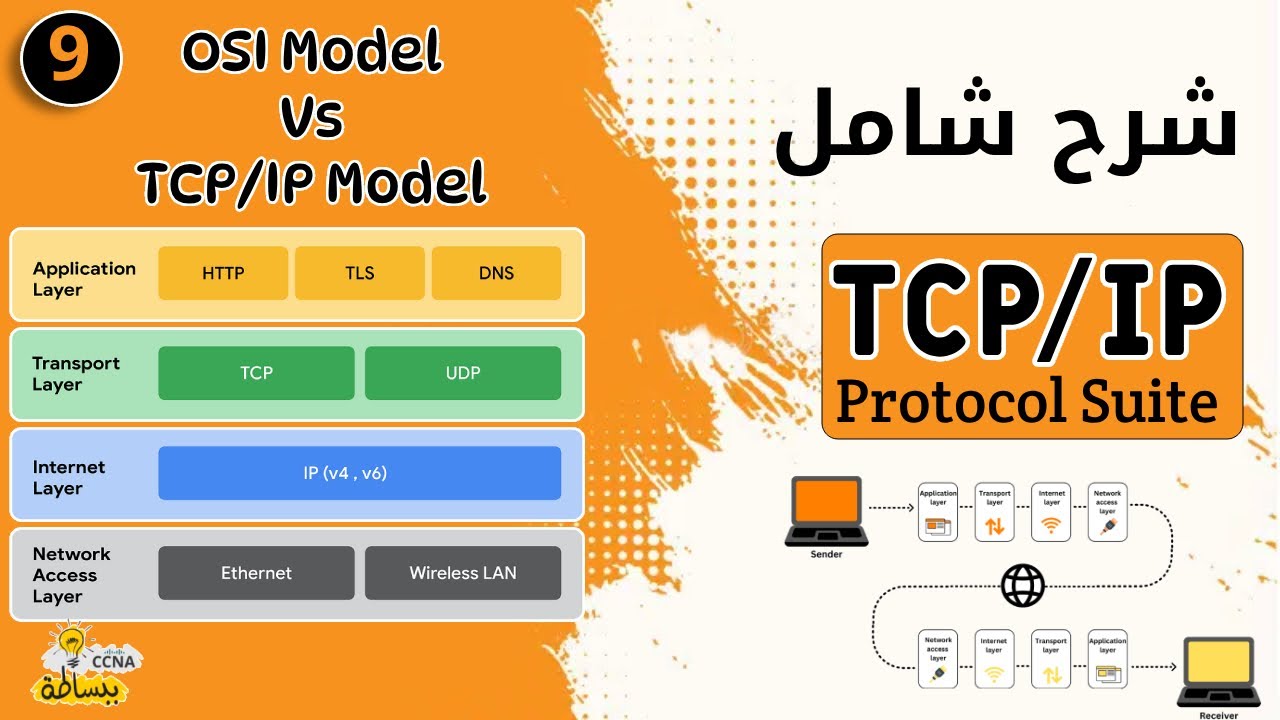
This video explains the TCP/IP protocol suite, its historical development stemming from the need for a more robust network protocol than NCP, and its structure in comparison to the OSI model. It details the functions of each layer in TCP/IP, emphasizing the differences and similarities with the OSI model, particularly how TCP/IP consolidates the top three OSI layers into its Application layer. The explanation covers key protocols like HTTP, FTP, SMTP, TCP, UDP, and IP, and illustrates the data flow with a practical example of sending a video via Telegram, highlighting the encapsulation and decapsulation process across different layers and devices.
How was this?
Save this permanently with flashcards, quizzes, and AI chat
Chapters
- Early networking protocols like NCP had limitations in device support and scalability.
- The US Department of Defense (DoD) needed a more flexible protocol to connect military systems.
- ARPA developed TCP/IP to handle network disruptions and accommodate expansion.
- TCP/IP officially became the standard in 1983 and is the foundation of the internet today.
Understanding the historical context of TCP/IP reveals why it was designed to be resilient and scalable, which are crucial for the global internet.
The US Department of Defense's need to connect numerous military systems due to the limitations of the Network Control Protocol (NCP).
- Both TCP/IP and OSI are protocol suites for device communication, but TCP/IP is the practical model used in modern networks.
- OSI is still taught for its detailed explanation of data movement and as a common reference language for network professionals.
- TCP/IP's Application layer combines OSI's Application, Presentation, and Session layers.
- TCP/IP's Internet layer corresponds to OSI's Network layer.
- TCP/IP's Link layer combines OSI's Data Link and Physical layers, though updated versions may split these.
Comparing TCP/IP to the OSI model helps clarify the functional mapping and understand why TCP/IP is the industry standard while OSI remains a valuable conceptual framework.
The consolidation of OSI's Application, Presentation, and Session layers into TCP/IP's single Application layer.
- Application Layer: Handles user-facing protocols like HTTP (browsing), FTP (file transfer), and SMTP (email).
- Transport Layer: Manages data flow and reliability, featuring TCP (connection-oriented, reliable) and UDP (connectionless, fast).
- Network (Internet) Layer: Responsible for routing and IP addressing, with routers operating here.
- Link Layer: Deals with physical transmission over network media, including Ethernet and wireless, and involves switches.
Knowing the specific protocols and functions at each layer is essential for troubleshooting and understanding how data travels across networks.
The choice between TCP for reliable email delivery and UDP for fast, real-time communication like Zoom calls.
- TCP (Transmission Control Protocol) is connection-oriented, ensuring data arrives accurately through acknowledgments, making it reliable but slower.
- UDP (User Datagram Protocol) is connectionless, sending data without confirmation, making it faster but less reliable.
- The choice between TCP and UDP depends on the application's needs: accuracy for critical data (like reports) versus speed for real-time applications (like gaming or video calls).
Understanding the trade-offs between TCP and UDP is critical for selecting the right protocol for different network services and applications.
Using UDP for a live video call where slight data loss is acceptable for real-time delivery, versus using TCP for sending an important work report where accuracy is paramount.
- When sending a video via Telegram, the Application layer initiates the request.
- The Transport layer (TCP) segments the data and manages the connection.
- The Internet layer adds IP headers with source and destination IP addresses for routing.
- The Link layer adds Ethernet headers with MAC addresses for local network delivery.
- Routers and switches process these headers to forward the data across different networks until it reaches the destination device.
This example demonstrates the end-to-end encapsulation and decapsulation process, showing how each layer contributes to successful data transmission across complex networks.
Samir sending a video to Madhat via Telegram, where the data is broken down, addressed, and reassembled across multiple network devices and links.
Key takeaways
- TCP/IP evolved from early networking needs to become the internet's foundational protocol suite.
- The TCP/IP model simplifies the OSI model by consolidating its top layers, making it more practical for modern networks.
- TCP ensures reliable data delivery through acknowledgments, while UDP prioritizes speed over guaranteed delivery.
- Network professionals often use OSI terminology even when working with the practical TCP/IP model.
- Each layer in TCP/IP has specific responsibilities, from application-level protocols to physical signal transmission.
- Understanding the data flow through encapsulation and decapsulation is key to grasping network communication.
- The choice between TCP and UDP is application-dependent, balancing reliability against speed.
Key terms
TCP/IP Protocol SuiteNetwork Control Protocol (NCP)ARPAOSI ModelApplication LayerTransport LayerInternet LayerLink LayerTCP (Transmission Control Protocol)UDP (User Datagram Protocol)IP AddressMAC AddressEncapsulationDecapsulationConnection-orientedConnectionless
Test your understanding
- What was the primary limitation of the Network Control Protocol (NCP) that led to the development of TCP/IP?
- How does the TCP/IP model's Application layer differ from the top three layers of the OSI model?
- What is the fundamental difference in data transmission between TCP and UDP, and when would you choose one over the other?
- Explain the role of IP addresses and MAC addresses in the data transmission process described in the video.
- How does the process of encapsulation and decapsulation enable communication between different layers and devices in the TCP/IP model?