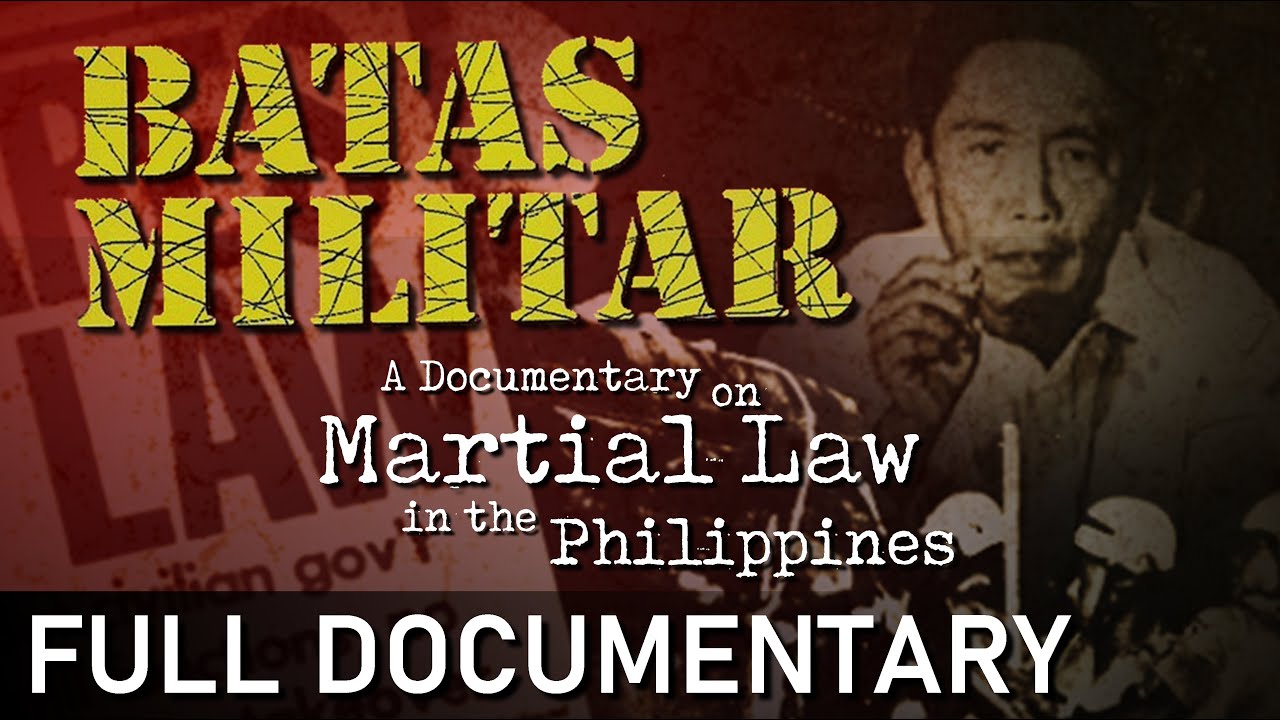
BATAS MILITAR (1997) A Documentary on Martial Law in the Philippines #MartialLaw #EDSA39
EDSA People Power Revolution
Overview
This documentary chronicles the imposition and impact of Martial Law in the Philippines under President Ferdinand Marcos. It details the political climate leading up to the declaration, including growing dissent, economic instability, and key events like the Plaza Miranda bombing. The film explores Marcos's consolidation of power, the role of his inner circle (the 'Rolex 12'), the systematic abuses and human rights violations that occurred, and the economic policies, including crony capitalism, that characterized his regime. It also highlights the emergence of opposition movements, the assassination of Ninoy Aquino, and the eventual People Power Revolution that led to Marcos's downfall.
Save this permanently with flashcards, quizzes, and AI chat
Chapters
- Ferdinand Marcos, nearing the end of his second term, was constitutionally barred from seeking a third, leading to speculation about his plans to retain power through a parliamentary system or martial law.
- Senator Benigno Aquino Jr. warned of the Philippines gradually becoming a 'garrison state' controlled by the military.
- Widespread protests in the early 1970s highlighted public dissatisfaction with rising prices, US military presence, economic control, and government corruption.
- The First Quarter Storm demonstrated significant public opposition and the government's use of force to quell dissent.
- The Plaza Miranda bombing during a Liberal Party rally in August 1971, which injured many civilians and opposition leaders, remains a mystery but is widely suspected to have been orchestrated by Marcos.
- Following the bombing, Marcos suspended the privilege of the writ of habeas corpus, allowing for warrantless arrests and detentions, a move later reversed due to strong public protest.
- The suspension of habeas corpus was seen as a 'dry run' for the eventual declaration of martial law.
- Subsequent bombings and incidents, like the raid on a military command post, were used to justify increased security measures and blame opposition groups like the Communist Party of the Philippines (CPP) and the New People's Army (NPA).
- A Constitutional Convention aimed to replace the 1935 Constitution, but became mired in political maneuvering, with delegates allegedly influenced by bribes to ensure Marcos's continued power.
- A key outcome was the inclusion of transitory provisions granting all legislative and executive powers to the sitting president (Marcos) during the transition period.
- Senator Aquino revealed 'Oplan Sagittarius,' a supposed blueprint for martial law involving the utilization of armed forces in case of unrest, though its exact nature and intent are debated.
- The 'Rolex 12,' a group of twelve high-ranking military and defense officials, were involved in the secret planning of martial law.
- On September 21, 1972, President Marcos declared Martial Law via Proclamation 1081, citing threats to the Republic and the need to reform society.
- The declaration was preceded by a staged ambush of Defense Minister Juan Ponce Enrile's car, which was later admitted to be a fabrication to justify the crackdown.
- Upon declaration, Congress was closed, media outlets were shut down, and thousands of opposition leaders, activists, and critics were arrested.
- Marcos implemented a 'New Society' (Bagong Lipunan) agenda, including measures against corruption and the deployment of private armies, while establishing constitutional authoritarianism.
- Martial law was characterized by widespread human rights violations, including torture, illegal detention, and extrajudicial killings, with tens of thousands of victims reported by organizations like Amnesty International.
- The military and police forces, particularly the Philippine Constabulary, were implicated in these abuses, often operating with impunity.
- Marcos implemented agrarian reform but also seized control of businesses, replacing the old oligarchy with 'cronies'—relatives and loyalists—leading to crony capitalism.
- The regime benefited from US support, partly due to Marcos protecting American military bases and business interests, and received significant foreign loans.
- Despite repression, opposition movements grew, including the Communist Party of the Philippines (CPP), the New People's Army (NPA), and the Moro National Liberation Front (MNLF).
- Ninoy Aquino, exiled in the US, became a symbol of resistance. He returned to the Philippines in 1983, despite warnings, and was assassinated upon arrival at the Manila International Airport.
- The assassination sparked widespread public outrage and intensified protests against the Marcos regime.
- The Agrava Commission, tasked with investigating Aquino's murder, was met with public skepticism, and key figures like General Fabian Ver were implicated.
- Facing mounting pressure and economic collapse, Marcos called a snap presidential election in 1986.
- The election was marred by widespread fraud and violence, with the opposition, led by Corazon Aquino (Ninoy's widow), alleging massive cheating by the Commission on Elections.
- The Reform the Armed Forces Movement (RAM) attempted a coup, but it was thwarted by popular support for the opposition and the intervention of civilians.
- The People Power Revolution in February 1986, a massive non-violent protest, forced Ferdinand Marcos into exile and led to the restoration of democracy under Corazon Aquino.
Key takeaways
- Authoritarian regimes often use constitutional mechanisms and staged events to legitimize their power grabs.
- Suppression of dissent and human rights abuses are hallmarks of dictatorships, creating deep societal trauma.
- Economic policies under authoritarian rule can lead to cronyism and widespread inequality, benefiting a select few.
- The manipulation of information and control of media are crucial tools for dictators to maintain their grip on power.
- The assassination of key opposition figures can paradoxically ignite broader resistance and accelerate the downfall of a regime.
- Popular uprisings and non-violent resistance can be powerful forces for democratic change, even against heavily armed regimes.
- The legacy of martial law includes lasting impacts on institutions, economy, and the collective memory of a nation.
Key terms
Test your understanding
- What were the primary political and economic conditions that allowed Ferdinand Marcos to declare Martial Law?
- How did the Plaza Miranda bombing and the suspension of the writ of habeas corpus serve as precursors to Martial Law?
- Describe the role of 'Oplan Sagittarius' and the 'Rolex 12' in the planning and implementation of Martial Law.
- What were the key human rights violations and economic policies that characterized the Marcos regime under Martial Law?
- How did the assassination of Ninoy Aquino contribute to the eventual downfall of Ferdinand Marcos and the rise of the People Power Revolution?