51:48
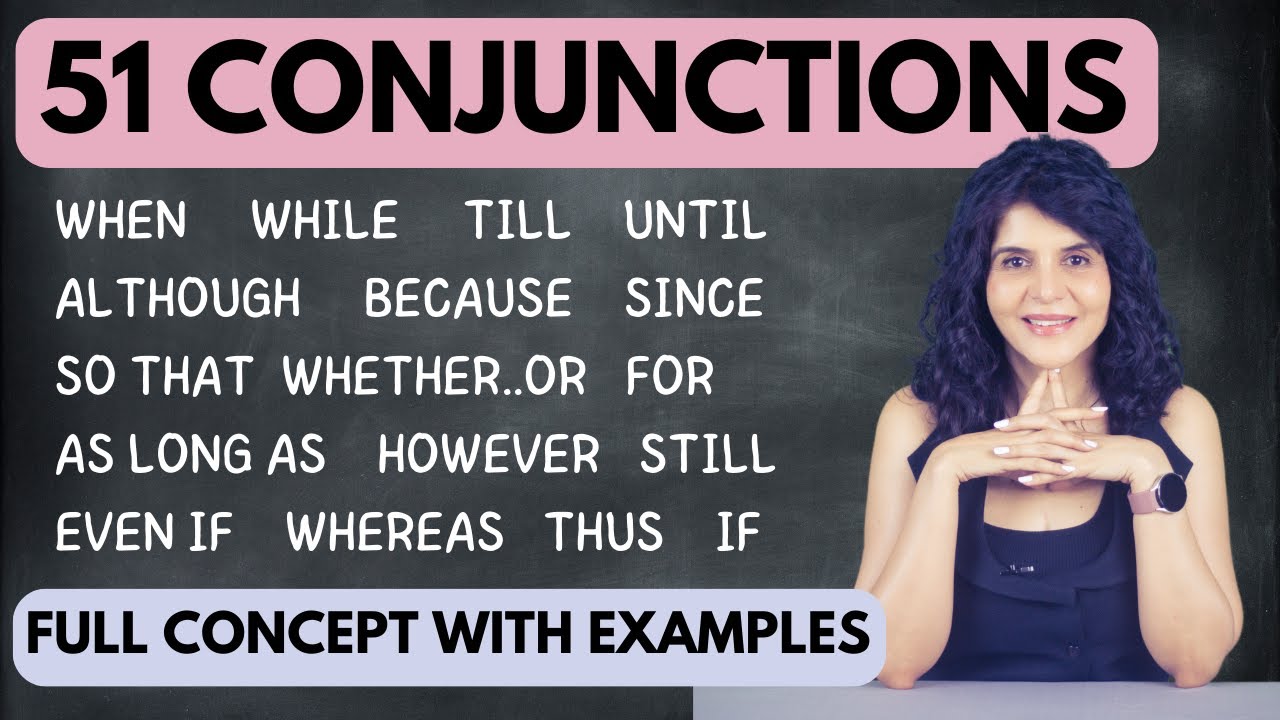
Conjunctions in English Grammar with Examples| What is Conjunction | English Grammar Lesson|ChetChat
ChetChat
Overview
This video provides a comprehensive guide to conjunctions in English grammar, explaining their function as connecting words. It categorizes conjunctions into five main groups: time, addition/emphasis, cause/reason, purpose/result, and alternatives/choices/possibilities. The lesson details the nuances and subtle differences between various conjunctions within each category, offering examples, pro-tips, and common mistakes to avoid. The goal is to help learners understand and use conjunctions accurately to improve their writing and exam performance.
How was this?
Save this permanently with flashcards, quizzes, and AI chat
Chapters
- Conjunctions are connecting words that join words, phrases, clauses, or sentences.
- They act as bridges, linking different parts of a sentence.
- Conjunctions are grouped by function for easier understanding and retention.
- The video aims to clarify subtle differences often missed in other lessons.
Understanding the fundamental role of conjunctions is crucial for constructing coherent and grammatically correct sentences, enabling clear communication of complex ideas.
A conjunction is like a bridge connecting two lands.
- These conjunctions indicate the sequence of events.
- Words like 'before', 'after', 'when', 'while', 'as soon as', 'till', and 'until' show temporal relationships.
- 'When' refers to a specific point in time or condition, while 'while' indicates simultaneous actions.
- 'As soon as' signifies immediate succession, and 'till'/'until' mark the end of a period.
Accurately using time conjunctions helps establish the order of events, making narratives and explanations logical and easy to follow.
I brush my teeth before I get ready for my morning walk.
- These conjunctions add information or emphasize related ideas.
- The basic conjunction 'and' connects similar ideas, typically using a plural verb.
- 'As well as' adds information with a slight emphasis on the first item, and the verb agrees with the first noun.
- 'Not only... but also' and 'both... and' emphasize two related ideas, with 'not only... but also' often implying surprise.
Choosing the right conjunction for addition or emphasis clarifies the relationship between ideas and guides the reader's attention, influencing the perceived importance of each element.
My pet Simba is not only a great cuddler but also a professional sock thief.
- These conjunctions explain the 'why' behind an action or situation.
- Common conjunctions include 'because', 'since', 'for', 'as', and the formal 'inasmuch as'.
- Differences lie in formality and sentence placement; 'because' and 'for' are typically mid-sentence, while 'since', 'as', and 'inasmuch as' can start sentences.
- 'As' can also indicate time/simultaneity or manner, in addition to reason.
Clearly stating the cause or reason behind events is fundamental to logical reasoning and understanding the motivations or explanations for phenomena.
I got a zero because my dog tore up my homework.
- These conjunctions describe the outcome or intention of an action.
- 'So' indicates a result and is informal, often connecting independent clauses.
- 'So that' expresses purpose or intention, explaining why an action is done.
- Formal conjunctions like 'therefore', 'thus', and 'in order that' also indicate logical conclusions or specific purposes.
Distinguishing between purpose and result is key to understanding intent versus outcome, which is vital for analyzing actions and their consequences.
She saved money so that she could buy a car.
- These conjunctions present options or possibilities.
- 'Or' offers simple alternatives, while 'nor' adds a negative alternative, often with inverted verbs.
- 'Either... or' and 'neither... nor' present two specific alternatives, with verb agreement matching the nearest subject.
- 'Whether' introduces doubt or alternatives, and 'whether or' explicitly connects two possibilities.
Understanding these conjunctions allows for precise expression of choices, negations, and uncertainties, which is essential for decision-making and nuanced communication.
You can either clean your room or explain to Mom why it's still messy.
- Conditional conjunctions set up conditions for an event to occur.
- 'If' is versatile, indicating conditions, hypothetical situations, polite requests, and regret.
- 'Unless' introduces a negative condition (meaning 'if not').
- Others like 'as long as', 'so long as', 'even if', 'provided that', 'on condition that', 'given that', and 'in case' specify different types of conditions, durations, or precautions.
Conditional conjunctions are fundamental for expressing cause-and-effect relationships, hypothetical scenarios, and requirements, forming the basis of logical arguments and planning.
If you eat all your veggies, you might turn into a superhero.
- These conjunctions highlight differences or unexpected outcomes.
- Conjunctions like 'yet', 'but', 'still', 'however', and 'nevertheless' show contrast, with varying degrees of formality and surprise.
- 'Whereas' specifically contrasts two different ideas.
- 'Although', 'even though', and 'though' mean 'despite the fact that' and can be used with 'yet' but not 'but'.
Conjunctions of contrast are vital for developing complex arguments, acknowledging counterpoints, and creating a more sophisticated and balanced presentation of ideas.
She studied hard, yet she didn't clear the exam.
Key takeaways
- Conjunctions are essential for creating complex sentences and showing relationships between ideas.
- Understanding the subtle differences between similar conjunctions (e.g., when vs. while, because vs. since) is key to accurate usage.
- Formality levels vary significantly among conjunctions, impacting their appropriate use in different contexts.
- Pay close attention to verb agreement when using conjunctions like 'and', 'as well as', 'not only... but also', and 'either... or'/'neither... nor'.
- Avoid double negatives, especially with 'unless' and 'lest'.
- Conjunctions of contrast often have subtle differences in formality and the degree of surprise they convey.
- Reading regularly is the best way to internalize the nuances of conjunction usage.
Key terms
ConjunctionCoordinating ConjunctionsSubordinating ConjunctionsCorrelative ConjunctionsClausePhraseTime ConjunctionsCause and Reason ConjunctionsContrast ConjunctionsConditional Conjunctions
Test your understanding
- What is the primary function of a conjunction in a sentence?
- How does the use of 'when' differ from 'while' in expressing time relationships?
- Explain the difference in verb agreement between using 'and' versus 'as well as' to connect two subjects.
- Why is it important to distinguish between conjunctions of cause/reason and those of purpose/result?
- What is the common mistake to avoid when using 'unless' in a sentence?