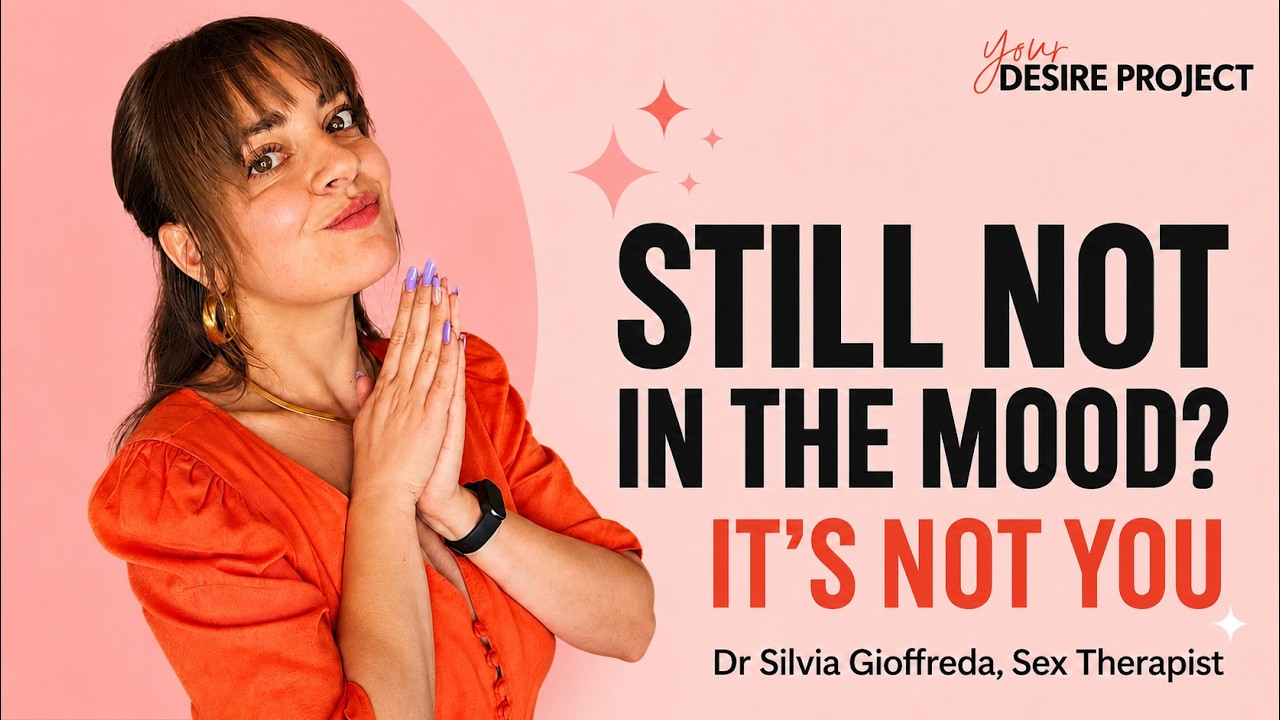
Your Desire Isn't Broken. Your Brakes Are On.
SeggsEd
Overview
This video explains that sexual desire, particularly in long-term relationships, is often responsive rather than spontaneous. It introduces a model where desire is controlled by an "accelerator" system (what turns you on) and a "brake" system (what turns you off), both deeply connected to feeling safe and seen. The speaker emphasizes that common attempts to boost desire by focusing on external stimuli (like lingerie) are often ineffective because they ignore the underlying brakes. Instead, understanding and addressing these personal brakes – which are often subtle, day-to-day issues like mental load or lack of relaxation time – is crucial for reigniting desire. The video encourages self-observation to identify these personal accelerators and brakes, empowering individuals to create conditions that foster desire.
Save this permanently with flashcards, quizzes, and AI chat
Chapters
- Sexual desire, especially in long-term relationships, is typically responsive, meaning it requires specific conditions to emerge, rather than being purely spontaneous.
- The speaker uses a car analogy: desire is controlled by an accelerator (what turns it on) and brakes (what turns it off).
- These accelerator and brake systems are unique to each individual and can change over time.
- Many people mistakenly try to increase desire by focusing only on external "accelerators" without addressing their "brakes."
- Sexual desire is fundamentally linked to the nervous system and the feeling of safety.
- When feeling stressed or unsafe, the body enters survival mode, shutting down vulnerable functions like sexuality.
- True accelerators are not just external stimuli, but factors that make a person feel safe, seen, and loved.
- Brakes are often subtle, everyday issues rather than major conflicts or lack of attraction.
- A common brake is the feeling of not being respected or seen, especially when interrupted during other tasks.
- Mental load, where one partner carries a disproportionate amount of household or emotional labor, acts as a significant brake.
- Lack of dedicated relaxation or 'bridge' time to transition from daily tasks to a pleasure-focused mindset can inhibit desire.
- The absence of non-sexual physical touch can also be a brake, creating pressure to always have sex or have no intimacy at all.
- Scheduling sex, often seen as unromantic, can be a practical way to ensure dedicated time for intimacy and signal importance.
- Implementing 'bridge activities' (e.g., 20-30 minutes of relaxation) helps transition the mind from daily stress to a state conducive to pleasure.
- Non-sexual physical contact, like massages or caresses without expectation, can build connection and safety, acting as an accelerator.
- Feeling safe is the ultimate accelerator, enabling individuals to communicate needs and feel loved, which is essential for desire.
- It's possible to be responsible for your own desire by understanding its triggers and blockers.
- Self-observation without judgment is the first step to identifying personal brakes and accelerators.
- Blame and judgment are significant inhibitors of desire and self-discovery.
- Individuals can break negative cycles and actively create the sexual life they desire.
Key takeaways
- Sexual desire in long-term relationships is mostly responsive, requiring specific conditions to emerge.
- Feeling safe, seen, and loved are the primary 'accelerators' of desire, more so than external stimuli.
- Subtle, everyday issues (like mental load or lack of relaxation) often act as significant 'brakes' on desire.
- Addressing personal brakes is more crucial for reigniting desire than trying to force external accelerators.
- Creating dedicated time for relaxation ('bridge activities') and non-sexual intimacy can help foster desire.
- Taking responsibility for understanding and cultivating your own desire is empowering and leads to a more satisfying sex life.
- Self-observation without judgment is the essential first step to identifying and managing your desire triggers.
Key terms
Test your understanding
- How does the concept of 'responsive desire' differ from 'spontaneous desire', and why is this distinction important for long-term relationships?
- Explain the 'accelerator' and 'brake' systems for sexual desire, providing examples of what might constitute each for an individual.
- Why is feeling safe considered a primary 'accelerator' for sexual desire, and how does the nervous system play a role?
- What are some common 'brakes' on sexual desire that are often overlooked, and how can they be addressed?
- How can 'bridge activities' and non-sexual physical touch help in cultivating sexual desire?