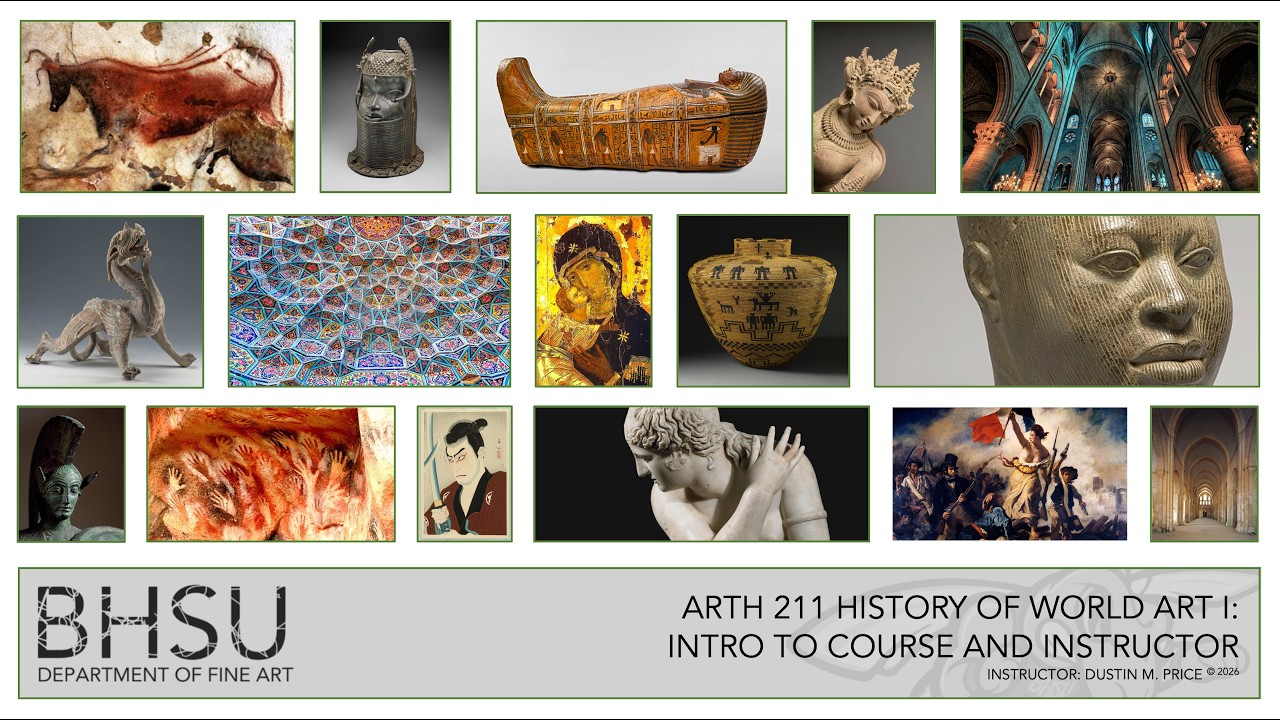
BHSU History of World Art I, Course Intro Lecture - Fall 2026
Dustin M. Price, MFA
Overview
This video serves as an introduction to a History of World Art I course, outlining the instructor's background, course objectives, and the structure of the online learning environment. It details the syllabus, grading policies, and the importance of weekly reflection essays and discussion topics. The instructor emphasizes the inherent nature of art in human history and encourages students to engage critically with the material, rather than just memorizing dates. The video also includes a segment on de-stressing through images of fascinating creatures and provides a walkthrough of the D2L platform, guiding students on how to navigate course content and submit assignments.
Save this permanently with flashcards, quizzes, and AI chat
Chapters
- The instructor aims to connect with students personally, sharing their background and scholarly interests.
- This online course mirrors the content and structure of face-to-face lectures.
- Key course components include syllabus review, grading, D2L navigation, syllabus agreement, weekly reflections, and discussion topics.
- The instructor is a practicing artist with a studio in South Dakota and has exhibited internationally.
- They hold multiple degrees, including a Master of Fine Arts, and have studied art restoration in Florence.
- With 19 years of university-level teaching experience across various institutions and time zones, the instructor brings extensive expertise.
- Personal interests include favorite films and music, which are shared to foster a more personal connection.
- The course incorporates moments to de-stress and focus by observing unique and beautiful creatures.
- This practice helps manage the high stress levels often associated with online or introductory university courses.
- Examples of fascinating animals like the pink fairy armadillo, maned wolf, orchid mantis, quokka, and blobfish are presented.
- The goal is to encourage a slower, more mindful approach to learning, separate from external pressures.
- Art is presented not as a luxury but as an inherent aspect of human existence, present from our earliest primal states.
- The course aims to explore art as a reflection of history, society, and politics, prompting critical questions about its universality and purpose.
- Students are encouraged to form opinions rather than memorize dates, with weekly reflections focusing on personal engagement with the material.
- Visual distinctions between a Buddha and a Bodhisattva are used as an example of learning to interpret visual information without rote memorization.
- Weekly reflection essays (300+ words) require students to share opinions and reactions to lectures and readings, not just summarize.
- Discussion topics occur bi-weekly, involving a 100+ word initial post and a 25+ word response to a peer.
- Assignments are due by Sunday midnight Mountain Standard Time each week, with a clear late penalty policy.
- AI-generated content is strictly prohibited for all assignments.
- The D2L platform is structured with weekly modules containing all necessary content, readings, and assignments.
- Key areas include 'Content' for weekly modules and 'Assessments' for the gradebook.
- The syllabus is available as a PDF, and the textbook is accessible via an embedded link.
- Students must ensure their D2L time zone is set to Mountain Standard Time.
- The syllabus agreement form requires students to confirm they have read and understood the course policies.
- The first discussion topic asks about students' majors and their thoughts on art's importance to humanity.
- The first reflection essay prompts students to share their initial reactions to the course material.
- Early engagement in discussions is encouraged to facilitate peer interaction throughout the week.
Key takeaways
- Art is an intrinsic part of human history and identity, not merely an academic subject.
- This online course prioritizes critical thinking and personal reflection over rote memorization of dates.
- Active engagement with course materials through weekly reflections and discussions is crucial for learning and grading.
- Effective navigation of the D2L platform is essential for accessing all course resources and submitting assignments.
- The instructor values personal connection and encourages students to reach out with questions.
- Managing stress and approaching learning with a mindful perspective can enhance the educational experience.
- Understanding the 'why' behind art's creation and its societal context is more important than memorizing facts.
Key terms
Test your understanding
- How does the instructor plan to foster a sense of community and personal connection in this asynchronous online course?
- What is the primary purpose of the weekly reflection essays, and how do they differ from a traditional summary?
- Why does the instructor emphasize understanding art as an inherent human trait rather than just a historical subject?
- How should students navigate the D2L platform to find course materials and submit assignments?
- What are the consequences of submitting late work, and what is the instructor's policy on extensions for valid reasons?