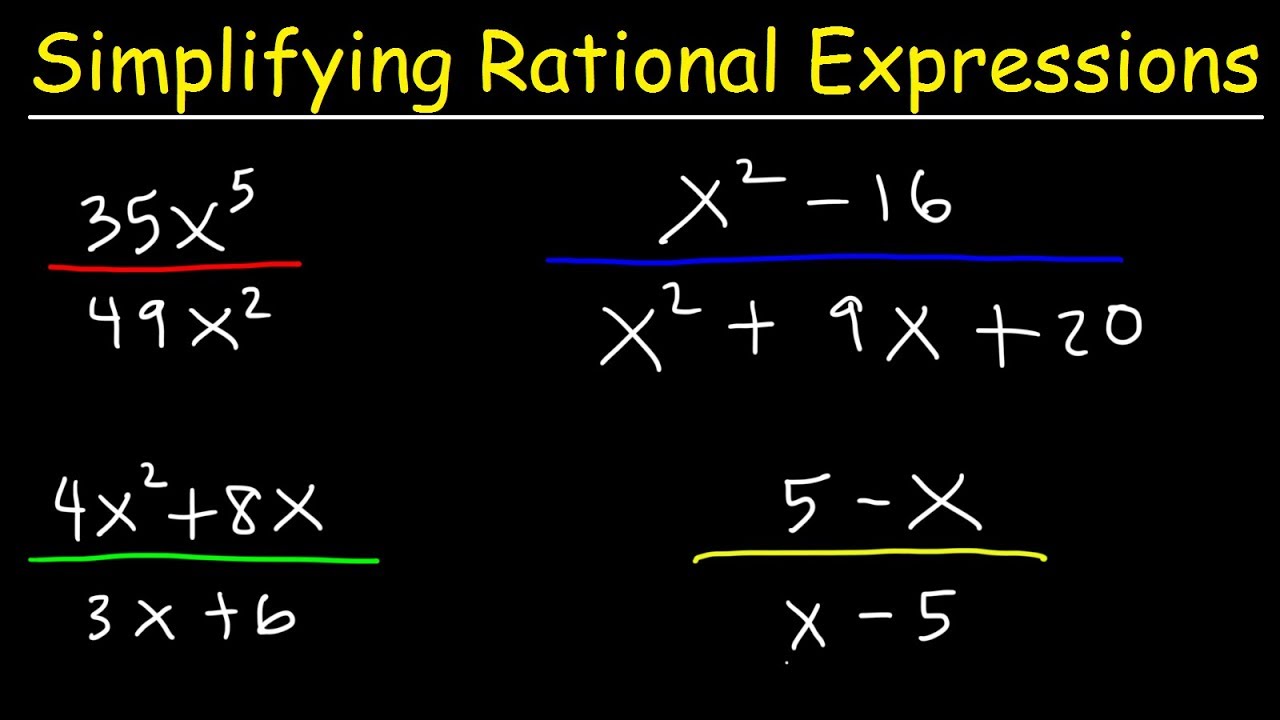
Simplifying Rational Expressions
The Organic Chemistry Tutor
Overview
This video explains how to simplify rational expressions, which are fractions with algebraic expressions in the numerator and denominator. It covers several methods, starting with simplifying numerical fractions and variable exponents. The core techniques involve factoring the numerator and denominator completely, identifying the greatest common factor (GCF), and canceling out common factors. The video demonstrates these techniques with various examples, including expressions with trinomials, differences of squares, and cases where a negative sign needs to be factored out to enable cancellation. The ultimate goal is to reduce the expression to its simplest form by eliminating all common factors.
Save this permanently with flashcards, quizzes, and AI chat
Chapters
- Rational expressions are simplified by reducing numerical coefficients and subtracting exponents of like bases when dividing.
- Simplification can be visualized by expanding terms into their prime factors and canceling common factors.
- The goal is to reduce the expression to its simplest form by eliminating common factors.
- When terms in the numerator or denominator have common factors, factor out the greatest common factor (GCF) first.
- For trinomials with a leading coefficient of one, find two numbers that multiply to the constant term and add to the middle term's coefficient.
- After factoring, cancel any common binomial or polynomial factors between the numerator and denominator.
- Recognize and apply the difference of squares formula: a^2 - b^2 = (a+b)(a-b).
- This technique is used when a binomial consists of two perfect squares separated by a minus sign.
- Factor both the numerator and denominator completely, including using the difference of squares, before looking for cancellations.
- When factors appear as opposites (e.g., x-5 and 5-x), factor out a -1 from one of them to make them identical.
- Factoring out -1 from a binomial reverses the signs of both terms.
- This allows for cancellation, resulting in a factor of -1 in the simplified expression.
- For trinomials with a leading coefficient not equal to one (ax^2 + bx + c), multiply 'a' and 'c', find factors of that product that add to 'b', and then use factoring by grouping.
- When factoring the denominator, always check for a GCF first, even if it appears to be a difference of squares.
- Complex rational expressions require multiple factoring steps before cancellation can occur.
Key takeaways
- Simplifying rational expressions relies on factoring the numerator and denominator completely.
- Always look for the Greatest Common Factor (GCF) first in both the numerator and denominator.
- Recognize and apply special factoring patterns like the difference of squares (a^2 - b^2).
- When factors are opposites (e.g., a-b and b-a), factor out -1 to enable cancellation.
- The ultimate goal of simplification is to cancel out all common factors between the numerator and denominator.
- Mastering factoring techniques is fundamental to simplifying rational expressions effectively.
- After factoring, cancel identical factors that appear in both the numerator and the denominator.
Key terms
Test your understanding
- What are the main steps involved in simplifying a rational expression?
- How does factoring help in simplifying rational expressions?
- Why is it important to identify and factor out the GCF before other factoring methods?
- How can you simplify a rational expression when a factor in the numerator is the opposite of a factor in the denominator?
- What is the difference between simplifying numerical fractions and algebraic rational expressions?