54:50
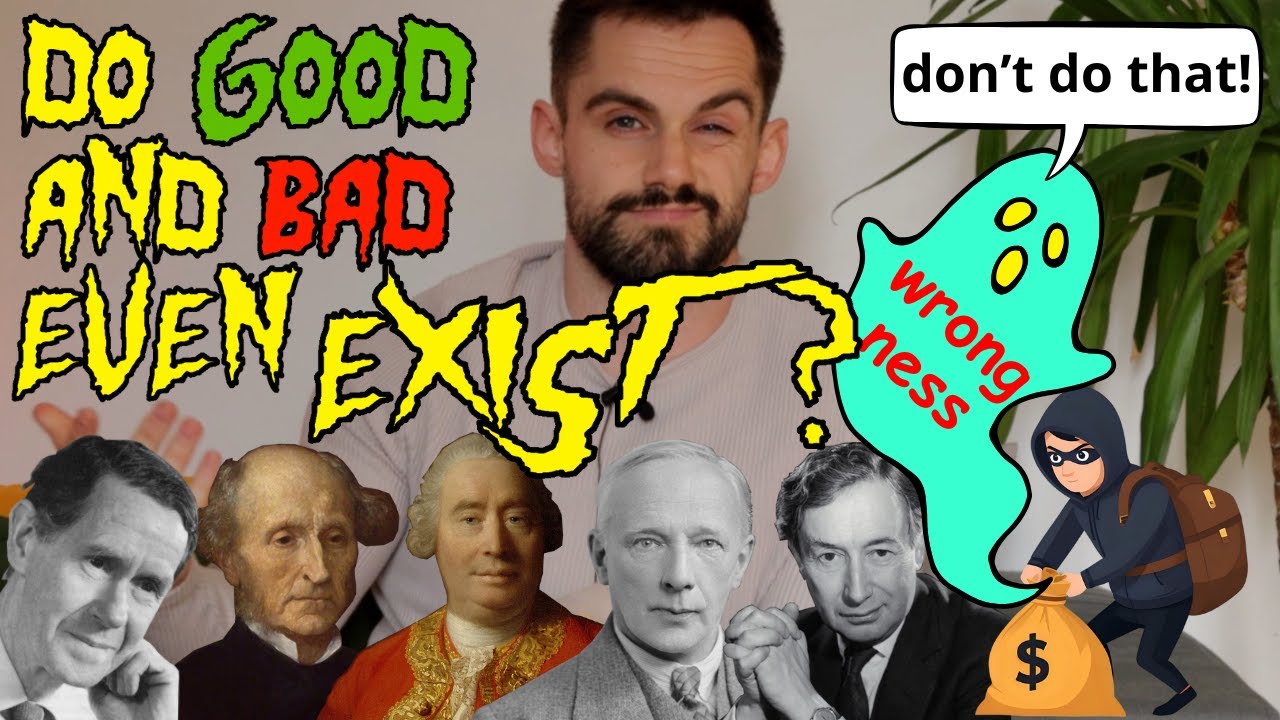
Meta-Ethics: Realism, Anti-Realism, Non-Cognitivism, Error Theory, etc. (Moral Philosophy Episode 4)
philosophymania
Overview
This video explores meta-ethics, focusing on the fundamental questions about the nature of morality. It distinguishes between the psychological question (what we mean by moral judgments) and the metaphysical question (whether moral properties are real and independent of our minds). The discussion covers the major debates of cognitivism vs. non-cognitivism and realism vs. anti-realism, delving into sub-theories like naturalism, non-naturalism, error theory, emotivism, and prescriptivism. The video aims to clarify these complex philosophical concepts and their implications for understanding morality itself.
How was this?
Save this permanently with flashcards, quizzes, and AI chat
Chapters
- Meta-ethics examines the nature of morality itself, questioning what 'good' and 'bad' actually are, unlike normative ethics which assumes their existence.
- The core questions are psychological (what do moral judgments express?) and metaphysical (do moral properties exist independently of us?).
- These questions lead to broad debates: cognitivism vs. non-cognitivism (psychological) and realism vs. anti-realism (metaphysical).
- Understanding meta-ethics is crucial for determining if morality is objective or merely a human construct.
This chapter sets the stage by defining meta-ethics and its central questions, providing the foundational framework for understanding the subsequent philosophical debates.
The video contrasts normative ethics, which assumes 'beating up a child for no reason is bad,' with meta-ethics, which asks 'what *is* bad?'
- Moral realism asserts that objective, mind-independent moral properties and facts exist in the world.
- These moral properties are considered as real as physical properties like height or color.
- Moral anti-realism rejects the existence of such mind-independent moral properties.
- Within realism, a key debate is whether moral properties are natural (reducible to observable properties) or non-natural (simple and unanalyzable).
This distinction addresses the fundamental question of whether morality has an objective basis in reality or is a product of human minds and societies.
Moral realism claims that 'stealing has the property of wrongness' similarly to how 'the Eiffel Tower has the property of being 330m tall.'
- Moral naturalism posits that moral properties are natural properties, reducible to observable and measurable characteristics.
- Utilitarianism, by reducing 'good' to pleasure and 'bad' to pain, is often seen as a form of moral naturalism.
- Moral non-naturalism, championed by G.E. Moore, argues that moral properties are simple, unanalyzable, and cannot be reduced to natural properties.
- Moore introduced the 'naturalistic fallacy' to criticize attempts to define moral terms using only natural properties, advocating for intuitionism to grasp these non-natural properties.
This chapter explores how realists conceptualize the nature of moral properties, differentiating between those that can be scientifically studied and those that are sui generis.
G.E. Moore argued that while all good things might produce happiness, goodness itself is not the same as happiness, just as yellow is not the same as the wavelength of light that produces the sensation of yellow.
- Cognitivism holds that moral judgments are beliefs that can be literally true or false, functioning as descriptions of the world.
- Non-cognitivism argues that moral judgments are not truth-apt; they express emotions, attitudes, or commands rather than stating facts.
- Emotivism (or 'boo-hooray' theory) views moral statements as expressions of emotional approval or disapproval.
- Prescriptivism interprets moral statements as commands or imperatives, like 'Don't steal.'
This debate clarifies whether moral statements convey factual information or simply express subjective states or directives.
Emotivism likens 'stealing is wrong' to the crowd booing at a football match – an expression of emotion, not a factual claim.
- Error theory, a form of moral anti-realism and cognitivism, claims that moral statements are truth-apt but always false.
- This is because the moral properties they refer to (like 'wrongness') do not actually exist.
- J.L. Mackie's 'argument from queerness' suggests that mind-independent moral properties would be metaphysically and epistemically strange, unlike anything else in our experience.
- Metaphysical queerness implies that objects themselves would have inherent 'oughts' or 'should nots,' while epistemic queerness questions how we could possibly know about such properties.
Error theory presents a radical view that our moral language is systematically mistaken, offering philosophical arguments for why objective morality might be impossible.
Error theory suggests that statements like 'Jenny is psychic' would be false if psychic powers don't exist; similarly, 'stealing is wrong' is false because 'wrongness' as an objective property doesn't exist.
- A key challenge is that anti-realism seems to preclude the possibility of genuine moral progress.
- Another concern is that anti-realism might lead to moral nihilism, where no actions are objectively wrong.
- The 'embedding problem' (or Fregean embedding problem) highlights how non-cognitivist analyses struggle to explain moral reasoning within complex sentences (e.g., conditional statements).
- Arguments from moral disagreement and reasoning suggest that people treat moral claims as truth-apt, contradicting non-cognitivist views.
These challenges explore the potential negative consequences and logical inconsistencies of adopting an anti-realist stance on morality.
The embedding problem illustrates that 'If eating animals is wrong, then you should be a vegetarian' makes sense if 'eating animals is wrong' is a truth-apt statement, but becomes nonsensical if it's just an expression like 'Boo eating animals.'
Key takeaways
- Meta-ethics investigates the fundamental nature and existence of morality, distinct from normative ethics.
- Moral realism posits that objective moral truths exist independently of human minds, while anti-realism denies this.
- Naturalism and non-naturalism offer different accounts of what these objective moral properties might be, if they exist.
- Cognitivism views moral statements as truth-apt beliefs, whereas non-cognitivism sees them as expressions of emotion or commands.
- Error theory argues that moral statements are meaningful beliefs but are always false because moral properties don't exist.
- Arguments from queerness challenge the coherence of objective moral properties, while counter-arguments focus on moral reasoning and progress.
- Understanding the distinctions between realism/anti-realism and cognitivism/non-cognitivism is essential for grasping the landscape of meta-ethical theories.
Key terms
Meta-ethicsNormative ethicsCognitivismNon-cognitivismMoral realismMoral anti-realismMoral naturalismMoral non-naturalismError theoryEmotivismPrescriptivismNaturalistic fallacyIntuitionismArgument from queerness
Test your understanding
- What is the fundamental difference between meta-ethics and normative ethics?
- How does moral realism differ from moral anti-realism regarding the existence of moral properties?
- Explain the core distinction between cognitivism and non-cognitivism in the context of moral judgments.
- What is error theory, and how does it combine elements of cognitivism and anti-realism?
- What are the main arguments for and against moral anti-realism discussed in the video?