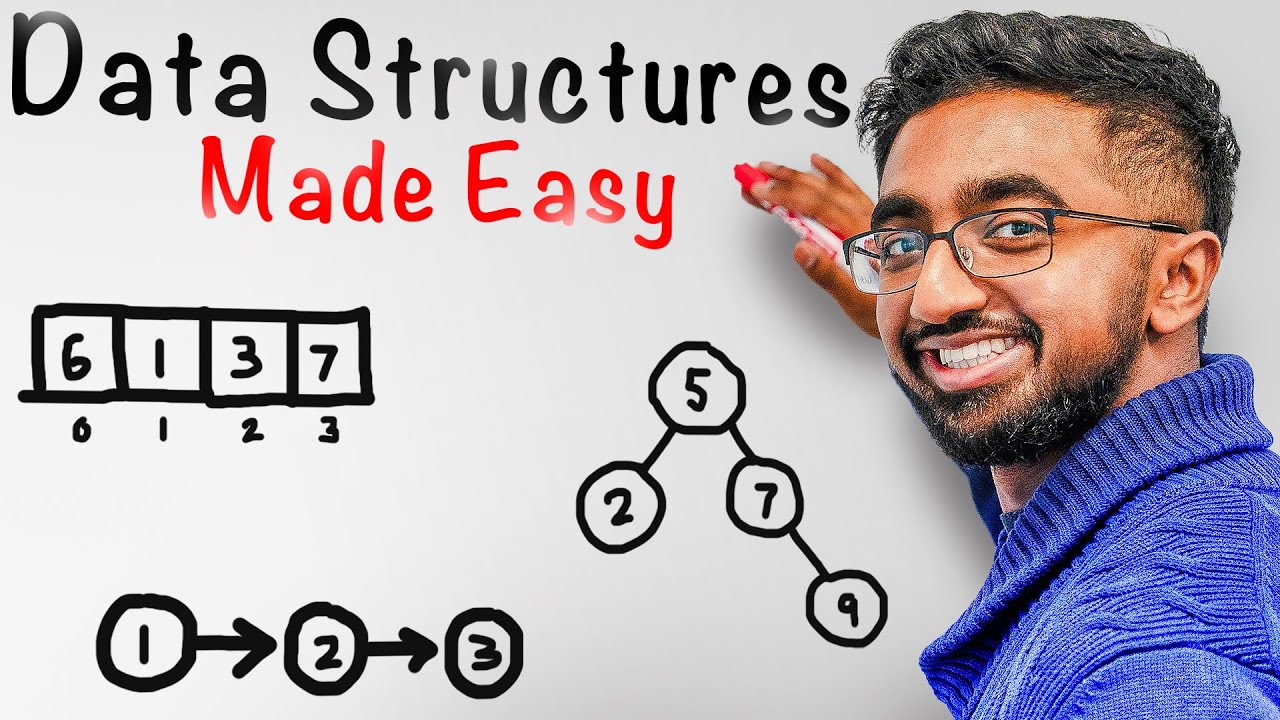
Data Structures Explained for Beginners - How I Wish I was Taught
Sajjaad Khader
Overview
This video explains fundamental data structures for beginners, emphasizing their importance in computer science and technical interviews. It begins by introducing Big O notation as a way to measure algorithm efficiency, detailing constant (O(1)), linear (O(n)), quadratic (O(n^2)), and logarithmic (O(log n)) time complexities. The video then breaks down several common data structures: arrays, linked lists, stacks, queues, heaps, hash maps, binary search trees, and sets, explaining their characteristics, real-world analogies, and time complexities for various operations. The goal is to provide a foundational understanding for choosing the right data structure for specific problems.
Save this permanently with flashcards, quizzes, and AI chat
Chapters
- Big O notation quantifies how an algorithm's runtime or space requirements grow with the input size.
- Constant time (O(1)) is the fastest, meaning operations take the same time regardless of data size.
- Linear time (O(n)) means time grows proportionally to the data size; operations may require checking each item.
- Quadratic time (O(n^2)) is slow, occurring when every item interacts with every other item.
- Logarithmic time (O(log n)) is efficient, significantly reducing the search space with each step, like searching a dictionary.
- Arrays store elements in contiguous memory locations, accessible by an index.
- Accessing an element by index is very fast (O(1)) due to direct memory addressing.
- Adding or removing elements can be slow (O(n)) if the array is full, requiring resizing and copying all existing elements.
- Deleting an element also requires shifting subsequent elements (O(n)), unless it's the last element (O(1)).
- Linked lists store elements in nodes, each containing data and a pointer to the next node.
- They are flexible for insertions and deletions (O(1) if the node reference is known) because no contiguous memory is required.
- Accessing an element by index requires traversing the list from the beginning (O(n)).
- Unlike arrays, linked lists do not require shifting elements when one is removed, avoiding resizing issues.
- Stacks follow a Last-In, First-Out (LIFO) principle; the last item added is the first removed (e.g., stack of plates).
- Queues follow a First-In, First-Out (FIFO) principle; the first item added is the first removed (e.g., a waiting line).
- Both stacks and queues offer efficient O(1) time complexity for their primary operations (push/pop for stacks, enqueue/dequeue for queues).
- Accessing elements by index is generally not a primary operation and would be O(n) if attempted.
- Heaps (Min Heap, Max Heap) maintain a specific order where the root is always the smallest or largest element.
- Heap insertion and deletion are O(log n) because elements 'bubble up' or 'bubble down' to maintain the heap property.
- Hash maps use key-value pairs and a hash function to store data, enabling very fast average-case lookups (O(1)).
- Hash collisions (multiple keys mapping to the same location) can degrade hash map performance to O(n) in the worst case.
- Binary Search Trees (BSTs) organize data with a rule: left children are smaller, right children are larger than the parent.
- BST operations (search, insert, delete) are typically O(log n) if balanced, but degrade to O(n) if unbalanced (like a linked list).
- Sets store unique elements and are often implemented using hash tables, providing average O(1) for insertion, deletion, and checking existence.
- Sets are useful for tasks like removing duplicates or tracking visited items, with worst-case performance of O(n) due to potential hash collisions.
Key takeaways
- Data structures are tools optimized for different operations; choosing the right one is key to efficient programming.
- Big O notation is essential for understanding and comparing the performance of algorithms and data structures.
- Arrays offer fast access but are rigid for modifications, while linked lists are flexible but slower for access.
- Stacks (LIFO) and Queues (FIFO) are specialized for ordered processing with constant-time operations.
- Hash maps provide near-instantaneous data retrieval using keys, but collision handling is important.
- Binary Search Trees offer efficient searching by maintaining an ordered structure, but balance is critical.
- Sets guarantee uniqueness of elements and are often implemented using hash tables for speed.
Key terms
Test your understanding
- How does Big O notation help in choosing between an array and a linked list for a task involving frequent insertions?
- What is the primary difference in operation between a stack and a queue, and why is their time complexity O(1) for core operations?
- Explain how a hash map achieves O(1) average time complexity for lookups, and what can cause it to degrade to O(n)?
- Why is the balance of a Binary Search Tree important for its performance, and what happens if it becomes unbalanced?
- Describe a scenario where using a Set would be more appropriate than using an Array or a Linked List.