AI-Generated Video Summary by NoteTube
YouTube Video W_lS_9Rokv4
Overview
This video provides an in-depth overview of the access arrangement inspection process for educational institutions. The speaker, Dustin from Scent Inspection Services, outlines recent changes, including a shift towards greater transparency and a new pilot program for in-depth inspections. Key aspects covered include the notification process (48 hours' notice via email), the types of documentation required (e.g., AAO, Form 8, Form 9, evidence, word processor policy, assessor qualifications), and the importance of tailoring applications to individual student needs. The presentation emphasizes that inspections are a collaborative process aimed at ensuring candidates receive appropriate support, rather than a punitive measure. It also highlights common pitfalls, such as incomplete forms and missing evidence, and offers guidance on how to prepare for both general and in-depth inspections.
This summary expires in 30 days. Save it permanently with flashcards, quizzes & AI chat.
Chapters
- •Apology for standing on stage and potential movement.
- •Thanks for the opportunity to share information about inspections.
- •Goal: Increase openness and transparency in the inspection process.
- •Overview of changes to the access arrangement inspection process.
- •48 hours' advanced notice for access arrangement inspections via email to the SENCO.
- •Inspectors are self-employed; check junk/spam folders for emails.
- •Inspections cannot be rearranged; a substitute must be available if the SENCO is absent.
- •Inspections occur in Autumn (Nov-Dec) and Spring (Mar-Apr).
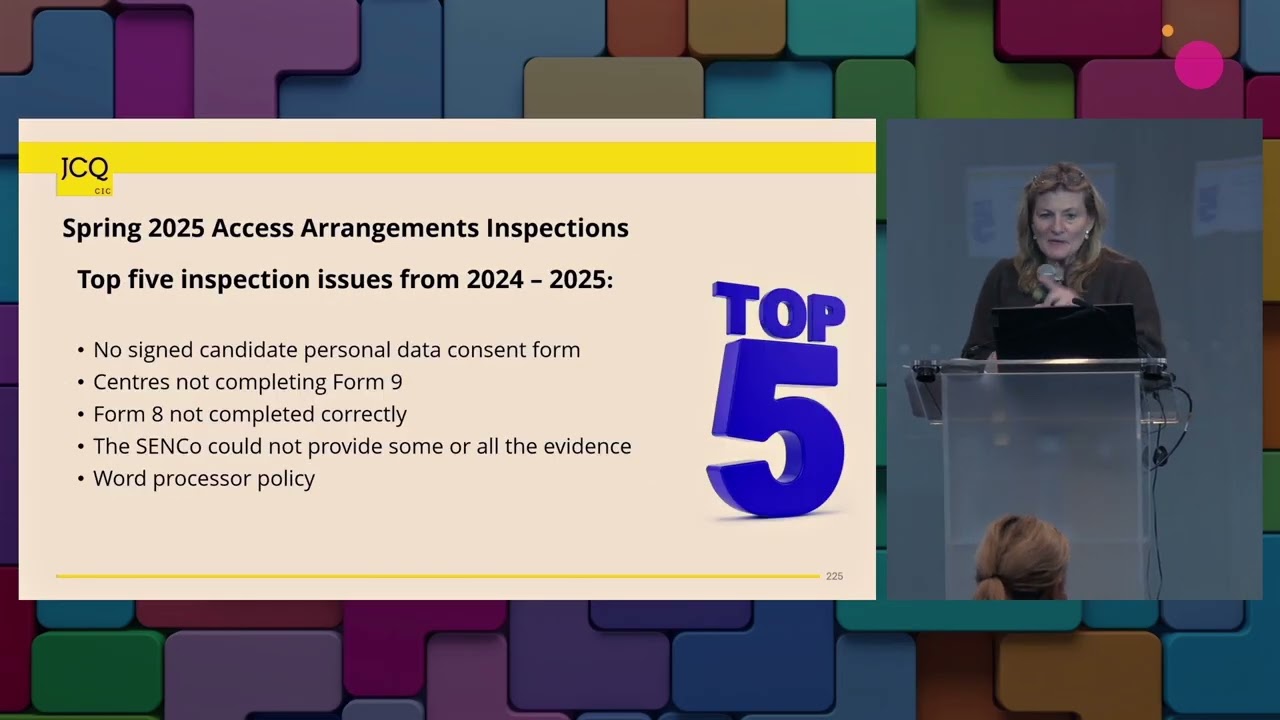
- •Minimum required documents: AAO, Form 8, Form 9, evidence, word processor policy, assessor qualifications.
- •Assessor qualifications must be readily available and current.
- •Form 9: Confirmation of supervised rest breaks for candidates with impairments other than learning difficulties.
- •Assessor qualifications must be equivalent to a Level 7 postgraduate course with 100 hours of assessment training.
- •High percentage of inspections previously flagged issues, but this is improving.
- •Commonly missed items: signed consent forms, fully completed Form 9s, dates, signatures.
- •Pilot of in-depth access arrangement inspections: more discussion-based.
- •In-depth inspections focus on the 'story' behind the application and evidence gathering.
- •Applications (Form 8, Form 9) must be tailored to individual needs, not copy-pasted.
- •Feedback from relevant teaching staff is crucial for Form 8.
- •Rest breaks for specific impairments need to be explored, not just logged.
- •Timed internal mocks and teacher evidence are part of decision-making.
- •Standardized scores must align with requested access arrangements.
- •General inspections are unannounced and focus on the exams officer's role.
- •A nominated person must be available to access candidate files during exam series.
- •Inspectors review a selection of files (typically 2-6).
- •General inspections are quicker, focusing on assurance rather than detailed discussion.
- •The 'story' of the individual candidate is paramount in all documentation.
- •Access arrangements must be needs-led, based on feedback and normal working practices.
- •Referral to CAMHS or NHS trusts is no longer sufficient; requires an agreement to assess letter.
- •Inspections are assurance visits, a two-way process to support SENCOs.
- •Be prepared: ensure files are accessible (digital or paper) and be ready to discuss evidence gathering.
- •Inspectors enjoy access arrangement inspections as they meet SENCOs and understand their work.
Key Takeaways
- 1Access arrangement inspections are shifting towards greater transparency and collaboration.
- 2Always provide 48 hours' notice for access arrangement inspections via email to the SENCO.
- 3Ensure all required documentation (AAO, Forms 8 & 9, evidence, policies, qualifications) is complete and readily available.
- 4Applications must be individualized, reflecting the candidate's specific needs and normal working practices.
- 5Assessor qualifications and training hours are critical and frequently reviewed.
- 6General inspections are unannounced and focus on the exams officer's role, but SENCOs must ensure file accessibility.
- 7Inspections serve as assurance visits to confirm that candidates are receiving appropriate access arrangements.
- 8Preparation is key: have accessible files and be ready to discuss evidence gathering and decision-making processes.